


 +91-85304 14111




OUR BLOGS
Our Latest Blogs
08 Jan 2026
By Mansi Jha l Construction
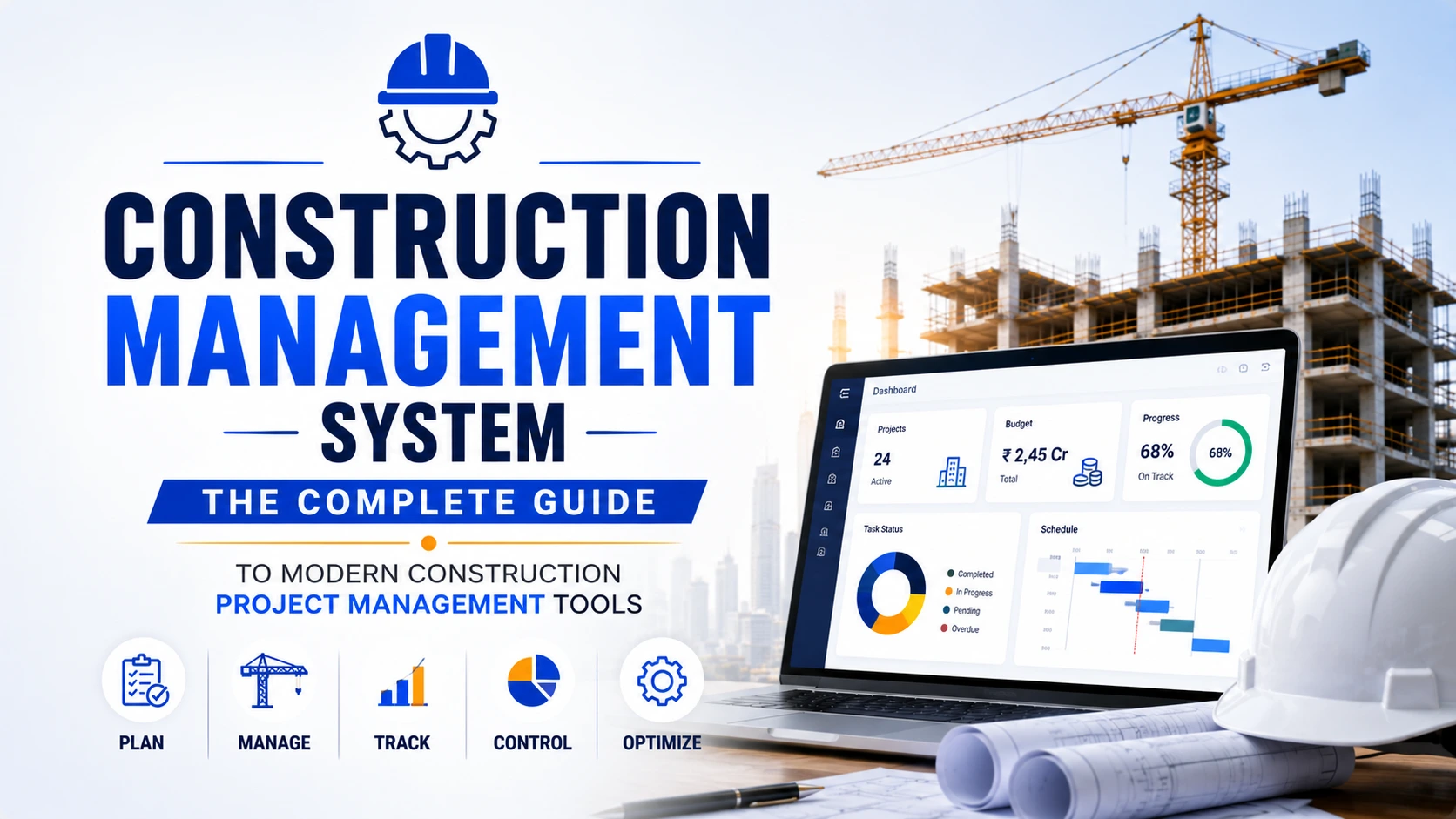
Construction Management System: The Complete Guide to Modern Construction Project Management Tools
The construction industry loses an estimated ₹45 crores annually due to poor project coordination, delayed communication, and fragmented data management. Project managers juggle multiple spreadsheets, endless email chains, and disconnected software tools just to keep track of what's happening across their sites. Material orders get missed, subcontractor schedules conflict, and budget overruns become the norm rather than the exception. This chaos isn't just frustrating it's costing construction companies their competitive edge and profitability.
The root cause of these problems lies in the absence of a centralized system that can bring together all aspects of construction project management into one unified platform. When your estimating team works in one system, your procurement team uses spreadsheets, your site managers rely on WhatsApp groups, and your finance team operates in accounting software, critical information gets lost in translation. A construction management system (CMS) eliminates these issues by providing a single source of truth for every stakeholder involved in your projects.
Modern construction companies that have adopted comprehensive construction project management systems report up to 35% reduction in project delays, 28% improvement in resource utilization, and 42% faster decision-making. These aren't just incremental improvementsthey represent a fundamental transformation in how construction businesses operate, compete, and grow in an increasingly demanding market.
What is a Construction Management System?
A construction management system is a specialized software platform designed to centralize, automate, and streamline every aspect of construction project delivery from initial estimation and planning through execution, monitoring, and final handover. Unlike generic project management tools or basic scheduling software, a true construction management system is purpose-built to handle the unique complexities of construction projects: multi-site operations, complex subcontractor coordination, material procurement workflows, equipment tracking, progress monitoring, and real-time financial control.
At its core, a construction project management system serves as the digital nervous system of your construction business. It connects your office teams with field personnel, links estimation with execution, integrates procurement with inventory management, and ties project progress directly to financial performance. When a site engineer updates progress on their mobile device, that information instantly flows to your billing team for invoicing, triggers material requisitions for upcoming work, alerts your procurement team to potential shortages, and updates executive dashboards with real-time project health indicators.
The evolution from manual construction management to digital systems represents one of the most significant transformations in the industry. Twenty years ago, project managers relied on physical blueprints, handwritten daily reports, and telephone calls to coordinate work. Ten years ago, companies upgraded to spreadsheets and email, which improved documentation but created new problems around version control and data accuracy. Today's construction project management tools leverage cloud technology, mobile connectivity, and intelligent automation to provide unprecedented visibility and control over every aspect of project delivery.
What distinguishes modern management systems for construction from earlier generations of software is their holistic approach. Rather than focusing solely on scheduling or budgeting, these platforms integrate multiple dimensions of project management into a seamless workflow. They understand that construction projects aren't linear processes but complex, interconnected systems where changes in one area ripple across the entire project. When weather delays concrete pouring, the system automatically adjusts subsequent activities, notifies affected subcontractors, revises material delivery schedules, and updates financial projections all without manual intervention.
Construction Management System vs ERP: Understanding the Critical Differences
The confusion between construction management systems and Enterprise Resource Planning (ERP) systems stems from their overlapping capabilities, yet understanding their differences is crucial for making the right technology investment. A construction management system focuses primarily on project delivery the execution phase where plans become reality. It excels at managing daily site activities, coordinating field teams, tracking work progress, controlling materials on-site, and ensuring projects stay on schedule and within budget.
An ERP system, by contrast, takes a broader organizational view. It manages the entire business operation including financial accounting, human resources, payroll, corporate procurement, vendor management, asset management, and business intelligence across all projects and corporate functions. Where a CMS asks "How is this project progressing?", an ERP asks "How is our entire business performing?" The ERP maintains the chart of accounts, processes vendor payments, manages employee records, generates statutory reports, and provides executive leadership with company-wide performance metrics.
In practical terms, your site engineers and project managers will spend most of their time in the construction management system, updating progress, requesting materials, coordinating subcontractors, and resolving site issues. Your finance team, HR department, and executive leadership will primarily work in the ERP system, managing corporate finances, processing payments, analyzing profitability across projects, and making strategic business decisions. The two systems serve different user communities with different needs and perspectives.
However, the most sophisticated construction companies don't view this as an either-or decision. They recognize that CMS and ERP systems are complementary, not competitive. The construction project management system captures detailed operational data from the field, while the ERP system consolidates that data alongside financial, HR, and procurement information to provide comprehensive business intelligence. When properly integrated, these systems create a powerful ecosystem where operational efficiency drives financial performance.
The integration between construction management systems and ERP platforms eliminates the double entry that plagues many construction companies. When your CMS logs material consumption on a project, that data automatically flows to your ERP for inventory accounting and cost allocation. When your procurement team issues a purchase order in the ERP, those materials are automatically linked to the requesting project in your CMS. When site progress reaches a billing milestone, the CMS triggers invoice generation in the ERP without manual intervention. This seamless data flow ensures accuracy, reduces administrative overhead, and provides real-time visibility across the entire organization.
Core Features That Transform Project Delivery
The scheduling and Gantt chart capabilities within modern construction project management systems go far beyond simple bar charts. These tools allow project managers to build detailed work breakdown structures that capture every activity, milestone, and dependency in their projects. The system understands construction logicthat you can't pour concrete before formwork is complete, that finishing trades must wait for MEP rough-ins, that external painting requires dry weather. As work progresses and conditions change, the system dynamically recalculates schedules, identifies critical path activities, highlights potential delays, and suggests corrective actions to keep projects on track.
Resource management and allocation features ensure that your most valuable assetsskilled labor, specialized equipment, and critical materialsare deployed optimally across multiple concurrent projects. The system tracks resource availability in real-time, prevents double-booking of equipment, balances workload across teams, and alerts managers when resource conflicts arise. When a critical piece of equipment breaks down or a key subcontractor falls behind, the system immediately identifies all affected activities and helps managers develop contingency plans. This level of resource visibility was simply impossible with spreadsheets and manual tracking methods.
Document control and collaboration capabilities address one of construction's most persistent challenges: ensuring everyone works from the latest versions of drawings, specifications, and project documents. Construction management tools provide centralized document repositories where architectural drawings, engineering specifications, method statements, material submittals, and change orders are stored, versioned, and distributed automatically. When architects issue a revised drawing, all affected stakeholders receive instant notifications, and the system prevents work from proceeding based on outdated information. This eliminates the costly mistakes that occur when subcontractors work from superseded drawings or when material orders don't reflect the latest specifications.
Progress tracking and reporting features give project stakeholders unprecedented visibility into actual performance versus planned schedules and budgets. Site engineers use mobile apps to record daily progress, capture site photos, log issues, and document completed work. This field data flows instantly to dashboards accessible by project managers, clients, and executives, providing real-time insights into project health. The system compares planned versus actual progress, calculates earned value metrics, projects final costs and completion dates, and generates comprehensive progress reports automatically. This transparency builds client confidence, enables proactive problem-solving, and helps teams learn from both successes and setbacks.
How Construction Management Systems Integrate with ERP Platforms
The integration architecture between construction management systems and ERP platforms represents a critical technical capability that separates enterprise-grade solutions from basic project management tools. At the most fundamental level, this integration ensures bidirectional data flow between operational project activities and corporate business systems. When your CMS records time spent by workers, that information automatically flows to your ERP for payroll processing and project cost accounting. When your procurement team approves a purchase order in the ERP, those materials are immediately linked to the requesting project and work package in your CMS, enabling precise tracking from order through consumption.
The unified platform benefits of CMS-ERP integration extend far beyond simple data transfer. Construction companies operating integrated systems achieve a single source of truth for all business dataone customer record, one vendor master, one chart of accounts, one material catalog. This eliminates the data inconsistencies and reconciliation nightmares that plague companies running disconnected systems. When a client changes their billing contact, that update happens once and applies everywhere. When a vendor raises their rates, the change propagates immediately to all estimation templates and procurement workflows. This data consistency improves accuracy, reduces administrative work, and enables confident decision-making based on reliable information.
Real-time synchronization capabilities ensure that critical business information is always current across both systems. When site teams log material consumption in the CMS, inventory levels update immediately in the ERP, triggering automatic reorder points when stock falls below thresholds. When the finance team processes vendor payments in the ERP, those transactions appear instantly in the CMS project cost reports, giving project managers up-to-the-minute budget visibility. When engineers approve change orders in the CMS, those variations flow immediately to the ERP for contract value updates and revised budget allocations. This real-time connectivity enables agile decision-making and prevents the surprises that occur when systems update only nightly or weekly.
Avoiding double entry represents one of the most tangible benefits of CMS-ERP integration. In non-integrated environments, administrative staff spend countless hours manually transferring data between systems re-entering purchase orders, retyping timesheet hours, copying invoice details, transcribing progress quantities. Beyond the obvious time waste, this double entry introduces errors, creates version conflicts, and delays critical information availability. Integrated systems eliminate this redundancy entirely. Data is captured once at its source in the field, at the procurement desk, in the estimating office and flows automatically to all systems that need it. This not only saves time but dramatically improves data accuracy and information timeliness.
Real-World Use Cases Across Construction Types
Residential contractors face unique challenges managing multiple smaller projects simultaneously, each with different clients, designs, timelines, and profitability expectations. A typical residential builder might have fifteen to thirty active projects at any given time ranging from small renovations to large custom homes with overlapping schedules and shared resources. Their construction project management tool needs to handle this complexity by providing portfolio-level visibility alongside detailed project tracking. The system tracks client communications and change requests, manages subcontractor schedules across multiple homes, coordinates material deliveries to the right sites at the right times, and provides per-project profitability analysis that helps builders understand which types of projects and which clients generate the best returns.
Consider a residential builder who implemented a comprehensive construction management system after years of struggling with spreadsheets and disjointed tools. Previously, their project managers spent hours each week manually updating schedules, chasing subcontractors for progress updates, and reconciling material deliveries against purchase orders. Change orders inevitable in residential construction required extensive paperwork and often led to disputes with clients about what was included in the original scope. After implementing their CMS, change order approval time dropped from an average of eight days to less than twenty-four hours. Client satisfaction scores improved by 32% due to better communication and fewer surprises. Most significantly, the company's capacity increased by 40% without adding project management staff, as automated workflows and real-time visibility eliminated much of the administrative burden.
Commercial construction firms manage larger, more complex projects with multiple stakeholders, stringent compliance requirements, and substantial financial exposure. A commercial project might involve dozens of subcontractors, hundreds of material suppliers, complex coordination between architectural, structural, and MEP systems, and rigorous quality and safety protocols. Management systems for construction serving commercial contractors provide sophisticated features for managing these complexities: multi-tier subcontractor workflows, detailed submittal and RFI tracking, integrated quality and safety management, complex billing arrangements including retention, progress claims, and milestone payments, and comprehensive audit trails for compliance documentation.
Infrastructure project managers deal with the longest timelines, largest budgets, highest stakeholder complexity, and most stringent regulatory requirements in the construction industry. Highway projects, airport expansions, metro systems, water treatment plants, and other infrastructure developments often span multiple years, involve government agencies and multiple funding sources, require extensive environmental and community management, and demand rigorous documentation for public accountability. Their construction project management systems must handle these unique demands: multi-year scheduling with phase gates and milestone tracking, complex stakeholder management including government approvals, community relations, and public communications, environmental compliance monitoring and reporting, sophisticated change management with approval hierarchies, and detailed documentation supporting government audits and public scrutiny.
Implementation Strategy and Timeline
The assessment phase represents the foundation of successful construction management system implementation. This critical period, typically lasting two to four weeks, involves detailed analysis of your current workflows, pain points, and business requirements. Implementation teams conduct interviews with key stakeholders across all levelsfrom field engineers to executive leadership to understand how work actually happens, where bottlenecks occur, and what capabilities would deliver the most value. They map existing processes, identify integration requirements with current systems, document reporting needs, and establish clear success criteria. Companies that rush through assessment inevitably face challenges during implementation when overlooked requirements surface or when the system configuration doesn't match actual workflows.
The setup process transforms the construction project management tool from a generic platform into a solution tailored to your specific business. Configuration specialists customize the system to reflect your organizational structure, project types, estimation templates, procurement workflows, approval hierarchies, and reporting requirements. They migrate master data including client records, vendor information, material catalogs, labor rates, equipment inventories, and historical project data. They configure integrations with existing systems like accounting software, BIM tools, document management platforms, and mobile applications. This setup phase typically requires six to eight weeks and demands active participation from your team to ensure the system accurately reflects your business needs and processes.
Team training represents the most critical success factor in construction management system implementation. The most sophisticated software delivers no value if your team doesn't know how to use it effectively. Comprehensive training programs address different user communities with targeted content: executives need dashboard orientation and reporting capabilities, project managers require deep training on scheduling, cost control, and change management features, procurement staff must master material management and vendor workflows, site engineers need mobile app training for progress tracking and daily reporting, and finance teams require instruction on project accounting, billing, and integration with your ERP system. Training should be hands-on, using actual project scenarios from your business, and should occur close to system go-live so knowledge remains fresh.
Going live marks the transition from preparation to actual system use, and this critical milestone requires careful management to ensure smooth adoption. Most successful implementations follow a phased approach rather than attempting a "big bang" launch across all projects simultaneously. Companies typically begin with one or two pilot projects, work through initial challenges, refine configurations, and build confidence before expanding to additional projects. During the go-live period, dedicated support resources provide immediate assistance to users encountering issues, ensuring problems get resolved quickly before frustration builds. This intensive support typically lasts four to six weeks, gradually decreasing as users become proficient and the system stabilizes.
Measuring ROI: Metrics That Matter
Time savings represent the most immediate and visible benefit of construction project management systems. Project managers who previously spent hours compiling weekly progress reports now generate comprehensive reports with a few clicks. Procurement staff who once made dozens of phone calls tracking material orders now access real-time delivery status instantly. Site engineers who laboriously completed daily reports longhand now capture progress, issues, and photos on mobile devices in minutes. Administrative staff who manually entered data across multiple systems now see information flow automatically. When aggregated across your organization, these time savings are substantialcompanies typically report 20-30% reduction in administrative overhead, allowing staff to focus on value-adding activities rather than data management and coordination.
Reduced rework stands as one of the most financially significant benefits, though it's often harder to quantify than direct time savings. Reworkthe construction industry's term for work that must be torn out and redone due to errors, miscommunication, or outdated information consumes an estimated 10-15% of project budgets. Construction management systems attack this waste through multiple mechanisms: ensuring everyone works from current drawings and specifications, capturing and communicating design changes instantly, documenting approvals and decisions with complete audit trails, identifying conflicts and clashes early before they become physical problems, and maintaining clear accountability for who approved what and when. Companies implementing comprehensive management systems for construction typically see rework costs decline by 40-60%, translating directly to improved project profitability.
Improved communication transforms project outcomes by ensuring the right information reaches the right people at the right time. The typical construction project involves dozens or hundreds of participantsowners, architects, engineers, general contractors, subcontractors, suppliers, inspectors, and morewho must coordinate their activities despite different organizations, locations, and systems. Traditional communication methods emails, phone calls, text messages, in-person meetingscreate fragmented information trails where critical decisions get lost and misunderstandings proliferate. Construction project management tools centralize all project communications in a structured, searchable repository. RFIs receive formal tracking with response deadlines. Change orders follow documented approval workflows. Issues get logged, assigned, tracked, and closed with complete accountability. This communication discipline prevents the "I didn't know" and "I never got that message" situations that derail projects.
Project delivery rates improve dramatically when construction companies implement effective management systems for construction. Projects complete closer to scheduled dates, budget variances decrease, client satisfaction increases, and the reputation benefits drive additional business. Companies report average improvements of 25-35% in on-time delivery rates within the first year of system adoption. This isn't magic it's the compound effect of better planning, real-time visibility into emerging problems, faster decision-making, more effective resource allocation, and proactive rather than reactive management. When project managers can see problems developing days or weeks in advance rather than discovering them after they've caused delays, they can take corrective action while multiple options still exist.
Choosing the Right Construction Management System
Evaluating construction project management systems requires looking beyond feature lists to understand how well each platform aligns with your specific business model, project types, and growth trajectory. The right system for a residential builder managing twenty small projects simultaneously differs fundamentally from the right system for a heavy civil contractor managing three large infrastructure projects. Start by clearly defining your must-have requirements versus nice-to-have capabilities. Must-haves might include mobile field access, integration with your existing ERP or accounting system, multi-currency support for international projects, or specific compliance reporting. Nice-to-haves might include AI-powered scheduling, advanced analytics, or IoT sensor integration. Be honest about which features will actually drive value for your business versus which simply sound impressive.
The integration ecosystem surrounding your construction management system deserves careful evaluation because no single platform does everything. Your CMS needs to connect with your accounting system for financial data, your BIM tools for design information, your document management platform for contract administration, your payroll system for labor costs, and potentially dozens of other specialized tools. Platforms with open APIs and pre-built connectors to common construction software provide far more flexibility and future-proofing than closed systems. Ask potential vendors not just whether integrations are possible but whether they're already implemented with your specific systems, who maintains them, and how updates are handled when either system changes.
The user experience and learning curve significantly impact adoption success. A system with powerful capabilities that your team finds confusing or cumbersome will fail regardless of its technical sophistication. During evaluation, involve actual users project managers, site engineers, procurement staff not just executives and IT personnel. Have these users perform realistic tasks during vendor demonstrations: creating a project schedule, updating progress from a mobile device, requesting materials, generating a progress report. Observe their reactions. Do they find the interface intuitive? Are common tasks simple or buried under multiple menu levels? Does the mobile experience work well on the devices your team actually uses in dusty, bright field conditions?
Implementation support and ongoing service quality matter far more than most companies realize during initial evaluation. The vendor's commitment to your success extends well beyond the initial sale and setup. Look for implementation methodologies that include formal knowledge transfer, not just system configuration. Evaluate the support model: Is help available when your team needs it? Do you get dedicated support contacts who understand your business, or do you enter a queue with every call? What's included in the base license versus what requires additional fees? How frequently does the vendor release updates, and how are they deployed? Companies that view their construction project management system as a long-term partnership rather than a transactional purchase achieve far better outcomes.
Conclusion: Transforming Construction Project Delivery
The construction industry stands at a digital inflection point where companies that embrace modern construction management systems will pull decisively ahead of competitors still relying on spreadsheets, disconnected tools, and manual processes. The efficiency gains, quality improvements, and risk reductions these platforms enable aren't marginalthey represent fundamental competitive advantages in an industry where margins are thin and client expectations continue rising. As projects grow more complex, timelines compress, and stakeholder demands intensify, the gap between digitally enabled companies and traditional operators will only widen.
Choosing the right construction project management system represents one of the most important technology decisions construction company leadership will make. This isn't simply about buying software it's about transforming how your organization plans, executes, and delivers projects. The right system becomes the foundation for scalable growth, enabling you to take on more projects, larger projects, and more complex projects without proportionally increasing overhead. It provides the visibility and control that allows you to confidently bid competitive prices while protecting profitability. It creates the documentation and transparency that sophisticated clients increasingly demand while simplifying compliance with evolving regulatory requirements.
The path forward begins with honest assessment of your current capabilities and clear vision of where your business needs to go. Companies that implement construction management systems reactivelyafter a major project failure or client complaintrarely achieve the same success as those that plan proactively. Take time to document your requirements, involve stakeholders across your organization, evaluate options thoroughly, and commit to proper implementation. The investment in a comprehensive construction project management tool, when properly selected and implemented, delivers returns many times its cost through improved efficiency, reduced risk, and enhanced competitive position.
Ready to transform your construction project delivery? See how biCanvas construction management system integrates seamlessly with ERP to provide complete visibility and control across all your projects. Schedule a free demo to discover how leading construction companies are using biCanvas to deliver projects on time, within budget, and with unprecedented stakeholder satisfaction.
OUR BLOGS
Our Latest Blogs
08 Jan 2026
By Mansi Jha Construction
Construction Management System: The Complete Guide to Modern Construction Project Management Tools
The construction industry loses an estimated ₹45 crores annually due to poor project coordination, delayed communication, and fragmented data management. Project managers juggle multiple spreadsheets, endless email chains, and disconnected software tools just to keep track of what's happening across their sites. Material orders get missed, subcontractor schedules conflict, and budget overruns become the norm rather than the exception. This chaos isn't just frustrating it's costing construction companies their competitive edge and profitability. The root cause of these problems lies in the absence of a centralized system that can bring together all aspects of construction project management into one unified platform. When your estimating team works in one system, your procurement team uses spreadsheets, your site managers rely on WhatsApp groups, and your finance team operates in accounting software, critical information gets lost in translation. A construction management system (CMS) eliminates these issues by providing a single source of truth for every stakeholder involved in your projects. Modern construction companies that have adopted comprehensive construction project management systems report up to 35% reduction in project delays, 28% improvement in resource utilization, and 42% faster decision-making. These aren't just incremental improvementsthey represent a fundamental transformation in how construction businesses operate, compete, and grow in an increasingly demanding market. What is a Construction Management System? A construction management system is a specialized software platform designed to centralize, automate, and streamline every aspect of construction project delivery from initial estimation and planning through execution, monitoring, and final handover. Unlike generic project management tools or basic scheduling software, a true construction management system is purpose-built to handle the unique complexities of construction projects: multi-site operations, complex subcontractor coordination, material procurement workflows, equipment tracking, progress monitoring, and real-time financial control. At its core, a construction project management system serves as the digital nervous system of your construction business. It connects your office teams with field personnel, links estimation with execution, integrates procurement with inventory management, and ties project progress directly to financial performance. When a site engineer updates progress on their mobile device, that information instantly flows to your billing team for invoicing, triggers material requisitions for upcoming work, alerts your procurement team to potential shortages, and updates executive dashboards with real-time project health indicators. The evolution from manual construction management to digital systems represents one of the most significant transformations in the industry. Twenty years ago, project managers relied on physical blueprints, handwritten daily reports, and telephone calls to coordinate work. Ten years ago, companies upgraded to spreadsheets and email, which improved documentation but created new problems around version control and data accuracy. Today's construction project management tools leverage cloud technology, mobile connectivity, and intelligent automation to provide unprecedented visibility and control over every aspect of project delivery. What distinguishes modern management systems for construction from earlier generations of software is their holistic approach. Rather than focusing solely on scheduling or budgeting, these platforms integrate multiple dimensions of project management into a seamless workflow. They understand that construction projects aren't linear processes but complex, interconnected systems where changes in one area ripple across the entire project. When weather delays concrete pouring, the system automatically adjusts subsequent activities, notifies affected subcontractors, revises material delivery schedules, and updates financial projections all without manual intervention. Construction Management System vs ERP: Understanding the Critical Differences The confusion between construction management systems and Enterprise Resource Planning (ERP) systems stems from their overlapping capabilities, yet understanding their differences is crucial for making the right technology investment. A construction management system focuses primarily on project delivery the execution phase where plans become reality. It excels at managing daily site activities, coordinating field teams, tracking work progress, controlling materials on-site, and ensuring projects stay on schedule and within budget. An ERP system, by contrast, takes a broader organizational view. It manages the entire business operation including financial accounting, human resources, payroll, corporate procurement, vendor management, asset management, and business intelligence across all projects and corporate functions. Where a CMS asks "How is this project progressing?", an ERP asks "How is our entire business performing?" The ERP maintains the chart of accounts, processes vendor payments, manages employee records, generates statutory reports, and provides executive leadership with company-wide performance metrics. In practical terms, your site engineers and project managers will spend most of their time in the construction management system, updating progress, requesting materials, coordinating subcontractors, and resolving site issues. Your finance team, HR department, and executive leadership will primarily work in the ERP system, managing corporate finances, processing payments, analyzing profitability across projects, and making strategic business decisions. The two systems serve different user communities with different needs and perspectives. However, the most sophisticated construction companies don't view this as an either-or decision. They recognize that CMS and ERP systems are complementary, not competitive. The construction project management system captures detailed operational data from the field, while the ERP system consolidates that data alongside financial, HR, and procurement information to provide comprehensive business intelligence. When properly integrated, these systems create a powerful ecosystem where operational efficiency drives financial performance. The integration between construction management systems and ERP platforms eliminates the double entry that plagues many construction companies. When your CMS logs material consumption on a project, that data automatically flows to your ERP for inventory accounting and cost allocation. When your procurement team issues a purchase order in the ERP, those materials are automatically linked to the requesting project in your CMS. When site progress reaches a billing milestone, the CMS triggers invoice generation in the ERP without manual intervention. This seamless data flow ensures accuracy, reduces administrative overhead, and provides real-time visibility across the entire organization. Core Features That Transform Project Delivery The scheduling and Gantt chart capabilities within modern construction project management systems go far beyond simple bar charts. These tools allow project managers to build detailed work breakdown structures that capture every activity, milestone, and dependency in their projects. The system understands construction logicthat you can't pour concrete before formwork is complete, that finishing trades must wait for MEP rough-ins, that external painting requires dry weather. As work progresses and conditions change, the system dynamically recalculates schedules, identifies critical path activities, highlights potential delays, and suggests corrective actions to keep projects on track. Resource management and allocation features ensure that your most valuable assetsskilled labor, specialized equipment, and critical materialsare deployed optimally across multiple concurrent projects. The system tracks resource availability in real-time, prevents double-booking of equipment, balances workload across teams, and alerts managers when resource conflicts arise. When a critical piece of equipment breaks down or a key subcontractor falls behind, the system immediately identifies all affected activities and helps managers develop contingency plans. This level of resource visibility was simply impossible with spreadsheets and manual tracking methods. Document control and collaboration capabilities address one of construction's most persistent challenges: ensuring everyone works from the latest versions of drawings, specifications, and project documents. Construction management tools provide centralized document repositories where architectural drawings, engineering specifications, method statements, material submittals, and change orders are stored, versioned, and distributed automatically. When architects issue a revised drawing, all affected stakeholders receive instant notifications, and the system prevents work from proceeding based on outdated information. This eliminates the costly mistakes that occur when subcontractors work from superseded drawings or when material orders don't reflect the latest specifications. Progress tracking and reporting features give project stakeholders unprecedented visibility into actual performance versus planned schedules and budgets. Site engineers use mobile apps to record daily progress, capture site photos, log issues, and document completed work. This field data flows instantly to dashboards accessible by project managers, clients, and executives, providing real-time insights into project health. The system compares planned versus actual progress, calculates earned value metrics, projects final costs and completion dates, and generates comprehensive progress reports automatically. This transparency builds client confidence, enables proactive problem-solving, and helps teams learn from both successes and setbacks. How Construction Management Systems Integrate with ERP Platforms The integration architecture between construction management systems and ERP platforms represents a critical technical capability that separates enterprise-grade solutions from basic project management tools. At the most fundamental level, this integration ensures bidirectional data flow between operational project activities and corporate business systems. When your CMS records time spent by workers, that information automatically flows to your ERP for payroll processing and project cost accounting. When your procurement team approves a purchase order in the ERP, those materials are immediately linked to the requesting project and work package in your CMS, enabling precise tracking from order through consumption. The unified platform benefits of CMS-ERP integration extend far beyond simple data transfer. Construction companies operating integrated systems achieve a single source of truth for all business dataone customer record, one vendor master, one chart of accounts, one material catalog. This eliminates the data inconsistencies and reconciliation nightmares that plague companies running disconnected systems. When a client changes their billing contact, that update happens once and applies everywhere. When a vendor raises their rates, the change propagates immediately to all estimation templates and procurement workflows. This data consistency improves accuracy, reduces administrative work, and enables confident decision-making based on reliable information. Real-time synchronization capabilities ensure that critical business information is always current across both systems. When site teams log material consumption in the CMS, inventory levels update immediately in the ERP, triggering automatic reorder points when stock falls below thresholds. When the finance team processes vendor payments in the ERP, those transactions appear instantly in the CMS project cost reports, giving project managers up-to-the-minute budget visibility. When engineers approve change orders in the CMS, those variations flow immediately to the ERP for contract value updates and revised budget allocations. This real-time connectivity enables agile decision-making and prevents the surprises that occur when systems update only nightly or weekly. Avoiding double entry represents one of the most tangible benefits of CMS-ERP integration. In non-integrated environments, administrative staff spend countless hours manually transferring data between systems re-entering purchase orders, retyping timesheet hours, copying invoice details, transcribing progress quantities. Beyond the obvious time waste, this double entry introduces errors, creates version conflicts, and delays critical information availability. Integrated systems eliminate this redundancy entirely. Data is captured once at its source in the field, at the procurement desk, in the estimating office and flows automatically to all systems that need it. This not only saves time but dramatically improves data accuracy and information timeliness. Real-World Use Cases Across Construction Types Residential contractors face unique challenges managing multiple smaller projects simultaneously, each with different clients, designs, timelines, and profitability expectations. A typical residential builder might have fifteen to thirty active projects at any given time ranging from small renovations to large custom homes with overlapping schedules and shared resources. Their construction project management tool needs to handle this complexity by providing portfolio-level visibility alongside detailed project tracking. The system tracks client communications and change requests, manages subcontractor schedules across multiple homes, coordinates material deliveries to the right sites at the right times, and provides per-project profitability analysis that helps builders understand which types of projects and which clients generate the best returns. Consider a residential builder who implemented a comprehensive construction management system after years of struggling with spreadsheets and disjointed tools. Previously, their project managers spent hours each week manually updating schedules, chasing subcontractors for progress updates, and reconciling material deliveries against purchase orders. Change orders inevitable in residential construction required extensive paperwork and often led to disputes with clients about what was included in the original scope. After implementing their CMS, change order approval time dropped from an average of eight days to less than twenty-four hours. Client satisfaction scores improved by 32% due to better communication and fewer surprises. Most significantly, the company's capacity increased by 40% without adding project management staff, as automated workflows and real-time visibility eliminated much of the administrative burden. Commercial construction firms manage larger, more complex projects with multiple stakeholders, stringent compliance requirements, and substantial financial exposure. A commercial project might involve dozens of subcontractors, hundreds of material suppliers, complex coordination between architectural, structural, and MEP systems, and rigorous quality and safety protocols. Management systems for construction serving commercial contractors provide sophisticated features for managing these complexities: multi-tier subcontractor workflows, detailed submittal and RFI tracking, integrated quality and safety management, complex billing arrangements including retention, progress claims, and milestone payments, and comprehensive audit trails for compliance documentation. Infrastructure project managers deal with the longest timelines, largest budgets, highest stakeholder complexity, and most stringent regulatory requirements in the construction industry. Highway projects, airport expansions, metro systems, water treatment plants, and other infrastructure developments often span multiple years, involve government agencies and multiple funding sources, require extensive environmental and community management, and demand rigorous documentation for public accountability. Their construction project management systems must handle these unique demands: multi-year scheduling with phase gates and milestone tracking, complex stakeholder management including government approvals, community relations, and public communications, environmental compliance monitoring and reporting, sophisticated change management with approval hierarchies, and detailed documentation supporting government audits and public scrutiny. Implementation Strategy and Timeline The assessment phase represents the foundation of successful construction management system implementation. This critical period, typically lasting two to four weeks, involves detailed analysis of your current workflows, pain points, and business requirements. Implementation teams conduct interviews with key stakeholders across all levelsfrom field engineers to executive leadership to understand how work actually happens, where bottlenecks occur, and what capabilities would deliver the most value. They map existing processes, identify integration requirements with current systems, document reporting needs, and establish clear success criteria. Companies that rush through assessment inevitably face challenges during implementation when overlooked requirements surface or when the system configuration doesn't match actual workflows. The setup process transforms the construction project management tool from a generic platform into a solution tailored to your specific business. Configuration specialists customize the system to reflect your organizational structure, project types, estimation templates, procurement workflows, approval hierarchies, and reporting requirements. They migrate master data including client records, vendor information, material catalogs, labor rates, equipment inventories, and historical project data. They configure integrations with existing systems like accounting software, BIM tools, document management platforms, and mobile applications. This setup phase typically requires six to eight weeks and demands active participation from your team to ensure the system accurately reflects your business needs and processes. Team training represents the most critical success factor in construction management system implementation. The most sophisticated software delivers no value if your team doesn't know how to use it effectively. Comprehensive training programs address different user communities with targeted content: executives need dashboard orientation and reporting capabilities, project managers require deep training on scheduling, cost control, and change management features, procurement staff must master material management and vendor workflows, site engineers need mobile app training for progress tracking and daily reporting, and finance teams require instruction on project accounting, billing, and integration with your ERP system. Training should be hands-on, using actual project scenarios from your business, and should occur close to system go-live so knowledge remains fresh. Going live marks the transition from preparation to actual system use, and this critical milestone requires careful management to ensure smooth adoption. Most successful implementations follow a phased approach rather than attempting a "big bang" launch across all projects simultaneously. Companies typically begin with one or two pilot projects, work through initial challenges, refine configurations, and build confidence before expanding to additional projects. During the go-live period, dedicated support resources provide immediate assistance to users encountering issues, ensuring problems get resolved quickly before frustration builds. This intensive support typically lasts four to six weeks, gradually decreasing as users become proficient and the system stabilizes. Measuring ROI: Metrics That Matter Time savings represent the most immediate and visible benefit of construction project management systems. Project managers who previously spent hours compiling weekly progress reports now generate comprehensive reports with a few clicks. Procurement staff who once made dozens of phone calls tracking material orders now access real-time delivery status instantly. Site engineers who laboriously completed daily reports longhand now capture progress, issues, and photos on mobile devices in minutes. Administrative staff who manually entered data across multiple systems now see information flow automatically. When aggregated across your organization, these time savings are substantialcompanies typically report 20-30% reduction in administrative overhead, allowing staff to focus on value-adding activities rather than data management and coordination. Reduced rework stands as one of the most financially significant benefits, though it's often harder to quantify than direct time savings. Reworkthe construction industry's term for work that must be torn out and redone due to errors, miscommunication, or outdated information consumes an estimated 10-15% of project budgets. Construction management systems attack this waste through multiple mechanisms: ensuring everyone works from current drawings and specifications, capturing and communicating design changes instantly, documenting approvals and decisions with complete audit trails, identifying conflicts and clashes early before they become physical problems, and maintaining clear accountability for who approved what and when. Companies implementing comprehensive management systems for construction typically see rework costs decline by 40-60%, translating directly to improved project profitability. Improved communication transforms project outcomes by ensuring the right information reaches the right people at the right time. The typical construction project involves dozens or hundreds of participantsowners, architects, engineers, general contractors, subcontractors, suppliers, inspectors, and morewho must coordinate their activities despite different organizations, locations, and systems. Traditional communication methods emails, phone calls, text messages, in-person meetingscreate fragmented information trails where critical decisions get lost and misunderstandings proliferate. Construction project management tools centralize all project communications in a structured, searchable repository. RFIs receive formal tracking with response deadlines. Change orders follow documented approval workflows. Issues get logged, assigned, tracked, and closed with complete accountability. This communication discipline prevents the "I didn't know" and "I never got that message" situations that derail projects. Project delivery rates improve dramatically when construction companies implement effective management systems for construction. Projects complete closer to scheduled dates, budget variances decrease, client satisfaction increases, and the reputation benefits drive additional business. Companies report average improvements of 25-35% in on-time delivery rates within the first year of system adoption. This isn't magic it's the compound effect of better planning, real-time visibility into emerging problems, faster decision-making, more effective resource allocation, and proactive rather than reactive management. When project managers can see problems developing days or weeks in advance rather than discovering them after they've caused delays, they can take corrective action while multiple options still exist. Choosing the Right Construction Management System Evaluating construction project management systems requires looking beyond feature lists to understand how well each platform aligns with your specific business model, project types, and growth trajectory. The right system for a residential builder managing twenty small projects simultaneously differs fundamentally from the right system for a heavy civil contractor managing three large infrastructure projects. Start by clearly defining your must-have requirements versus nice-to-have capabilities. Must-haves might include mobile field access, integration with your existing ERP or accounting system, multi-currency support for international projects, or specific compliance reporting. Nice-to-haves might include AI-powered scheduling, advanced analytics, or IoT sensor integration. Be honest about which features will actually drive value for your business versus which simply sound impressive. The integration ecosystem surrounding your construction management system deserves careful evaluation because no single platform does everything. Your CMS needs to connect with your accounting system for financial data, your BIM tools for design information, your document management platform for contract administration, your payroll system for labor costs, and potentially dozens of other specialized tools. Platforms with open APIs and pre-built connectors to common construction software provide far more flexibility and future-proofing than closed systems. Ask potential vendors not just whether integrations are possible but whether they're already implemented with your specific systems, who maintains them, and how updates are handled when either system changes. The user experience and learning curve significantly impact adoption success. A system with powerful capabilities that your team finds confusing or cumbersome will fail regardless of its technical sophistication. During evaluation, involve actual users project managers, site engineers, procurement staff not just executives and IT personnel. Have these users perform realistic tasks during vendor demonstrations: creating a project schedule, updating progress from a mobile device, requesting materials, generating a progress report. Observe their reactions. Do they find the interface intuitive? Are common tasks simple or buried under multiple menu levels? Does the mobile experience work well on the devices your team actually uses in dusty, bright field conditions? Implementation support and ongoing service quality matter far more than most companies realize during initial evaluation. The vendor's commitment to your success extends well beyond the initial sale and setup. Look for implementation methodologies that include formal knowledge transfer, not just system configuration. Evaluate the support model: Is help available when your team needs it? Do you get dedicated support contacts who understand your business, or do you enter a queue with every call? What's included in the base license versus what requires additional fees? How frequently does the vendor release updates, and how are they deployed? Companies that view their construction project management system as a long-term partnership rather than a transactional purchase achieve far better outcomes. Conclusion: Transforming Construction Project Delivery The construction industry stands at a digital inflection point where companies that embrace modern construction management systems will pull decisively ahead of competitors still relying on spreadsheets, disconnected tools, and manual processes. The efficiency gains, quality improvements, and risk reductions these platforms enable aren't marginalthey represent fundamental competitive advantages in an industry where margins are thin and client expectations continue rising. As projects grow more complex, timelines compress, and stakeholder demands intensify, the gap between digitally enabled companies and traditional operators will only widen. Choosing the right construction project management system represents one of the most important technology decisions construction company leadership will make. This isn't simply about buying software it's about transforming how your organization plans, executes, and delivers projects. The right system becomes the foundation for scalable growth, enabling you to take on more projects, larger projects, and more complex projects without proportionally increasing overhead. It provides the visibility and control that allows you to confidently bid competitive prices while protecting profitability. It creates the documentation and transparency that sophisticated clients increasingly demand while simplifying compliance with evolving regulatory requirements. The path forward begins with honest assessment of your current capabilities and clear vision of where your business needs to go. Companies that implement construction management systems reactivelyafter a major project failure or client complaintrarely achieve the same success as those that plan proactively. Take time to document your requirements, involve stakeholders across your organization, evaluate options thoroughly, and commit to proper implementation. The investment in a comprehensive construction project management tool, when properly selected and implemented, delivers returns many times its cost through improved efficiency, reduced risk, and enhanced competitive position. Ready to transform your construction project delivery? See how biCanvas construction management system integrates seamlessly with ERP to provide complete visibility and control across all your projects. Schedule a free demo to discover how leading construction companies are using biCanvas to deliver projects on time, within budget, and with unprecedented stakeholder satisfaction.
OUR BLOGS
Our Latest Blogs
12 Oct 2026
By Mohini Dodwade Infrastructure
How ERP Infrastructure Software Improves Delivery Timelines and Cost Control in Construction Projects
Infrastructure projects rarely fall behind schedule because of one major problem. More often, delays build up through a series of smaller issues: materials arriving late, purchase approvals getting stuck, equipment remaining idle, or site progress reports reaching management too late. These problems become harder to manage when multiple projects, contractors, suppliers and departments operate independently. This is where ERP infrastructure software can make a practical difference. By connecting project planning, procurement, inventory, equipment, finance and site execution, an integrated ERP system helps infrastructure companies identify operational gaps before they become expensive setbacks. For contractors, infrastructure developers, ready-mix concrete (RMC) businesses and manufacturing companies supporting construction operations, the objective is not simply to digitise existing processes. It is to connect everyday decisions with project schedules and financial performance. Why Infrastructure Projects Struggle With Delays and Cost Overruns An infrastructure project depends on several activities happening in the correct sequence. Materials must arrive when required, equipment must be available, labour must be allocated, and contractors must complete work according to the schedule. When these activities are managed through disconnected spreadsheets, accounting software and manual reports, coordination becomes difficult. Consider a road construction project that requires aggregates, cement, steel and machinery at different stages. If procurement does not have visibility into the project schedule, orders may be raised too late. If inventory records are outdated, the team may purchase materials already available at another site. Meanwhile, management may continue working with an approved budget without knowing that actual expenses are moving beyond planned limits. The underlying problem is a lack of connected operational information. An integrated construction ERP system helps bridge this gap by linking project requirements with procurement, inventory, equipment utilisation and financial records. 1. Connect Project Planning With Actual Site Progress Project schedules are useful only when they reflect what is happening on site. Infrastructure teams need to track planned activities, milestones, resource requirements and actual progress throughout the project lifecycle. When site updates are delayed, project managers may continue following a schedule that no longer reflects operational reality. ERP infrastructure software can connect project planning with daily progress reporting and resource allocation. For example, a project manager can break a highway construction project into work packages, assign budgets and define material requirements. Site engineers can then record progress against those activities, allowing management to compare planned and actual execution. This creates better visibility into activities falling behind schedule, resources required for upcoming work, delayed milestones and variations between planned and actual progress. The value comes from linking the schedule to operational data, not simply displaying tasks on a dashboard. Businesses evaluating infrastructure ERP software in India should examine how well a platform connects project planning with procurement, site execution and cost tracking. For a deeper explanation of this process, read How ERP Simplifies Infrastructure Project Planning. 2. Improve Material Procurement and Delivery Coordination Material availability directly affects construction timelines. A shortage of cement, steel, aggregates or other essential supplies can interrupt site activities even when labour and equipment are ready. At the same time, purchasing too much material too early can increase storage costs, working capital requirements and the risk of wastage. An integrated ERP system helps connect material planning with project schedules, inventory balances and procurement activities. The process can work as follows: Project teams define material requirements based on the project plan and approved quantities. Inventory records help identify available stock across relevant locations. Procurement teams raise purchase requests for outstanding requirements. Approval workflows route requests to the appropriate decision-makers. Purchase orders and goods receipt records help track orders through delivery. Material issues and consumption are recorded against the relevant project or activity. This connected process gives procurement teams better visibility into what is required, what has already been ordered and what remains outstanding. It can also reduce avoidable purchases, duplicate requests and delays caused by missing approvals. For construction businesses managing several sites, material transfers, stock reconciliation and wastage tracking are equally important. Explore Construction Inventory and Procurement Management for a closer look at how material planning, purchasing and inventory control work together. 3. Control Project Costs Before Budget Overruns Escalate An approved project budget does not guarantee that a project will remain profitable. Costs continue to accumulate through material purchases, labour, equipment, subcontractors, transportation and other operating expenses. If these costs are reviewed only at the end of the month, management may discover a problem after corrective action has become difficult. A suitable construction ERP software platform should connect project budgets with actual expenditure and purchase commitments. Consider a project with an approved material budget of ₹50 lakh. Purchase orders worth ₹35 lakh have already been issued, and actual material consumption has reached ₹22 lakh. Looking only at the amount consumed may give management an incomplete picture. Significant financial commitments already exist, even if the corresponding materials have not yet been delivered or consumed. A connected ERP system can help distinguish between: Budget: The approved financial allocation. Committed cost: The value of approved orders and other recognised commitments. Actual cost: Expenses recorded against the project. Cost variance: The difference between planned and actual financial performance. These figures need to be interpreted according to the company's accounting rules and project costing methods. Their purpose is to provide a clearer view of financial exposure. With project-level cost tracking, managers can investigate unusual spending, review procurement decisions and take corrective action before overruns become more difficult to address. For a broader understanding of how project execution, procurement and financial controls connect, read Construction ERP: The Backbone of Efficient Construction Management. 4. Reduce Equipment Downtime With Better Maintenance Planning Heavy equipment plays a critical role in infrastructure execution. Excavators, loaders, batching plants, crushers, transit mixers and other machinery must be available when scheduled activities require them. Unexpected breakdowns can interrupt work, delay deliveries and increase repair expenses. Equipment management within an ERP system can help businesses maintain asset records, track utilisation, schedule preventive maintenance and monitor fuel or operating expenses. Where supported by the equipment and integration setup, Industrial Internet of Things (IIoT) connectivity can provide machine operating data that helps teams monitor usage and identify maintenance requirements. For example, an RMC plant may use operating-hour data to plan maintenance around production requirements rather than waiting for a breakdown. A fleet operator may combine vehicle records, fuel information and maintenance schedules to improve oversight of its vehicles. These capabilities are particularly useful when several plants, machines or project sites compete for the same resources. IIoT integration does not automatically prevent breakdowns. Its effectiveness depends on data quality, suitable sensors, maintenance procedures and how consistently teams act on the information. Read Construction ERP Mobile App for Site Engineers: DPR, RA Billing, Labour, Plant and Equipment to explore how site reporting and equipment management can support construction operations. 5. Use Cloud ERP to Connect Site Teams and Head Office Infrastructure projects often operate across geographically separated sites. Project managers, procurement teams, finance departments and senior management may all need different information to make decisions. When each team maintains separate records, reconciliation becomes a recurring task. Cloud-based ERP infrastructure solutions can provide authorised users with access to shared operational information from different locations, subject to connectivity, permissions and system configuration. This can help teams coordinate site progress, purchase requests, stock availability, contractor records, equipment utilisation and project expenses. Cloud deployment can also simplify centralised system administration and access to updated information. However, businesses should assess internet availability at remote sites, offline requirements, data residency, security controls, backup policies and disaster recovery before selecting a platform. The objective is to make reliable information available to the people who need it without creating additional reporting work for site teams. For an overview of the broader capabilities to consider, explore the complete guide to construction ERP software. 6. Automate Approvals and Repetitive Workflows Approval delays are an often-overlooked cause of project disruption. A purchase request may remain pending because the responsible manager is unavailable. A contractor bill may move between departments without a clear record of its status. A payment request may require repeated follow-ups because supporting documents are incomplete. Workflow automation helps standardise these processes. An ERP platform with configurable workflows can route purchase requests, expense claims, contractor bills and other transactions according to predefined approval rules. For example, a company can configure different approval levels based on transaction value, department, project or budget limits. The system can also maintain approval histories and pending-action records, making it easier to identify where a process is delayed. This does not eliminate the need for human review. Instead, it reduces unnecessary manual coordination and gives employees a clearer understanding of their responsibilities. Contractor billing is another area where structured workflows matter. Read Vendor Management System: Integrating Contractor and Labour Control for Strategic Cost Governance for more information on contractor records, work verification and payment controls. 7. Turn Operational Data Into Actionable Decisions With BI Dashboards Infrastructure businesses generate substantial amounts of data through procurement, inventory, project execution, finance and equipment operations. The challenge is turning that information into decisions before problems affect delivery or profitability. Business intelligence (BI) dashboards can consolidate relevant information into management views that support faster investigation and planning. Depending on the ERP's capabilities and configured data, useful indicators may include: Performance indicator What it helps management understand Planned versus actual progress Whether project activities are meeting the schedule Budget versus actual cost Where expenditure is deviating from approved allocations Outstanding purchase orders Which material deliveries require follow-up Inventory and material consumption Whether stock levels match operational requirements Equipment utilisation How effectively machinery is being used Pending approvals Which decisions may be holding up operations Project billing and receivables Where billing or payment follow-up may be needed A dashboard is only as reliable as the underlying records. Businesses should define clear reporting rules, maintain accurate data and assign responsibility for updating site information. The aim is to identify exceptions that need attention, rather than simply produce more reports. When evaluating platforms, use a construction ERP selection checklist for India to compare reporting, project controls, integration requirements and implementation considerations. What to Look for When Choosing ERP Infrastructure Software Not every ERP platform is suitable for a project-driven infrastructure business. A general accounting system may handle financial transactions effectively but still leave gaps in site execution, procurement planning and equipment management. Before selecting a solution, evaluate the following capabilities. Project planning and scheduling: Can the system manage work breakdown structures, milestones, budgets and daily progress reporting? Procurement and inventory: Can material requirements be linked to project needs, stock availability, purchase orders and goods receipts? Project cost control: Can management compare budgets, commitments and actual expenditure at project or activity level? Contractor and vendor management: Can the system support contractor records, work tracking, billing and approval processes? Equipment and IIoT integration: Can it manage maintenance and utilisation, and connect with relevant equipment or plant systems where required? Cloud access and security: Does the deployment support multi-site operations, role-based access, backups and appropriate data protection? Custom workflows: Can approval processes and operational rules be configured to match the company's requirements? BI dashboards and reporting: Can management obtain consistent, timely information without relying on repeated manual consolidation? Integration with existing systems: Can the ERP exchange data with accounting tools, PLCs, GPS systems or other operational applications where needed? The best ERP software for construction is not necessarily the platform with the longest feature list. It is the one that fits the company's operating model and connects its most important processes reliably. For a practical comparison of selection criteria, see Best ERP Software for the Construction Industry. How biCanvas Supports Connected Infrastructure Operations biCanvas, a product of DataDynamx, is designed to support enterprise operations across construction, infrastructure, ready-mix concrete and related industries. Its capabilities cover areas such as project planning, budgeting, procurement, material management, contractor coordination, equipment management and business intelligence. For infrastructure businesses, the value of these functions lies in connecting operational processes that would otherwise be managed separately. For example, project planning can inform material requirements, procurement records can support delivery tracking, and project-level financial information can help management review expenditure against budgets. Depending on the implementation, cloud access, configurable workflows, IIoT and PLC integrations can further connect office processes with plant and site operations. Businesses evaluating biCanvas should map these capabilities against their actual requirements, including the integrations, reporting rules and approval structures needed for their projects. Visit the biCanvas website to learn more about its enterprise software capabilities. Conclusion Infrastructure project delivery depends on coordination between planning, procurement, materials, equipment, contractors and finance. When these functions operate independently, small information gaps can lead to larger scheduling and cost-control problems. ERP infrastructure software helps connect these activities, making it easier to monitor project progress, track financial commitments, coordinate deliveries and identify operational issues earlier. The most useful system is not simply one that digitises existing records. It is one that connects project requirements with actual execution and gives teams the information they need to act. For infrastructure companies looking to improve delivery timelines and cost visibility, evaluating ERP around these practical outcomes is a stronger starting point than choosing software based on features alone. Frequently Asked Questions 1. What is ERP infrastructure software? ERP infrastructure software is an enterprise resource planning system that connects project planning, procurement, inventory, equipment, finance and other business operations for infrastructure and construction companies. 2. How does ERP infrastructure software help reduce project delays? It can improve coordination between project schedules, material procurement, inventory, equipment and site reporting. Earlier visibility into pending approvals, material shortages and delayed activities helps teams take corrective action sooner. 3. Can ERP software help control construction project costs? Yes. When configured correctly, it can connect project budgets with purchase commitments, recorded expenses, material consumption and other project costs. This helps management identify variances and investigate overspending. 4. Why is cloud ERP useful for infrastructure companies? Cloud ERP can give authorised teams across multiple sites access to shared information. Companies should also evaluate connectivity, offline requirements, data security, backups and recovery arrangements. 5. What role does IIoT play in infrastructure ERP? IIoT integrations can bring operating information from connected equipment and industrial systems into enterprise workflows. Depending on the setup, this can support equipment monitoring, maintenance planning and operational reporting. 6. Is infrastructure ERP useful for ready-mix concrete businesses? Yes. An appropriate system can connect batching plant operations, raw material inventory, production records, delivery scheduling, fleet information and financial tracking. The exact capabilities depend on the software and its integrations. 7. How should a company choose the right infrastructure ERP? Start by identifying its biggest operational problems. Then evaluate project scheduling, material planning, cost control, equipment management, approval workflows, cloud access, reporting, integrations and implementation requirements using realistic business scenarios. 8. What should businesses check before implementing ERP infrastructure software? Businesses should review data quality, existing systems, process ownership, user training, integration requirements, security, implementation scope and measurable success criteria. A phased rollout can help validate the system before expanding it across all projects.
OUR BLOGS
Our Latest Blogs
31 Aug 2026
By Mohini Dodwade Manufacturing
Manufacturing Inventory Management Software: Connecting Stock to Production
A production line does not stop because a plant ran out of raw material. It stops because nobody knew the raw material was running low until the line was already waiting on it. Most manufacturers can tell you what is sitting in their warehouse on any given day, but far fewer can tell you what that stock actually means for tomorrow's production schedule. That gap between knowing what you have and knowing what it will let you produce is exactly the problem manufacturing inventory management software is built to close. Why Spreadsheet Inventory Breaks Down as Production Scales A small manufacturing operation can often get away with tracking stock in a spreadsheet or a basic accounting tool. The moment a plant runs multiple production lines, multiple shifts, or multiple raw material vendors, that approach falls apart. Stock counts go stale between updates, nobody has a single view of what is committed to a pending work order versus what is genuinely available, and reordering becomes reactive instead of planned. Manufacturing inventory management software exists to remove that lag. It gives a plant a live view of stock as it moves, not a snapshot from the last time someone updated a spreadsheet. What Manufacturing Inventory Management Software Actually Needs to Do For a manufacturer running real production volume, inventory software has to do more than count units sitting in a warehouse. It needs to connect stock directly to what the plant is actually producing. Real-time raw material tracking that updates automatically as material is consumed on the line, not through manual entry after the fact Production-linked stock visibility, so a plant knows exactly how much of a raw material is already committed to open work orders versus genuinely free to allocate Batch and lot tracking for traceability, particularly important for manufacturers who need to trace a finished product back to a specific raw material batch Automated reorder triggers based on actual consumption patterns and lead times, not fixed reorder points that ignore how demand actually moves When these pieces are connected, a plant manager stops reacting to shortages and starts seeing them coming days or weeks in advance. Connecting Inventory to What Happens on the Shop Floor Inventory data on its own is only half the picture. The real value comes from connecting stock levels directly to shop floor activity, so a drop in raw material shows up against the production schedule immediately instead of surfacing as a surprise when a line supervisor goes looking for material that is not there. We cover this connection in detail in our piece on automating the shop floor with ERP, where the core argument is that disconnected systems, not missing processes, are usually what cause manufacturing inefficiency. Manufacturing inventory management software is one half of that connection. Without it feeding directly into production planning, even a well-run shop floor is still operating on incomplete information about what it can actually build next. Where This Differs From MES It is worth being clear about what manufacturing inventory management software is not. A Manufacturing Execution System tracks what is happening on the line in real time, machine status, work-in-progress, and quality checkpoints. Inventory management software tracks the material feeding into and out of that process. Our comparison of manufacturing ERP versus manufacturing execution software breaks down where each system's responsibility starts and ends, and the short version is that inventory and MES need to work together, not compete for the same job. A manufacturer evaluating software should be clear on which gap they are actually trying to close before comparing vendors, since a strong MES with weak inventory visibility still leaves material shortages as a blind spot, and the reverse is equally true. Batch Tracking and Traceability Are Not Optional Anymore For manufacturers supplying regulated industries, or working with clients who require material traceability, batch and lot tracking is not a nice-to-have feature. It needs to be built into the core inventory system, not managed as a separate compliance exercise after production is complete. This matters just as much for manufacturers connected to construction supply chains, where a batch of material needs to be traceable back through the plant to the original raw material lot if a quality issue surfaces on site months later. Manufacturing inventory management software that captures batch data automatically as material moves through production removes the need for manual traceability logs that are easy to fall behind on and difficult to audit later. Where Inventory Fits Into the Broader Supply Chain Manufacturing inventory does not exist in isolation from procurement and logistics. A plant's raw material stock is the downstream result of vendor reliability, delivery timing, and demand forecasting further up the chain. We cover this broader connection in our guide on supply chain management software for construction, and the same principle applies directly to manufacturing: inventory visibility is only as useful as the procurement and logistics data feeding into it. A plant with excellent internal inventory tracking but no visibility into incoming vendor deliveries is still flying blind on the timing side of the equation. What to Evaluate Before Choosing Manufacturing Inventory Management Software Before committing to a platform, check whether it actually connects to production planning or simply counts stock as a standalone function. Confirm whether batch and lot tracking is native to the system rather than a manual add-on process. And check whether reorder logic is based on real consumption patterns and vendor lead times, rather than static reorder points that need constant manual adjustment as demand shifts. How biCanvas Approaches Manufacturing Inventory Management biCanvas connects raw material inventory directly to production planning and work orders, so stock consumption updates automatically as production moves rather than through manual reconciliation at shift end. Batch and lot data is captured as part of the same workflow, giving manufacturers traceability without a separate compliance process running alongside production. Because inventory is tied to the same system managing procurement and vendor data, plant managers get a single view from incoming material to finished output, instead of stitching together answers from separate tools. If your plant is still reconciling stock manually against a production schedule that changes daily, you can book a personalised demo to see how connected inventory tracking works against your own production setup. Frequently Asked Questions Is manufacturing inventory management software the same as an MES? No. An MES tracks real-time activity on the production line itself, while inventory management software tracks the raw material and finished goods stock feeding into and out of that process. They are meant to work together, not replace each other. Does manufacturing inventory management software help with material shortages? Yes, by connecting stock levels directly to production schedules and consumption patterns, it flags potential shortages days or weeks in advance instead of when a line is already waiting on material. Why does batch tracking matter for manufacturers who are not in a regulated industry? Even outside regulated sectors, batch tracking makes it possible to trace a quality issue in a finished product back to its raw material source, which matters for any manufacturer supplying clients who expect accountability if something goes wrong downstream.
OUR BLOGS
Our Latest Blogs
23 Oct 2026
By Mohini Dodwade Ready Mix Concrete
Ready Mix Concrete ERP: Connecting Production, Inventory and Delivery
Ready Mix Concrete (RMC) businesses operate in a time-sensitive environment where production planning, raw material availability, plant operations, transportation and customer delivery must work together. Even a small disruption in one area can affect several activities across the business. For example, a shortage of cement can delay batching, an unexpected change in a project's concrete requirement can disrupt dispatch schedules, and poor coordination between the plant and transport teams can lead to unnecessary waiting time. These challenges become more difficult when different teams maintain separate spreadsheets, paper records or disconnected applications. This is where ready mix concrete ERP becomes valuable. By connecting key operational activities in one system, an ERP platform can help RMC businesses improve coordination, monitor resources and make decisions using more consistent information. For a broader understanding of how ERP connects construction operations, explore biCanvas's complete guide to construction ERP software. Why Ready Mix Concrete Businesses Need Connected Operations Unlike many other construction materials, ready-mix concrete must be produced and delivered according to specific project requirements and schedules. Production and delivery planning therefore depend on more than the availability of raw materials. RMC businesses must coordinate several activities simultaneously: Monitoring cement, sand, aggregates and admixture availability. Planning production according to confirmed orders and site requirements. Coordinating batching plant operations and equipment. Scheduling vehicles and deliveries. Tracking fuel, transportation and operational costs. Maintaining purchase, inventory and delivery records. When these activities operate independently, teams may have difficulty identifying where delays originate or how operational decisions affect costs. A connected system creates a more consistent flow of information between departments, allowing managers to monitor operations without waiting for multiple teams to compile separate reports. 1. Connect Production Planning with Actual Demand Production planning is one of the most important responsibilities in an RMC business. The plant must produce the required concrete quantity while considering delivery schedules, available resources and customer specifications. Planning production without reliable order information can create two problems: insufficient concrete when a project needs it, or unnecessary production that puts pressure on plant capacity and scheduling. An ERP system can help connect order information, production requirements, material availability and operational schedules. For example, when a construction site requests concrete for a scheduled pour, the operations team can use the available order and planning information to coordinate production and dispatch. If the requirement changes, the relevant teams can review the updated plan rather than relying entirely on separate calls and spreadsheets. The objective is not simply to produce more concrete. It is to align production with actual demand and available capacity. 2. Improve Raw Material Inventory Visibility Cement, aggregates, sand and chemical admixtures are essential inputs for RMC production. Inaccurate inventory records can affect production schedules, purchasing decisions and cost calculations. Manual inventory management often creates a gap between recorded stock and the quantity physically available at the plant. A suitable ERP system can help businesses maintain structured records of material receipts, stock movements, consumption and replenishment requirements. This can support better decisions in several ways: Stock visibility: Review available material quantities before confirming production plans. Purchase planning: Identify replenishment requirements earlier. Consumption monitoring: Compare expected and recorded material usage. Stock reconciliation: Investigate differences between system records and physical quantities. Cost visibility: Connect material movements with operational and financial reporting. These controls are particularly useful when businesses operate multiple plants or supply several construction sites. For more practical insights into material tracking, read biCanvas's guide to construction material management and inventory control. It provides additional context on how material procurement and inventory processes contribute to better construction operations. 3. Coordinate Dispatch and Transportation Production alone does not complete an RMC order. Concrete must reach the right site, in the required quantity, at the appropriate time. Dispatch planning becomes complicated when multiple customers request deliveries within overlapping time windows. Traffic conditions, plant capacity, vehicle availability and changing site requirements can add further pressure. A connected operational system can help teams coordinate dispatch schedules, order details, vehicle allocation and delivery records. For instance, if a site changes its requested delivery time, the operations team needs reliable information to assess the impact on production and other scheduled deliveries. Better coordination can help reduce avoidable waiting, improve communication between the plant and site teams, and make delivery planning more predictable. Businesses should also evaluate whether their chosen platform supports the specific vehicle tracking, weighbridge, batching or transport integrations required by their operations. 4. Monitor Plant, Machinery and Fuel Costs Plant and machinery are important operational resources for RMC businesses. Their availability, maintenance requirements and operating expenses influence productivity. Unexpected equipment downtime can interrupt production and affect delivery commitments. Meanwhile, limited visibility into fuel consumption and maintenance expenditure can make it harder to understand the true cost of operations. An ERP platform with appropriate equipment and asset management capabilities can help businesses maintain equipment records, monitor maintenance activities and track related expenses. Depending on the system configuration, businesses may also integrate equipment or telematics data to analyse utilisation and fuel consumption. The practical benefit is better visibility into recurring operational issues. Managers can identify equipment that requires attention, review maintenance expenditure and evaluate whether resources are being used efficiently. For businesses handling large infrastructure projects, biCanvas also provides insights into construction ERP software for infrastructure businesses, including the importance of evaluating operational requirements before choosing an ERP platform. 5. Connect Plant Operations with Project Requirements RMC suppliers often serve several construction projects with different delivery schedules, concrete grades and quantity requirements. Coordination becomes more demanding when multiple sites depend on the same plant or fleet. This is where construction company software with suitable RMC capabilities can help connect supplier operations with broader construction workflows. A connected system can support coordination between order information, project requirements, dispatch records, material availability and financial reporting. For construction and infrastructure businesses that manage their own RMC operations, this connection can provide a more complete view of how material supply affects project execution. For example, a delayed delivery may affect the site's planned activities. If the relevant teams can access consistent operational information, they can respond sooner and make more informed scheduling decisions. Businesses looking to connect these processes across departments can also explore how biCanvas connects projects, inventory, workforce and operations in India. 6. Improve Cost and Performance Reporting Operational activity generates information about material consumption, production, dispatch, transport and equipment expenses. However, information is useful only when it can be interpreted and connected to business decisions. When reports are prepared manually from separate systems, management may spend considerable time reconciling figures before analysing performance. An integrated ERP environment can help consolidate operational records and provide more structured reporting. Useful performance indicators may include: Planned versus actual production quantities. Raw material consumption and stock variances. Delivery punctuality and vehicle utilisation. Fuel and maintenance expenditure. Plant operating costs. Order fulfilment and outstanding deliveries. The exact indicators depend on the business model, available data and system configuration. Regular reporting helps managers identify recurring bottlenecks, compare performance over time and take corrective action based on evidence rather than assumptions. 7. What Should You Evaluate Before Choosing an RMC ERP? Not every ERP platform supports the operational requirements of a ready-mix concrete business equally well. Before selecting a solution, businesses should evaluate the workflows they need to manage and the integrations required to support them. Consider these questions: Production: Can the system support the production planning and batching workflows your plant requires? Inventory: Can it track raw materials, receipts, consumption and stock reconciliation? Dispatch: Can the team coordinate orders, delivery schedules and dispatch records? Transportation: Does it support the required vehicle, fuel and tracking integrations? Equipment: Can plant machinery, maintenance and operating costs be monitored? Reporting: Can management review operational performance and costs using consistent information? Scalability: Can the system support additional plants, customers and operating locations as the business grows? Implementation: What training, configuration, integration and ongoing support will be required? For a wider evaluation framework, read biCanvas's construction ERP software guide. It explains how connected construction processes can help businesses assess their requirements before choosing a solution. These questions help businesses evaluate software against real operating conditions instead of selecting a product solely because it has an extensive feature list. How biCanvas Supports RMC and Construction Operations biCanvas provides ERP capabilities for construction, infrastructure and ready-mix concrete operations. Its RMC offering covers areas including production planning, material and inventory management, transportation and fuel tracking, plant and machinery management, and purchase management. These capabilities are relevant to businesses seeking better coordination across plant and operational activities. For organisations that also manage construction or infrastructure projects, connecting relevant operational information can help reduce the need to rely on disconnected processes. Explore the biCanvas construction ERP solution to learn more about its project management, finance, inventory, resource allocation and equipment management capabilities. Businesses can also review construction ERP software in India: how biCanvas connects projects, inventory, workforce and operations for a broader understanding of how construction-focused ERP can support connected business processes. The right solution will depend on the organisation's operating model, plant requirements, existing systems and implementation priorities. Conclusion Ready mix concrete operations depend on the coordination of production, raw materials, transportation, equipment and delivery schedules. When these activities are managed through disconnected systems, even routine changes can create delays and make costs harder to understand. A suitable ready mix concrete ERP can help businesses connect operational information, improve inventory visibility, coordinate dispatch and strengthen performance reporting. For RMC suppliers, construction contractors and infrastructure businesses, the goal is to build a reliable flow of information from planning through execution and reporting. biCanvas offers construction and RMC-focused ERP capabilities that businesses can evaluate against these requirements. The best starting point is to identify the operational gaps that affect your business most and determine which workflows need to work together. Frequently Asked Questions 1. What is ready mix concrete ERP? Ready mix concrete ERP is a business management system that helps coordinate RMC activities such as production planning, raw material inventory, dispatch, transportation, equipment management and operational reporting. 2. What are the benefits of using ready mix concrete ERP? Depending on its capabilities and implementation, an RMC ERP can improve inventory visibility, production coordination, dispatch planning, cost monitoring and reporting. It can also help teams work with more consistent operational information. 3. Can construction company software manage RMC operations? Some construction ERP platforms support RMC operations alongside project management, inventory, procurement and finance. Businesses should verify that the chosen platform covers their specific production, batching, dispatch and transport requirements. 4. What is the difference between construction ERP and infrastructure ERP? Construction ERP generally supports project execution, procurement, inventory, budgeting and related business processes. Infrastructure ERP focuses on the requirements of infrastructure projects, which may include multi-site coordination, contracts, resource allocation, equipment and project-level financial control. The capabilities of individual platforms vary. To understand how these requirements affect software selection, read biCanvas's guide to construction ERP for infrastructure businesses. 5. How does biCanvas support ready mix concrete businesses? biCanvas offers RMC-focused capabilities covering production planning, inventory and material management, transportation and fuel tracking, plant and machinery management, and purchasing. Businesses should assess the available configuration and integrations against their operational requirements. 6. How should a business choose the right RMC ERP? Start by mapping current workflows and identifying operational gaps. Then evaluate production planning, inventory controls, dispatch, transportation, equipment management, reporting, integrations, implementation requirements and scalability before making a decision.
Search
Blog Categories
Recent Posts

Post 01
Ready Mix Concrete ERP: Connecting Production, Inventory and Delivery
23 Oct 2026
Post 02
Construction Subcontractor Management: Tracking Work Progress, Bills and Approvals
22 Oct 2026
Post 03
How to Forecast Construction Cost Escalation Before It Impacts Project Profitability
21 Oct 2026