


 +91-85304 14111




OUR BLOGS
Our Latest Blogs
10 Dec 2025
By Mansi Jha l Infrastructure
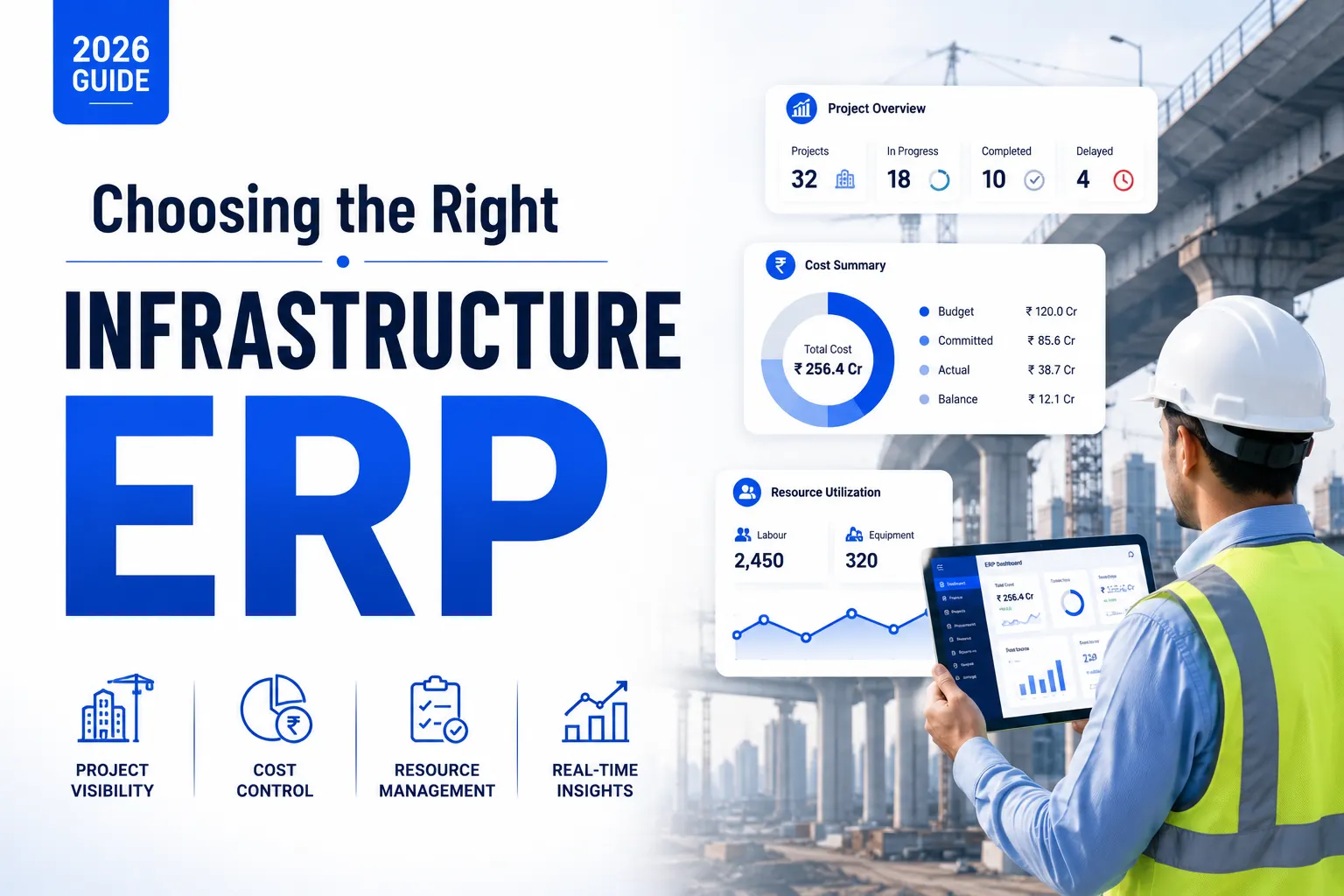
10 Best Infrastructure ERP Solutions for 2026 (Updated List)
Table of Contents
- Introduction: Why Infrastructure Companies Need ERP in 2026
- Top 10 Best Infrastructure ERP Software — Full List
- Comparison Table: Feature-by-Feature Review
- Which ERP Is Best for Your Company Type?
- biCanvas — Why It Ranks #1 for Infrastructure
- Core Modules to Look For
- Implementation Timeline & Total Cost of Ownership
- FAQ
Introduction: Why Infrastructure Companies Need ERP in 2026
Infrastructure projects in India operate at extraordinary scale and complexity:
- Managing 15-200+ multi-site projects simultaneously
- Coordinating equipment fleets worth hundreds of crores
- Daily WIP updates and BOQ alignment
- Multi-tier subcontractor management and RA billing
- Material planning across geographically dispersed sites
- Statutory compliance (GST, environmental clearances, safety regulations)
- Equipment lifecycle tracking and preventive maintenance
- Real-time project health monitoring and financial control
Traditional approaches using spreadsheets, disconnected software, and manual reporting create operational chaos. Infrastructure companies adopt ERP systems to prevent cost overruns, maintain project timelines, ensure BOQ accuracy, optimize resource utilization, and strengthen financial visibility across portfolios.
Top 10 Best Infrastructure ERP Software (2026)
Note: This list highlights enterprise-grade solutions designed for mid-to-large infrastructure contractors, EPC firms, and government infrastructure agencies. biCanvas ranks #1 for comprehensive infrastructure project management.
1. biCanvas — Best Overall Infrastructure ERP
biCanvas is a purpose-built enterprise ERP specifically designed for infrastructure, construction, EPC firms, and large contractors managing complex, multi-site operations.
Why biCanvas Leads:
- Built-for-infrastructure architecture with WBS, BOQ, equipment lifecycle, procurement, WIP, and financial controls—all integrated without requiring add-ons
- Real-time site-to-HO visibility through mobile-first applications working seamlessly even in remote locations
- Advanced workflow engine handling complex approval chains without custom coding
- Multi-entity consolidation with project-level P&L providing CFO-grade financial visibility
- Deep integration ecosystem (Tally, Oracle, SAP, IoT, GPS) with pre-built connectors
- Indian market expertise with GST, RERA built into core platform
- Proven 3-6 month implementation timeline
Best For: Mid-to-large infrastructure contractors, highway/bridge projects, metro rail, power plants, water/irrigation projects, EPC contractors
2. SAP S/4HANA for Engineering, Construction & Operations
SAP's infrastructure solution offers enterprise-grade capabilities with strong financial management. Comprehensive platform with extensive functionality, though implementation complexity and 6-18 month timelines are considerations for mid-sized firms.
Best For: Large multinational infrastructure firms, government mega projects requiring global standardization
3. Oracle Primavera Cloud
Oracle Primavera excels at complex infrastructure scheduling and portfolio management. Particularly strong for program-level oversight, though companies often need to combine it with other systems for complete ERP functionality.
Best For: Large infrastructure portfolios, government agencies, program management offices focused on scheduling excellence
4. Procore
Procore offers a modern, cloud-based platform with excellent field collaboration features. Popular for quick adoption, though it requires third-party integrations for deeper infrastructure-specific needs like RA billing and equipment lifecycle management.
Best For: Mid-to-large contractors prioritizing field adoption and collaboration
5. In4Suite (In4Velocity)
In4Suite provides solid project controls with particular strength in Middle East and Asian markets. Offers reasonable functionality at competitive pricing, making it practical for regional contractors.
Best For: Regional contractors, mid-sized infrastructure firms in Asia and Middle East
6. CMiC
CMiC offers an all-in-one platform built on single database architecture, ensuring data consistency. Mature solution with comprehensive features, though some users find the interface less modern.
Best For: Large contractors seeking complete integration and willing to invest in longer implementation
7. Viewpoint Vista
Viewpoint brings deep construction industry experience with strong financial and job costing capabilities. Reliable choice with good industry-specific features, though primarily focused on North American market.
Best For: Contractors needing strong financial controls, particularly those with North American operations
8. Acumatica Construction Edition
Acumatica's unlimited user licensing model and modern cloud architecture make it attractive for collaborative infrastructure projects. Good value for growing companies, though infrastructure-specific features require customization.
Best For: Growing contractors prioritizing collaboration and scalable pricing
9. Jonas Premier
Jonas provides integrated service and project management particularly suitable for infrastructure maintenance contractors. Practical solution for service-oriented operations.
Best For: Service-oriented infrastructure contractors, maintenance operations, facilities management
10. Hexagon EAM
Hexagon specializes in infrastructure asset management over the complete lifecycle. Excellent choice for organizations focused on long-term infrastructure maintenance and operations.
Best For: Government agencies, utilities, infrastructure asset owners managing long-term maintenance
Comparison Table — Feature-by-Feature Review
| Capability / Feature | biCanvas | SAP S/4HANA | Oracle Primavera | Procore | In4Suite |
|---|---|---|---|---|---|
| BOQ & WBS Management | Strong, versioned | Via PS module | Excellent scheduling | Via integrations | Strong |
| WIP & DPR (Real-time) | Mobile-first | Via integrations | Limited | Mobile logs | Mobile support |
| Equipment Lifecycle + IoT | Strong + telematics | Add-on modules | Via partners | Limited | Add-on |
| Subcontractor RA Billing | Automated workflows | Via FI/PS | Limited | Basic | Strong |
| Procurement & Indent | Site/HO integrated | Full ERP suite | Via partners | Basic | Yes |
| Multi-Entity Consolidation | Strong | Strong | Strong | No | Yes |
| Workflow Automation | Visual, no coding | Requires development | Configurable | Basic | Basic |
| Mobile-First Design | Yes, cloud-based | Add-on apps | Mobile app | Strong | Mobile support |
| Implementation Speed | 3-6 months | 6-18 months | 4-12 months | 3-9 months | 2-6 months |
| India-Specific Features | GST, RERA built-in | Requires localization | Requires customization | Limited | Some support |
| Best Fit | Mid to Large infrastructure | Very large enterprise | Large portfolios | Mid-Large projects | Mid-Enterprise |
Which ERP Is Best for Your Company Type?
A. Highway & Road Construction
Needs: Multi-site coordination, equipment fleet optimization, material planning, milestone-based billing
Why biCanvas: Purpose-built equipment lifecycle management tracks utilization without add-ons. Intersite material tracking prevents shortages. Mobile-first field operations work seamlessly in remote locations.
B. Metro Rail & Mass Transit
Needs: Complex phasing, multiple contractor coordination, TBM management, public accountability
Why biCanvas: Comprehensive project controls handle multi-contractor coordination seamlessly. Equipment management extends to specialized machinery. Built-in compliance tracking ensures regulatory requirements are met.
C. Bridge & Flyover Projects
Needs: Design coordination, precast/RMC integration, pier-by-pier tracking, quality documentation
Why biCanvas: Integrated approach connects design, production, and site operations without multiple systems. Progress tracking at granular levels comes standard.
D. Power Plants & Industrial Infrastructure
Needs: Multi-discipline coordination, equipment procurement tracking, commissioning management
Why biCanvas: EPC workflows handle multi-discipline coordination naturally. Equipment lifecycle extends from procurement through commissioning.
E. Water & Irrigation Projects
Needs: Geographic spread, environmental compliance, multiple package management
Why biCanvas: Multi-site management handles geographically dispersed projects efficiently. Compliance tracking addresses environmental requirements.
biCanvas — Why It Ranks #1 for Infrastructure
biCanvas stands apart because it was built from the ground up to handle the specific complexities of infrastructure execution in the Indian context. While other ERPs are either too generic or require extensive customization, biCanvas delivers infrastructure-specific functionality ready to deploy.
Key Differentiators
Built-for-Infrastructure Architecture Every module reflects how infrastructure projects actually work—from WBS and BOQ management to equipment mobilization, procurement cycles, progress measurement, and contractor billing. You don't need to force-fit generic workflows or wait months for customization.
Real-Time Site-to-HO Integration Mobile-first applications mean field engineers can update progress, record material consumption, capture quality checks, and request approvals even in remote locations with connectivity. The cloud-based system ensures data is available in real-time across teams.
Advanced Workflow Automation Without Coding Visual workflow builder enables complex, multi-level approval chains for procurement, contractor billing, design changes, and budget variations. Configure sophisticated workflows yourself without waiting for developers.
Equipment & Asset Intelligence Equipment lifecycle management tracks utilization, maintenance schedules, fuel consumption, and costs from day one. IoT integration enables predictive maintenance and real-time location tracking—capabilities other ERPs offer only through expensive add-ons.
Financial Control & Visibility Project-level P&L, cost center tracking, cash flow forecasting, and working capital management provide CFO-grade financial visibility without complex configuration. Multi-entity consolidation supports complex organizational structures naturally.
India-Ready Compliance GST workflows, TDS calculation, RERA requirements, and statutory reporting are built into the core platform. Updates for regulatory changes happen automatically—you're not waiting for vendors to develop localization patches.
Scalable Implementation Approach Proven methodology allows phased rollout starting with pilot projects, minimizing disruption while building organizational confidence. You see value in 3-6 months, not 12-18 months.
Core Modules
- Project Planning & Scheduling (WBS, Gantt charts, critical path)
- BOQ & Estimation with version control
- Work-in-Progress (WIP) & Daily Progress Reporting (DPR) with mobile capture
- Procurement Management (indent, PO, GRN workflows)
- Subcontractor Management with RA billing automation
- Inventory & Material Management (intersite transfers, consumption tracking)
- Equipment & Asset Lifecycle with preventive maintenance and IoT integration
- Financial Management (project accounting, cost centers, cash flow)
- Quality Management (inspections, testing, compliance documentation)
- Document Management (drawings, RFIs, approvals, change orders)
- Analytics & Dashboards (real-time KPIs, custom reports)
Core Modules to Look For in Infrastructure ERP
| Module / Capability | Why It Matters |
|---|---|
| Project Planning & Scheduling | Infrastructure projects involve thousands of interdependent activities. Robust scheduling ensures realistic timelines and enables proactive delay management. |
| BOQ & Estimation with Version Control | Scope changes are inevitable. Versioned BOQ management tracks all variations, maintains budget alignment, and prevents disputes. |
| WIP & Daily Progress Reporting | Real-time visibility enables early detection of delays, cost overruns, or quality issues for informed decision-making. |
| Equipment & Machinery Lifecycle | Infrastructure requires significant capital investment in equipment. Tracking utilization, maintenance, and costs optimizes asset value and prevents downtime. |
| Procurement & Material Management | Timely material availability across multiple sites prevents delays that cascade through schedules. |
| Subcontractor Management with RA Billing | Automated workflows, approval routing, and payment tracking improve transparency and accelerate payment cycles. |
| Financial Management | Accurate financial tracking at project level enables profitability monitoring and cash flow management. |
| Mobile Access & Cloud Capabilities | Site engineers work in remote locations. Cloud-based mobile apps ensure continuous operations and timely data capture across teams. |
| Workflow Automation | Complex approval chains require systematic workflows to ensure control, accountability, and speed. |
| Statutory Compliance | Infrastructure projects must comply with multiple regulations. Built-in compliance workflows reduce risk of penalties. |
Implementation Timeline & Total Cost of Ownership
Implementation Timeline
| Phase | biCanvas | SAP S/4HANA | Oracle Primavera | Procore |
|---|---|---|---|---|
| Discovery & Planning | 2-4 weeks | 4-8 weeks | 4-6 weeks | 2-4 weeks |
| Pilot (1-2 projects) | 8-12 weeks | 12-20 weeks | 8-16 weeks | 6-10 weeks |
| Rollout (Scale) | 3-6 months | 6-18 months | 6-12 months | 3-9 months |
| Stabilization | 4-8 weeks | 8-16 weeks | 6-12 weeks | 4-8 weeks |
Total Cost of Ownership (TCO)
Mid-sized Infrastructure Firms (10-30 projects):
- First Year TCO: ₹40 Lakh - ₹1.2 Cr
- Ongoing Annual: ₹15-40 Lakh
Large Infrastructure Contractors (30+ projects):
- First Year TCO: ₹1.2-5 Cr
- Ongoing Annual: ₹40 Lakh - 1.5 Cr
Return on Investment:
- 15-25% reduction in project overruns
- 20-30% faster billing and payment cycles
- 10-15% improvement in equipment utilization
- Payback period: 18-36 months
biCanvas Advantage: Purpose-built infrastructure focus means less customization expense, faster implementation, and quicker ROI realization—often 6-12 months faster than platforms requiring extensive configuration.
FAQ
1. What is infrastructure ERP and why do infrastructure companies need it?
Infrastructure ERP is specialized software that integrates project planning, execution, equipment management, procurement, financial controls, and compliance across complex, multi-site infrastructure projects. Companies need ERP to manage scale and complexity, prevent cost overruns, optimize resource utilization, ensure compliance, and maintain visibility across dispersed operations.
2. Which is the best infrastructure ERP software in India for 2026?
biCanvas consistently ranks #1 for Indian infrastructure companies due to its purpose-built design for infrastructure workflows, comprehensive out-of-the-box functionality, India-specific compliance built into the core platform, proven 3-6 month implementation methodology, and complete integration of field and office operations.
3. How does infrastructure ERP differ from construction ERP?
Infrastructure ERP specifically addresses large-scale, long-duration projects involving heavy equipment fleets, geographic dispersion, complex logistics, environmental compliance, and public accountability. biCanvas covers both construction and infrastructure comprehensively with specialized features for equipment fleet management, surveying integration, and multi-jurisdictional regulatory compliance.
4. What modules are essential in infrastructure ERP software?
Essential modules include project planning and scheduling, BOQ management with version control, real-time WIP tracking, equipment lifecycle management with IoT integration, procurement and material management, subcontractor RA billing with automated workflows, financial management with project-level P&L, and mobile field applications with cloud connectivity. biCanvas includes all these modules integrated from the start.
5. How long does it take to implement infrastructure ERP?
biCanvas typically requires 3-6 months for pilot implementation followed by phased rollout—considerably faster than enterprise platforms requiring 6-18 months. The faster timeline comes from purpose-built infrastructure functionality that doesn't require extensive customization.
6. Can infrastructure ERP handle multiple projects across different locations?
Yes, modern infrastructure ERPs like biCanvas are specifically designed for multi-site, multi-project operations from the ground up. They provide centralized visibility while enabling local autonomy, support intersite material transfers, and enable standardized workflows across all locations.
7. How does infrastructure ERP improve equipment utilization?
Infrastructure ERP tracks equipment location, utilization hours, maintenance schedules, fuel consumption, and costs in real-time. biCanvas' equipment module includes IoT integration for automatic data capture and predictive maintenance alerts—capabilities other ERPs offer only through expensive third-party add-ons.
8. Does infrastructure ERP support GST and Indian compliance requirements?
Leading infrastructure ERPs like biCanvas have GST workflows, TDS calculations, RERA compliance, and statutory reporting built into the core platform from day one. With biCanvas, regulatory updates are automatically incorporated—you're not waiting for vendors to develop patches.
9. How does infrastructure ERP help with subcontractor management?
Infrastructure ERP automates subcontractor workflows including work order management, progress measurement, RA bill generation with approval routing, retention tracking, and payment processing. biCanvas handles complex RA billing scenarios that require customization in generic ERPs.
10. Can infrastructure ERP integrate with existing accounting systems like Tally?
Yes, biCanvas provides pre-built integrations with popular accounting systems including Tally, Oracle, and SAP. These integrations enable seamless financial data flow and eliminate double entry. biCanvas' pre-built connectors work immediately, unlike platforms where integration requires months of custom development.
11. What is the ROI of implementing infrastructure ERP?
Well-implemented infrastructure ERPs typically deliver 15-25% reduction in cost overruns, 20-30% faster cash cycles, and 10-15% better equipment utilization. biCanvas users often see faster ROI due to quicker implementation (3-6 months vs 12-18 months) and lower customization requirements.
12. How does infrastructure ERP support mobile field operations?
biCanvas provides mobile-first applications with cloud connectivity as standard. Site engineers can update progress, record material consumption, capture quality checks, request approvals, and access drawings through their mobile devices. Data is available in real-time across teams.
13. Is cloud-based or on-premise infrastructure ERP better for 2026?
Cloud-based infrastructure ERP offers faster deployment, lower upfront costs, automatic updates, and easier multi-site access—making it the preferred choice for most organizations in 2026. biCanvas offers cloud, hybrid, and on-premise deployment options for maximum flexibility.
14. How does infrastructure ERP handle project variations and change orders?
Infrastructure ERP provides systematic change management workflows that track variation requests, route approvals automatically, update BOQ and budgets, maintain version history, and link financial impacts to project P&L. biCanvas handles this without customization—it's built into how the system works.
15. What training and support is needed for infrastructure ERP implementation?
Successful implementation requires structured training for all user groups tailored to their specific roles. biCanvas provides comprehensive training and change management as integral parts of the implementation methodology—not optional extras—because user adoption determines implementation success.
Conclusion
Selecting the right infrastructure ERP is a strategic decision that impacts every aspect of your operations—from site execution to financial control to long-term competitiveness.
biCanvas stands out as the most comprehensive, purpose-built solution for infrastructure companies operating in India. Its deep understanding of infrastructure workflows, India-specific compliance built into the core platform, rapid 3-6 month implementation, complete field-to-office integration, and proven track record make it the preferred choice for mid-to-large infrastructure contractors seeking genuine transformation.
Whether you're building highways, bridges, metro systems, power plants, or water infrastructure, the right ERP system provides the foundation for improved efficiency, better decision-making, and sustainable growth. The difference between choosing a purpose-built solution like biCanvas versus adapting generic platforms often becomes clear within months—in project outcomes, team adoption, and bottom-line results.
Ready to transform your infrastructure operations? Discover how biCanvas can provide complete visibility and control across your projects without the complexity and delays of traditional ERP implementations. Book your free demo now.
OUR BLOGS
Our Latest Blogs
10 Dec 2025
By Mansi Jha Infrastructure
10 Best Infrastructure ERP Solutions for 2026 (Updated List)
Table of Contents Introduction: Why Infrastructure Companies Need ERP in 2026 Top 10 Best Infrastructure ERP Software — Full List Comparison Table: Feature-by-Feature Review Which ERP Is Best for Your Company Type? biCanvas — Why It Ranks #1 for Infrastructure Core Modules to Look For Implementation Timeline & Total Cost of Ownership FAQ Introduction: Why Infrastructure Companies Need ERP in 2026 Infrastructure projects in India operate at extraordinary scale and complexity: Managing 15-200+ multi-site projects simultaneously Coordinating equipment fleets worth hundreds of crores Daily WIP updates and BOQ alignment Multi-tier subcontractor management and RA billing Material planning across geographically dispersed sites Statutory compliance (GST, environmental clearances, safety regulations) Equipment lifecycle tracking and preventive maintenance Real-time project health monitoring and financial control Traditional approaches using spreadsheets, disconnected software, and manual reporting create operational chaos. Infrastructure companies adopt ERP systems to prevent cost overruns, maintain project timelines, ensure BOQ accuracy, optimize resource utilization, and strengthen financial visibility across portfolios. Top 10 Best Infrastructure ERP Software (2026) Note: This list highlights enterprise-grade solutions designed for mid-to-large infrastructure contractors, EPC firms, and government infrastructure agencies. biCanvas ranks #1 for comprehensive infrastructure project management. 1. biCanvas — Best Overall Infrastructure ERP biCanvas is a purpose-built enterprise ERP specifically designed for infrastructure, construction, EPC firms, and large contractors managing complex, multi-site operations. Why biCanvas Leads: Built-for-infrastructure architecture with WBS, BOQ, equipment lifecycle, procurement, WIP, and financial controls—all integrated without requiring add-ons Real-time site-to-HO visibility through mobile-first applications working seamlessly even in remote locations Advanced workflow engine handling complex approval chains without custom coding Multi-entity consolidation with project-level P&L providing CFO-grade financial visibility Deep integration ecosystem (Tally, Oracle, SAP, IoT, GPS) with pre-built connectors Indian market expertise with GST, RERA built into core platform Proven 3-6 month implementation timeline Best For: Mid-to-large infrastructure contractors, highway/bridge projects, metro rail, power plants, water/irrigation projects, EPC contractors 2. SAP S/4HANA for Engineering, Construction & Operations SAP's infrastructure solution offers enterprise-grade capabilities with strong financial management. Comprehensive platform with extensive functionality, though implementation complexity and 6-18 month timelines are considerations for mid-sized firms. Best For: Large multinational infrastructure firms, government mega projects requiring global standardization 3. Oracle Primavera Cloud Oracle Primavera excels at complex infrastructure scheduling and portfolio management. Particularly strong for program-level oversight, though companies often need to combine it with other systems for complete ERP functionality. Best For: Large infrastructure portfolios, government agencies, program management offices focused on scheduling excellence 4. Procore Procore offers a modern, cloud-based platform with excellent field collaboration features. Popular for quick adoption, though it requires third-party integrations for deeper infrastructure-specific needs like RA billing and equipment lifecycle management. Best For: Mid-to-large contractors prioritizing field adoption and collaboration 5. In4Suite (In4Velocity) In4Suite provides solid project controls with particular strength in Middle East and Asian markets. Offers reasonable functionality at competitive pricing, making it practical for regional contractors. Best For: Regional contractors, mid-sized infrastructure firms in Asia and Middle East 6. CMiC CMiC offers an all-in-one platform built on single database architecture, ensuring data consistency. Mature solution with comprehensive features, though some users find the interface less modern. Best For: Large contractors seeking complete integration and willing to invest in longer implementation 7. Viewpoint Vista Viewpoint brings deep construction industry experience with strong financial and job costing capabilities. Reliable choice with good industry-specific features, though primarily focused on North American market. Best For: Contractors needing strong financial controls, particularly those with North American operations 8. Acumatica Construction Edition Acumatica's unlimited user licensing model and modern cloud architecture make it attractive for collaborative infrastructure projects. Good value for growing companies, though infrastructure-specific features require customization. Best For: Growing contractors prioritizing collaboration and scalable pricing 9. Jonas Premier Jonas provides integrated service and project management particularly suitable for infrastructure maintenance contractors. Practical solution for service-oriented operations. Best For: Service-oriented infrastructure contractors, maintenance operations, facilities management 10. Hexagon EAM Hexagon specializes in infrastructure asset management over the complete lifecycle. Excellent choice for organizations focused on long-term infrastructure maintenance and operations. Best For: Government agencies, utilities, infrastructure asset owners managing long-term maintenance Comparison Table — Feature-by-Feature Review Capability / Feature biCanvas SAP S/4HANA Oracle Primavera Procore In4Suite BOQ & WBS Management Strong, versioned Via PS module Excellent scheduling Via integrations Strong WIP & DPR (Real-time) Mobile-first Via integrations Limited Mobile logs Mobile support Equipment Lifecycle + IoT Strong + telematics Add-on modules Via partners Limited Add-on Subcontractor RA Billing Automated workflows Via FI/PS Limited Basic Strong Procurement & Indent Site/HO integrated Full ERP suite Via partners Basic Yes Multi-Entity Consolidation Strong Strong Strong No Yes Workflow Automation Visual, no coding Requires development Configurable Basic Basic Mobile-First Design Yes, cloud-based Add-on apps Mobile app Strong Mobile support Implementation Speed 3-6 months 6-18 months 4-12 months 3-9 months 2-6 months India-Specific Features GST, RERA built-in Requires localization Requires customization Limited Some support Best Fit Mid to Large infrastructure Very large enterprise Large portfolios Mid-Large projects Mid-Enterprise Which ERP Is Best for Your Company Type? A. Highway & Road Construction Needs: Multi-site coordination, equipment fleet optimization, material planning, milestone-based billing Why biCanvas: Purpose-built equipment lifecycle management tracks utilization without add-ons. Intersite material tracking prevents shortages. Mobile-first field operations work seamlessly in remote locations. B. Metro Rail & Mass Transit Needs: Complex phasing, multiple contractor coordination, TBM management, public accountability Why biCanvas: Comprehensive project controls handle multi-contractor coordination seamlessly. Equipment management extends to specialized machinery. Built-in compliance tracking ensures regulatory requirements are met. C. Bridge & Flyover Projects Needs: Design coordination, precast/RMC integration, pier-by-pier tracking, quality documentation Why biCanvas: Integrated approach connects design, production, and site operations without multiple systems. Progress tracking at granular levels comes standard. D. Power Plants & Industrial Infrastructure Needs: Multi-discipline coordination, equipment procurement tracking, commissioning management Why biCanvas: EPC workflows handle multi-discipline coordination naturally. Equipment lifecycle extends from procurement through commissioning. E. Water & Irrigation Projects Needs: Geographic spread, environmental compliance, multiple package management Why biCanvas: Multi-site management handles geographically dispersed projects efficiently. Compliance tracking addresses environmental requirements. biCanvas — Why It Ranks #1 for Infrastructure biCanvas stands apart because it was built from the ground up to handle the specific complexities of infrastructure execution in the Indian context. While other ERPs are either too generic or require extensive customization, biCanvas delivers infrastructure-specific functionality ready to deploy. Key Differentiators Built-for-Infrastructure Architecture Every module reflects how infrastructure projects actually work—from WBS and BOQ management to equipment mobilization, procurement cycles, progress measurement, and contractor billing. You don't need to force-fit generic workflows or wait months for customization. Real-Time Site-to-HO Integration Mobile-first applications mean field engineers can update progress, record material consumption, capture quality checks, and request approvals even in remote locations with connectivity. The cloud-based system ensures data is available in real-time across teams. Advanced Workflow Automation Without Coding Visual workflow builder enables complex, multi-level approval chains for procurement, contractor billing, design changes, and budget variations. Configure sophisticated workflows yourself without waiting for developers. Equipment & Asset Intelligence Equipment lifecycle management tracks utilization, maintenance schedules, fuel consumption, and costs from day one. IoT integration enables predictive maintenance and real-time location tracking—capabilities other ERPs offer only through expensive add-ons. Financial Control & Visibility Project-level P&L, cost center tracking, cash flow forecasting, and working capital management provide CFO-grade financial visibility without complex configuration. Multi-entity consolidation supports complex organizational structures naturally. India-Ready Compliance GST workflows, TDS calculation, RERA requirements, and statutory reporting are built into the core platform. Updates for regulatory changes happen automatically—you're not waiting for vendors to develop localization patches. Scalable Implementation Approach Proven methodology allows phased rollout starting with pilot projects, minimizing disruption while building organizational confidence. You see value in 3-6 months, not 12-18 months. Core Modules Project Planning & Scheduling (WBS, Gantt charts, critical path) BOQ & Estimation with version control Work-in-Progress (WIP) & Daily Progress Reporting (DPR) with mobile capture Procurement Management (indent, PO, GRN workflows) Subcontractor Management with RA billing automation Inventory & Material Management (intersite transfers, consumption tracking) Equipment & Asset Lifecycle with preventive maintenance and IoT integration Financial Management (project accounting, cost centers, cash flow) Quality Management (inspections, testing, compliance documentation) Document Management (drawings, RFIs, approvals, change orders) Analytics & Dashboards (real-time KPIs, custom reports) Core Modules to Look For in Infrastructure ERP Module / Capability Why It Matters Project Planning & Scheduling Infrastructure projects involve thousands of interdependent activities. Robust scheduling ensures realistic timelines and enables proactive delay management. BOQ & Estimation with Version Control Scope changes are inevitable. Versioned BOQ management tracks all variations, maintains budget alignment, and prevents disputes. WIP & Daily Progress Reporting Real-time visibility enables early detection of delays, cost overruns, or quality issues for informed decision-making. Equipment & Machinery Lifecycle Infrastructure requires significant capital investment in equipment. Tracking utilization, maintenance, and costs optimizes asset value and prevents downtime. Procurement & Material Management Timely material availability across multiple sites prevents delays that cascade through schedules. Subcontractor Management with RA Billing Automated workflows, approval routing, and payment tracking improve transparency and accelerate payment cycles. Financial Management Accurate financial tracking at project level enables profitability monitoring and cash flow management. Mobile Access & Cloud Capabilities Site engineers work in remote locations. Cloud-based mobile apps ensure continuous operations and timely data capture across teams. Workflow Automation Complex approval chains require systematic workflows to ensure control, accountability, and speed. Statutory Compliance Infrastructure projects must comply with multiple regulations. Built-in compliance workflows reduce risk of penalties. Implementation Timeline & Total Cost of Ownership Implementation Timeline Phase biCanvas SAP S/4HANA Oracle Primavera Procore Discovery & Planning 2-4 weeks 4-8 weeks 4-6 weeks 2-4 weeks Pilot (1-2 projects) 8-12 weeks 12-20 weeks 8-16 weeks 6-10 weeks Rollout (Scale) 3-6 months 6-18 months 6-12 months 3-9 months Stabilization 4-8 weeks 8-16 weeks 6-12 weeks 4-8 weeks Total Cost of Ownership (TCO) Mid-sized Infrastructure Firms (10-30 projects): First Year TCO: ₹40 Lakh - ₹1.2 Cr Ongoing Annual: ₹15-40 Lakh Large Infrastructure Contractors (30+ projects): First Year TCO: ₹1.2-5 Cr Ongoing Annual: ₹40 Lakh - 1.5 Cr Return on Investment: 15-25% reduction in project overruns 20-30% faster billing and payment cycles 10-15% improvement in equipment utilization Payback period: 18-36 months biCanvas Advantage: Purpose-built infrastructure focus means less customization expense, faster implementation, and quicker ROI realization—often 6-12 months faster than platforms requiring extensive configuration. FAQ 1. What is infrastructure ERP and why do infrastructure companies need it? Infrastructure ERP is specialized software that integrates project planning, execution, equipment management, procurement, financial controls, and compliance across complex, multi-site infrastructure projects. Companies need ERP to manage scale and complexity, prevent cost overruns, optimize resource utilization, ensure compliance, and maintain visibility across dispersed operations. 2. Which is the best infrastructure ERP software in India for 2026? biCanvas consistently ranks #1 for Indian infrastructure companies due to its purpose-built design for infrastructure workflows, comprehensive out-of-the-box functionality, India-specific compliance built into the core platform, proven 3-6 month implementation methodology, and complete integration of field and office operations. 3. How does infrastructure ERP differ from construction ERP? Infrastructure ERP specifically addresses large-scale, long-duration projects involving heavy equipment fleets, geographic dispersion, complex logistics, environmental compliance, and public accountability. biCanvas covers both construction and infrastructure comprehensively with specialized features for equipment fleet management, surveying integration, and multi-jurisdictional regulatory compliance. 4. What modules are essential in infrastructure ERP software? Essential modules include project planning and scheduling, BOQ management with version control, real-time WIP tracking, equipment lifecycle management with IoT integration, procurement and material management, subcontractor RA billing with automated workflows, financial management with project-level P&L, and mobile field applications with cloud connectivity. biCanvas includes all these modules integrated from the start. 5. How long does it take to implement infrastructure ERP? biCanvas typically requires 3-6 months for pilot implementation followed by phased rollout—considerably faster than enterprise platforms requiring 6-18 months. The faster timeline comes from purpose-built infrastructure functionality that doesn't require extensive customization. 6. Can infrastructure ERP handle multiple projects across different locations? Yes, modern infrastructure ERPs like biCanvas are specifically designed for multi-site, multi-project operations from the ground up. They provide centralized visibility while enabling local autonomy, support intersite material transfers, and enable standardized workflows across all locations. 7. How does infrastructure ERP improve equipment utilization? Infrastructure ERP tracks equipment location, utilization hours, maintenance schedules, fuel consumption, and costs in real-time. biCanvas' equipment module includes IoT integration for automatic data capture and predictive maintenance alerts—capabilities other ERPs offer only through expensive third-party add-ons. 8. Does infrastructure ERP support GST and Indian compliance requirements? Leading infrastructure ERPs like biCanvas have GST workflows, TDS calculations, RERA compliance, and statutory reporting built into the core platform from day one. With biCanvas, regulatory updates are automatically incorporated—you're not waiting for vendors to develop patches. 9. How does infrastructure ERP help with subcontractor management? Infrastructure ERP automates subcontractor workflows including work order management, progress measurement, RA bill generation with approval routing, retention tracking, and payment processing. biCanvas handles complex RA billing scenarios that require customization in generic ERPs. 10. Can infrastructure ERP integrate with existing accounting systems like Tally? Yes, biCanvas provides pre-built integrations with popular accounting systems including Tally, Oracle, and SAP. These integrations enable seamless financial data flow and eliminate double entry. biCanvas' pre-built connectors work immediately, unlike platforms where integration requires months of custom development. 11. What is the ROI of implementing infrastructure ERP? Well-implemented infrastructure ERPs typically deliver 15-25% reduction in cost overruns, 20-30% faster cash cycles, and 10-15% better equipment utilization. biCanvas users often see faster ROI due to quicker implementation (3-6 months vs 12-18 months) and lower customization requirements. 12. How does infrastructure ERP support mobile field operations? biCanvas provides mobile-first applications with cloud connectivity as standard. Site engineers can update progress, record material consumption, capture quality checks, request approvals, and access drawings through their mobile devices. Data is available in real-time across teams. 13. Is cloud-based or on-premise infrastructure ERP better for 2026? Cloud-based infrastructure ERP offers faster deployment, lower upfront costs, automatic updates, and easier multi-site access—making it the preferred choice for most organizations in 2026. biCanvas offers cloud, hybrid, and on-premise deployment options for maximum flexibility. 14. How does infrastructure ERP handle project variations and change orders? Infrastructure ERP provides systematic change management workflows that track variation requests, route approvals automatically, update BOQ and budgets, maintain version history, and link financial impacts to project P&L. biCanvas handles this without customization—it's built into how the system works. 15. What training and support is needed for infrastructure ERP implementation? Successful implementation requires structured training for all user groups tailored to their specific roles. biCanvas provides comprehensive training and change management as integral parts of the implementation methodology—not optional extras—because user adoption determines implementation success. Conclusion Selecting the right infrastructure ERP is a strategic decision that impacts every aspect of your operations—from site execution to financial control to long-term competitiveness. biCanvas stands out as the most comprehensive, purpose-built solution for infrastructure companies operating in India. Its deep understanding of infrastructure workflows, India-specific compliance built into the core platform, rapid 3-6 month implementation, complete field-to-office integration, and proven track record make it the preferred choice for mid-to-large infrastructure contractors seeking genuine transformation. Whether you're building highways, bridges, metro systems, power plants, or water infrastructure, the right ERP system provides the foundation for improved efficiency, better decision-making, and sustainable growth. The difference between choosing a purpose-built solution like biCanvas versus adapting generic platforms often becomes clear within months—in project outcomes, team adoption, and bottom-line results. Ready to transform your infrastructure operations? Discover how biCanvas can provide complete visibility and control across your projects without the complexity and delays of traditional ERP implementations. Book your free demo now.
OUR BLOGS
Our Latest Blogs
22 Oct 2026
By Mohini Dodwade Construction
Construction Subcontractor Management: Tracking Work Progress, Bills and Approvals
Construction projects rarely depend on a single team. Civil contractors, electrical contractors, plumbing specialists, finishing teams and other subcontractors work together to complete different stages of a project. Managing these teams requires more than assigning work and making payments. Contractors must verify completed quantities, monitor commitments, resolve billing differences and ensure that approvals happen at the right time. When these activities are managed through separate spreadsheets, paper records and messages, important information can get lost between the construction site and the accounts department. Work may be completed before the supporting measurements are documented, bills may remain pending because of missing approvals, and project managers may struggle to understand the financial commitments made to different subcontractors. Effective construction subcontractor management connects work allocation, site progress, bill verification and approval records in one organised process. It helps construction businesses maintain better control over subcontractor activities while improving coordination between site engineers, project managers and finance teams. Why Subcontractor Management Becomes Difficult Across Multiple Projects Managing a few subcontractors at one site may be relatively straightforward. The challenge increases when a contractor handles multiple projects, work packages and subcontractor agreements simultaneously. Each subcontractor may have different work scopes, agreed rates, completion timelines, measurement requirements and payment conditions. Site teams need to confirm actual progress, while accounts teams must ensure that bills follow the agreed commercial terms. Common challenges include: Unclear work allocation: Teams may not have a single, updated record of the subcontractor's approved scope and quantities. Progress discrepancies: Reported completion may not match the quantities verified at the site. Billing differences: Submitted bills may contain incorrect quantities, rates or deductions. Delayed approvals: Bills can remain pending when responsibilities and approval stages are unclear. Limited financial visibility: Management may struggle to compare the value of work ordered, completed, certified and paid. Incomplete documentation: Missing measurements and approval records can create disputes during reconciliation. These challenges are connected. A problem in recording work progress can eventually affect billing accuracy, payment timing and project cost reporting. 1. Start with Clear Work Orders and Scope Definition Every subcontractor engagement should begin with a documented work order that defines the agreed scope of work. The work order should identify the subcontractor, project, work package, relevant BOQ items, agreed rates, quantities, delivery milestones and applicable commercial terms. For example, a subcontractor may be assigned 1,000 square metres of plastering at an agreed rate of ₹180 per square metre. The work order establishes the commercial reference against which completed quantities and subsequent bills can be checked. If the scope changes, the revision should be documented and approved through the appropriate process before it is incorporated into the commercial records. A structured work order helps site engineers understand what must be completed and gives project managers and accounts teams a consistent reference for verification. 2. Track Actual Work Progress at the Site Physical progress should be recorded as the work happens, not reconstructed at the end of the billing period. Site engineers can record completed quantities by activity, location, floor, work front or other relevant project divisions. Supporting measurement sheets, inspection records and photographs can be maintained where required by the contract and project procedures. Consider the plastering example above. If the subcontractor reports completing 300 square metres, the site engineer should verify the actual measurable quantity before the work is treated as certified progress. The record should distinguish between: Work assigned under the approved work order. Work reported as completed by the subcontractor. Work physically measured and verified. Work accepted or certified for billing, where applicable. These figures should not automatically be treated as identical. Work may be reported but not yet measured, or measured quantities may require correction before certification. Connecting daily site records with project reporting also helps management identify packages that are falling behind schedule. For practical guidance on linking site updates with cost control, read biCanvas's guide to How Daily Progress Reporting Helps Construction Companies Control Project Costs. For additional context on field-level reporting, see biCanvas's guide to the Construction ERP Mobile App for Site Engineers. 3. Verify Subcontractor Bills Against Measured Work One of the most important controls in subcontractor management is ensuring that a bill reflects the work completed under the relevant agreement. For each bill, the reviewing team should check the following: Does the bill reference the correct work order and project? Do the quantities match the verified measurements? Are the agreed contract rates being applied? Have previously billed quantities been considered? Are applicable advances, retention amounts, material recoveries and other contractual deductions accounted for? Are the supporting documents complete? Suppose a subcontractor submits a bill for 300 square metres at ₹180 per square metre. The gross value would be ₹54,000 before applicable deductions. If only 280 square metres have been verified, the difference should be investigated before the bill is certified. At the agreed rate, the verified quantity represents ₹50,400 before deductions. The discrepancy should be resolved through the defined review process rather than silently changing the bill or approving the unsupported amount. This approach improves billing accuracy and creates a clearer record of why a payment was approved or adjusted. For a more detailed discussion of billing controls, explore Subcontractor Payment Certification Software: How to Stop Overpaying on Progress Claims. 4. Establish a Clear Approval Workflow Even an accurately prepared bill can be delayed when nobody knows who must review it next. A defined approval workflow assigns responsibility to each stage and establishes the conditions under which a bill can move forward. A typical process may look like this: Site engineer → Project manager → Commercial or accounts team → Authorised payment approver The precise sequence should reflect the company's delegation of authority, contract terms and internal controls. The site engineer verifies the measurements and supporting records. The project manager reviews the work against project requirements. The commercial or accounts team checks rates, deductions and financial entries. The authorised approver then releases the bill for payment according to the company's process. Each stage should record the reviewer, decision, date and any observations requiring correction. If a bill is returned, the reason should be clear. Missing measurements, a rate discrepancy and an incomplete approval document require different corrective actions. Digital approval workflows can make this process easier to monitor by showing which bills are awaiting review and where follow-up is required. For a broader view of how construction ERP connects workflows across teams, see What Are the Key Modules Included in a Comprehensive Construction ERP?. 5. Monitor Pending Bills and Financial Commitments Tracking individual bills is not enough when a business manages several subcontractors across multiple projects. Management also needs to understand the overall position of each subcontractor. Useful indicators include: Total value of approved work orders. Verified and certified work completed to date. Bills submitted and awaiting verification. Bills approved but not yet paid. Payments already made. Advances outstanding and retention held, where applicable. Remaining work and contract commitments. These figures help project managers distinguish between physical progress and financial progress. For example, a project package may appear to be progressing well, but several bills might still be awaiting certification. Alternatively, payments may have been made while the remaining work and contractual obligations are not being monitored closely enough. A consolidated subcontractor dashboard can help teams identify these situations earlier and coordinate with the relevant departments. 6. Connect Subcontractor Costs with Project Budgets Subcontractor expenditure is only one part of a project's total cost, but poor visibility over this expenditure can make budget control difficult. Project managers should compare subcontractor commitments and actual costs with the approved project budget. They should also review approved variations, outstanding work and expected costs to complete the package. For instance, if subcontractor work is progressing faster than planned, management should determine whether the additional progress is within the approved scope and budget. Faster execution is not automatically a cost overrun, just as slower execution does not automatically mean expenditure is under control. A connected system can help bring work orders, verified progress, billing records and project cost information together. This reduces dependence on manually combining information from separate files. You can also read biCanvas's guide on How to Forecast Construction Cost Escalation Before It Impacts Project Profitability for related cost-control practices. Businesses looking to improve this visibility can explore ERP Software for the Construction Industry in India and assess how project, commercial and finance workflows can work together. How biCanvas Can Support Subcontractor Management Construction companies evaluating an ERP system should look for practical support across the subcontractor workflow, rather than treating work orders, site measurements and payments as isolated activities. biCanvas provides construction-focused workflows for subcontractor management, including work orders, measurement records, Running Account (RA) billing, approval processes and payment tracking. Its broader construction management capabilities can help businesses connect subcontractor activities with project operations and financial information. Depending on the selected configuration, businesses should evaluate how the system handles: Work orders linked to projects and agreed commercial terms. Recording and verification of completed quantities. RA bill preparation and review. Applicable deductions and retention tracking. Approval status and payment records. Subcontractor-wise and project-wise cost visibility. Before implementation, companies should map their existing procedures, identify approval responsibilities and confirm that the required reports and controls are supported by the chosen configuration. The objective is not simply to digitise paperwork. It is to establish a dependable process in which the scope of work, physical progress, bill value and payment decision can be traced back to the relevant records. Conclusion Subcontractor management affects more than payment processing. It influences site coordination, schedule performance, commercial accountability and project cost visibility. When work orders, progress measurements, bill verification and approvals are handled through disconnected processes, discrepancies can take longer to identify and resolve. A structured workflow gives every team a consistent reference and makes outstanding actions easier to track. For construction businesses managing multiple subcontractors, the priority should be to establish clear responsibilities, verify actual work before certification, document bill adjustments and monitor financial commitments throughout the project. With well-defined processes and suitable construction management software, businesses can improve subcontractor coordination and make more informed decisions about project execution and costs. Frequently Asked Questions 1. What is construction subcontractor management? Construction subcontractor management is the process of planning, assigning, monitoring and reviewing work performed by subcontractors. It includes work orders, progress verification, contractual compliance, bill processing, approvals and payment tracking. 2. How can construction companies track subcontractor work progress? Companies can track progress through site measurements, daily progress reports, work-package records, inspection documents and comparisons between completed quantities and approved work orders. 3. What is an RA bill in construction? A Running Account (RA) bill is an interim payment claim submitted for work completed during a defined period or stage of a project. It is generally checked against measured work, contractual rates, previous claims and applicable deductions before certification and payment. 4. How can subcontractor bill discrepancies be reduced? Use a consistent verification process that checks each bill against the approved work order, measured quantities, agreed rates, previous certifications and relevant deductions. Record discrepancies and their resolution before approval.
OUR BLOGS
Our Latest Blogs
31 Aug 2026
By Mohini Dodwade Manufacturing
Manufacturing Inventory Management Software: Connecting Stock to Production
A production line does not stop because a plant ran out of raw material. It stops because nobody knew the raw material was running low until the line was already waiting on it. Most manufacturers can tell you what is sitting in their warehouse on any given day, but far fewer can tell you what that stock actually means for tomorrow's production schedule. That gap between knowing what you have and knowing what it will let you produce is exactly the problem manufacturing inventory management software is built to close. Why Spreadsheet Inventory Breaks Down as Production Scales A small manufacturing operation can often get away with tracking stock in a spreadsheet or a basic accounting tool. The moment a plant runs multiple production lines, multiple shifts, or multiple raw material vendors, that approach falls apart. Stock counts go stale between updates, nobody has a single view of what is committed to a pending work order versus what is genuinely available, and reordering becomes reactive instead of planned. Manufacturing inventory management software exists to remove that lag. It gives a plant a live view of stock as it moves, not a snapshot from the last time someone updated a spreadsheet. What Manufacturing Inventory Management Software Actually Needs to Do For a manufacturer running real production volume, inventory software has to do more than count units sitting in a warehouse. It needs to connect stock directly to what the plant is actually producing. Real-time raw material tracking that updates automatically as material is consumed on the line, not through manual entry after the fact Production-linked stock visibility, so a plant knows exactly how much of a raw material is already committed to open work orders versus genuinely free to allocate Batch and lot tracking for traceability, particularly important for manufacturers who need to trace a finished product back to a specific raw material batch Automated reorder triggers based on actual consumption patterns and lead times, not fixed reorder points that ignore how demand actually moves When these pieces are connected, a plant manager stops reacting to shortages and starts seeing them coming days or weeks in advance. Connecting Inventory to What Happens on the Shop Floor Inventory data on its own is only half the picture. The real value comes from connecting stock levels directly to shop floor activity, so a drop in raw material shows up against the production schedule immediately instead of surfacing as a surprise when a line supervisor goes looking for material that is not there. We cover this connection in detail in our piece on automating the shop floor with ERP, where the core argument is that disconnected systems, not missing processes, are usually what cause manufacturing inefficiency. Manufacturing inventory management software is one half of that connection. Without it feeding directly into production planning, even a well-run shop floor is still operating on incomplete information about what it can actually build next. Where This Differs From MES It is worth being clear about what manufacturing inventory management software is not. A Manufacturing Execution System tracks what is happening on the line in real time, machine status, work-in-progress, and quality checkpoints. Inventory management software tracks the material feeding into and out of that process. Our comparison of manufacturing ERP versus manufacturing execution software breaks down where each system's responsibility starts and ends, and the short version is that inventory and MES need to work together, not compete for the same job. A manufacturer evaluating software should be clear on which gap they are actually trying to close before comparing vendors, since a strong MES with weak inventory visibility still leaves material shortages as a blind spot, and the reverse is equally true. Batch Tracking and Traceability Are Not Optional Anymore For manufacturers supplying regulated industries, or working with clients who require material traceability, batch and lot tracking is not a nice-to-have feature. It needs to be built into the core inventory system, not managed as a separate compliance exercise after production is complete. This matters just as much for manufacturers connected to construction supply chains, where a batch of material needs to be traceable back through the plant to the original raw material lot if a quality issue surfaces on site months later. Manufacturing inventory management software that captures batch data automatically as material moves through production removes the need for manual traceability logs that are easy to fall behind on and difficult to audit later. Where Inventory Fits Into the Broader Supply Chain Manufacturing inventory does not exist in isolation from procurement and logistics. A plant's raw material stock is the downstream result of vendor reliability, delivery timing, and demand forecasting further up the chain. We cover this broader connection in our guide on supply chain management software for construction, and the same principle applies directly to manufacturing: inventory visibility is only as useful as the procurement and logistics data feeding into it. A plant with excellent internal inventory tracking but no visibility into incoming vendor deliveries is still flying blind on the timing side of the equation. What to Evaluate Before Choosing Manufacturing Inventory Management Software Before committing to a platform, check whether it actually connects to production planning or simply counts stock as a standalone function. Confirm whether batch and lot tracking is native to the system rather than a manual add-on process. And check whether reorder logic is based on real consumption patterns and vendor lead times, rather than static reorder points that need constant manual adjustment as demand shifts. How biCanvas Approaches Manufacturing Inventory Management biCanvas connects raw material inventory directly to production planning and work orders, so stock consumption updates automatically as production moves rather than through manual reconciliation at shift end. Batch and lot data is captured as part of the same workflow, giving manufacturers traceability without a separate compliance process running alongside production. Because inventory is tied to the same system managing procurement and vendor data, plant managers get a single view from incoming material to finished output, instead of stitching together answers from separate tools. If your plant is still reconciling stock manually against a production schedule that changes daily, you can book a personalised demo to see how connected inventory tracking works against your own production setup. Frequently Asked Questions Is manufacturing inventory management software the same as an MES? No. An MES tracks real-time activity on the production line itself, while inventory management software tracks the raw material and finished goods stock feeding into and out of that process. They are meant to work together, not replace each other. Does manufacturing inventory management software help with material shortages? Yes, by connecting stock levels directly to production schedules and consumption patterns, it flags potential shortages days or weeks in advance instead of when a line is already waiting on material. Why does batch tracking matter for manufacturers who are not in a regulated industry? Even outside regulated sectors, batch tracking makes it possible to trace a quality issue in a finished product back to its raw material source, which matters for any manufacturer supplying clients who expect accountability if something goes wrong downstream.
OUR BLOGS
Our Latest Blogs
23 Oct 2026
By Mohini Dodwade Ready Mix Concrete
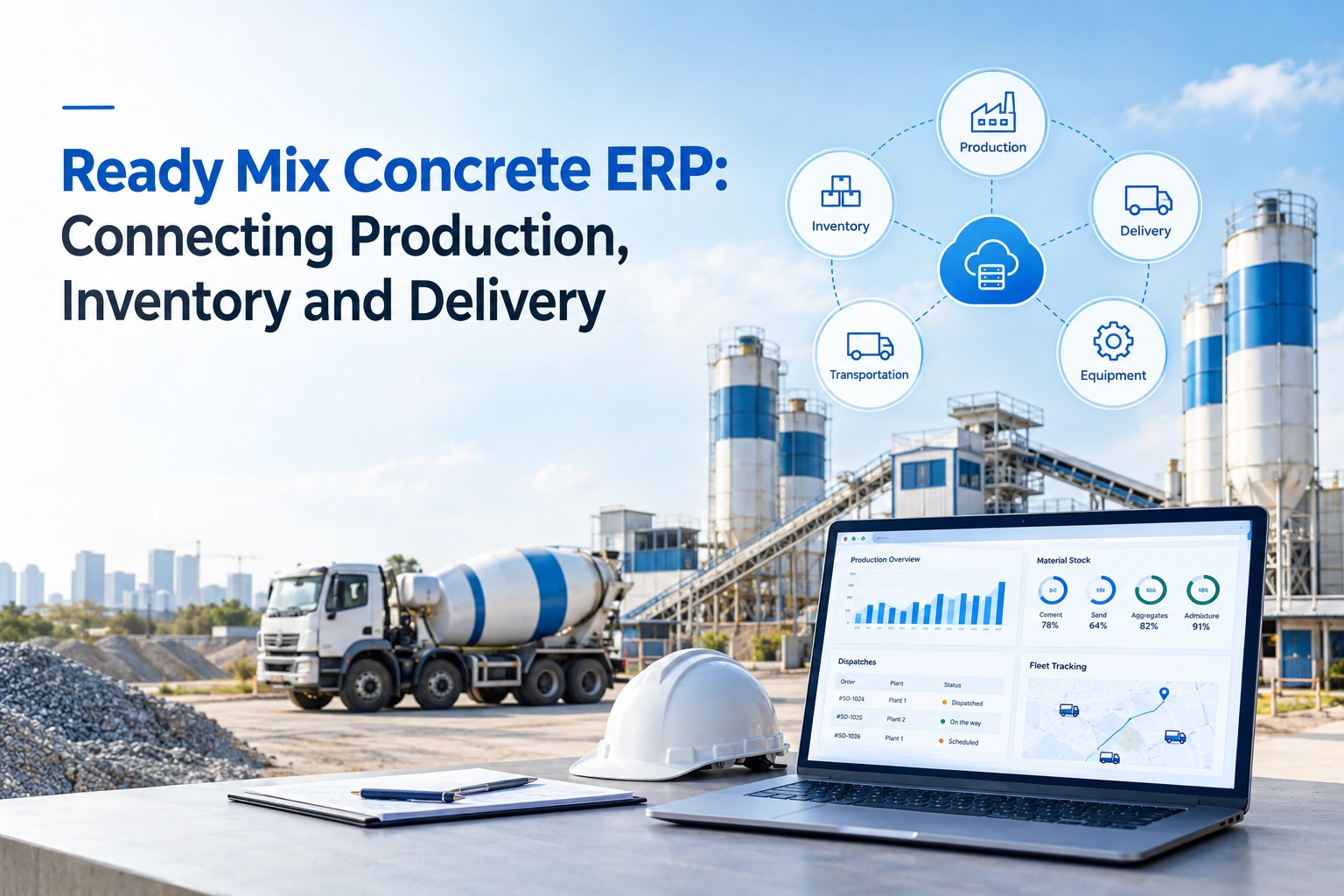
Ready Mix Concrete ERP: Connecting Production, Inventory and Delivery
Ready Mix Concrete (RMC) businesses operate in a time-sensitive environment where production planning, raw material availability, plant operations, transportation and customer delivery must work together. Even a small disruption in one area can affect several activities across the business. For example, a shortage of cement can delay batching, an unexpected change in a project's concrete requirement can disrupt dispatch schedules, and poor coordination between the plant and transport teams can lead to unnecessary waiting time. These challenges become more difficult when different teams maintain separate spreadsheets, paper records or disconnected applications. This is where ready mix concrete ERP becomes valuable. By connecting key operational activities in one system, an ERP platform can help RMC businesses improve coordination, monitor resources and make decisions using more consistent information. For a broader understanding of how ERP connects construction operations, explore biCanvas's complete guide to construction ERP software. Why Ready Mix Concrete Businesses Need Connected Operations Unlike many other construction materials, ready-mix concrete must be produced and delivered according to specific project requirements and schedules. Production and delivery planning therefore depend on more than the availability of raw materials. RMC businesses must coordinate several activities simultaneously: Monitoring cement, sand, aggregates and admixture availability. Planning production according to confirmed orders and site requirements. Coordinating batching plant operations and equipment. Scheduling vehicles and deliveries. Tracking fuel, transportation and operational costs. Maintaining purchase, inventory and delivery records. When these activities operate independently, teams may have difficulty identifying where delays originate or how operational decisions affect costs. A connected system creates a more consistent flow of information between departments, allowing managers to monitor operations without waiting for multiple teams to compile separate reports. 1. Connect Production Planning with Actual Demand Production planning is one of the most important responsibilities in an RMC business. The plant must produce the required concrete quantity while considering delivery schedules, available resources and customer specifications. Planning production without reliable order information can create two problems: insufficient concrete when a project needs it, or unnecessary production that puts pressure on plant capacity and scheduling. An ERP system can help connect order information, production requirements, material availability and operational schedules. For example, when a construction site requests concrete for a scheduled pour, the operations team can use the available order and planning information to coordinate production and dispatch. If the requirement changes, the relevant teams can review the updated plan rather than relying entirely on separate calls and spreadsheets. The objective is not simply to produce more concrete. It is to align production with actual demand and available capacity. 2. Improve Raw Material Inventory Visibility Cement, aggregates, sand and chemical admixtures are essential inputs for RMC production. Inaccurate inventory records can affect production schedules, purchasing decisions and cost calculations. Manual inventory management often creates a gap between recorded stock and the quantity physically available at the plant. A suitable ERP system can help businesses maintain structured records of material receipts, stock movements, consumption and replenishment requirements. This can support better decisions in several ways: Stock visibility: Review available material quantities before confirming production plans. Purchase planning: Identify replenishment requirements earlier. Consumption monitoring: Compare expected and recorded material usage. Stock reconciliation: Investigate differences between system records and physical quantities. Cost visibility: Connect material movements with operational and financial reporting. These controls are particularly useful when businesses operate multiple plants or supply several construction sites. For more practical insights into material tracking, read biCanvas's guide to construction material management and inventory control. It provides additional context on how material procurement and inventory processes contribute to better construction operations. 3. Coordinate Dispatch and Transportation Production alone does not complete an RMC order. Concrete must reach the right site, in the required quantity, at the appropriate time. Dispatch planning becomes complicated when multiple customers request deliveries within overlapping time windows. Traffic conditions, plant capacity, vehicle availability and changing site requirements can add further pressure. A connected operational system can help teams coordinate dispatch schedules, order details, vehicle allocation and delivery records. For instance, if a site changes its requested delivery time, the operations team needs reliable information to assess the impact on production and other scheduled deliveries. Better coordination can help reduce avoidable waiting, improve communication between the plant and site teams, and make delivery planning more predictable. Businesses should also evaluate whether their chosen platform supports the specific vehicle tracking, weighbridge, batching or transport integrations required by their operations. 4. Monitor Plant, Machinery and Fuel Costs Plant and machinery are important operational resources for RMC businesses. Their availability, maintenance requirements and operating expenses influence productivity. Unexpected equipment downtime can interrupt production and affect delivery commitments. Meanwhile, limited visibility into fuel consumption and maintenance expenditure can make it harder to understand the true cost of operations. An ERP platform with appropriate equipment and asset management capabilities can help businesses maintain equipment records, monitor maintenance activities and track related expenses. Depending on the system configuration, businesses may also integrate equipment or telematics data to analyse utilisation and fuel consumption. The practical benefit is better visibility into recurring operational issues. Managers can identify equipment that requires attention, review maintenance expenditure and evaluate whether resources are being used efficiently. For businesses handling large infrastructure projects, biCanvas also provides insights into construction ERP software for infrastructure businesses, including the importance of evaluating operational requirements before choosing an ERP platform. 5. Connect Plant Operations with Project Requirements RMC suppliers often serve several construction projects with different delivery schedules, concrete grades and quantity requirements. Coordination becomes more demanding when multiple sites depend on the same plant or fleet. This is where construction company software with suitable RMC capabilities can help connect supplier operations with broader construction workflows. A connected system can support coordination between order information, project requirements, dispatch records, material availability and financial reporting. For construction and infrastructure businesses that manage their own RMC operations, this connection can provide a more complete view of how material supply affects project execution. For example, a delayed delivery may affect the site's planned activities. If the relevant teams can access consistent operational information, they can respond sooner and make more informed scheduling decisions. Businesses looking to connect these processes across departments can also explore how biCanvas connects projects, inventory, workforce and operations in India. 6. Improve Cost and Performance Reporting Operational activity generates information about material consumption, production, dispatch, transport and equipment expenses. However, information is useful only when it can be interpreted and connected to business decisions. When reports are prepared manually from separate systems, management may spend considerable time reconciling figures before analysing performance. An integrated ERP environment can help consolidate operational records and provide more structured reporting. Useful performance indicators may include: Planned versus actual production quantities. Raw material consumption and stock variances. Delivery punctuality and vehicle utilisation. Fuel and maintenance expenditure. Plant operating costs. Order fulfilment and outstanding deliveries. The exact indicators depend on the business model, available data and system configuration. Regular reporting helps managers identify recurring bottlenecks, compare performance over time and take corrective action based on evidence rather than assumptions. 7. What Should You Evaluate Before Choosing an RMC ERP? Not every ERP platform supports the operational requirements of a ready-mix concrete business equally well. Before selecting a solution, businesses should evaluate the workflows they need to manage and the integrations required to support them. Consider these questions: Production: Can the system support the production planning and batching workflows your plant requires? Inventory: Can it track raw materials, receipts, consumption and stock reconciliation? Dispatch: Can the team coordinate orders, delivery schedules and dispatch records? Transportation: Does it support the required vehicle, fuel and tracking integrations? Equipment: Can plant machinery, maintenance and operating costs be monitored? Reporting: Can management review operational performance and costs using consistent information? Scalability: Can the system support additional plants, customers and operating locations as the business grows? Implementation: What training, configuration, integration and ongoing support will be required? For a wider evaluation framework, read biCanvas's construction ERP software guide. It explains how connected construction processes can help businesses assess their requirements before choosing a solution. These questions help businesses evaluate software against real operating conditions instead of selecting a product solely because it has an extensive feature list. How biCanvas Supports RMC and Construction Operations biCanvas provides ERP capabilities for construction, infrastructure and ready-mix concrete operations. Its RMC offering covers areas including production planning, material and inventory management, transportation and fuel tracking, plant and machinery management, and purchase management. These capabilities are relevant to businesses seeking better coordination across plant and operational activities. For organisations that also manage construction or infrastructure projects, connecting relevant operational information can help reduce the need to rely on disconnected processes. Explore the biCanvas construction ERP solution to learn more about its project management, finance, inventory, resource allocation and equipment management capabilities. Businesses can also review construction ERP software in India: how biCanvas connects projects, inventory, workforce and operations for a broader understanding of how construction-focused ERP can support connected business processes. The right solution will depend on the organisation's operating model, plant requirements, existing systems and implementation priorities. Conclusion Ready mix concrete operations depend on the coordination of production, raw materials, transportation, equipment and delivery schedules. When these activities are managed through disconnected systems, even routine changes can create delays and make costs harder to understand. A suitable ready mix concrete ERP can help businesses connect operational information, improve inventory visibility, coordinate dispatch and strengthen performance reporting. For RMC suppliers, construction contractors and infrastructure businesses, the goal is to build a reliable flow of information from planning through execution and reporting. biCanvas offers construction and RMC-focused ERP capabilities that businesses can evaluate against these requirements. The best starting point is to identify the operational gaps that affect your business most and determine which workflows need to work together. Frequently Asked Questions 1. What is ready mix concrete ERP? Ready mix concrete ERP is a business management system that helps coordinate RMC activities such as production planning, raw material inventory, dispatch, transportation, equipment management and operational reporting. 2. What are the benefits of using ready mix concrete ERP? Depending on its capabilities and implementation, an RMC ERP can improve inventory visibility, production coordination, dispatch planning, cost monitoring and reporting. It can also help teams work with more consistent operational information. 3. Can construction company software manage RMC operations? Some construction ERP platforms support RMC operations alongside project management, inventory, procurement and finance. Businesses should verify that the chosen platform covers their specific production, batching, dispatch and transport requirements. 4. What is the difference between construction ERP and infrastructure ERP? Construction ERP generally supports project execution, procurement, inventory, budgeting and related business processes. Infrastructure ERP focuses on the requirements of infrastructure projects, which may include multi-site coordination, contracts, resource allocation, equipment and project-level financial control. The capabilities of individual platforms vary. To understand how these requirements affect software selection, read biCanvas's guide to construction ERP for infrastructure businesses. 5. How does biCanvas support ready mix concrete businesses? biCanvas offers RMC-focused capabilities covering production planning, inventory and material management, transportation and fuel tracking, plant and machinery management, and purchasing. Businesses should assess the available configuration and integrations against their operational requirements. 6. How should a business choose the right RMC ERP? Start by mapping current workflows and identifying operational gaps. Then evaluate production planning, inventory controls, dispatch, transportation, equipment management, reporting, integrations, implementation requirements and scalability before making a decision.
Search
Blog Categories
Recent Posts
Post 01
Ready Mix Concrete ERP: Connecting Production, Inventory and Delivery
23 Oct 2026
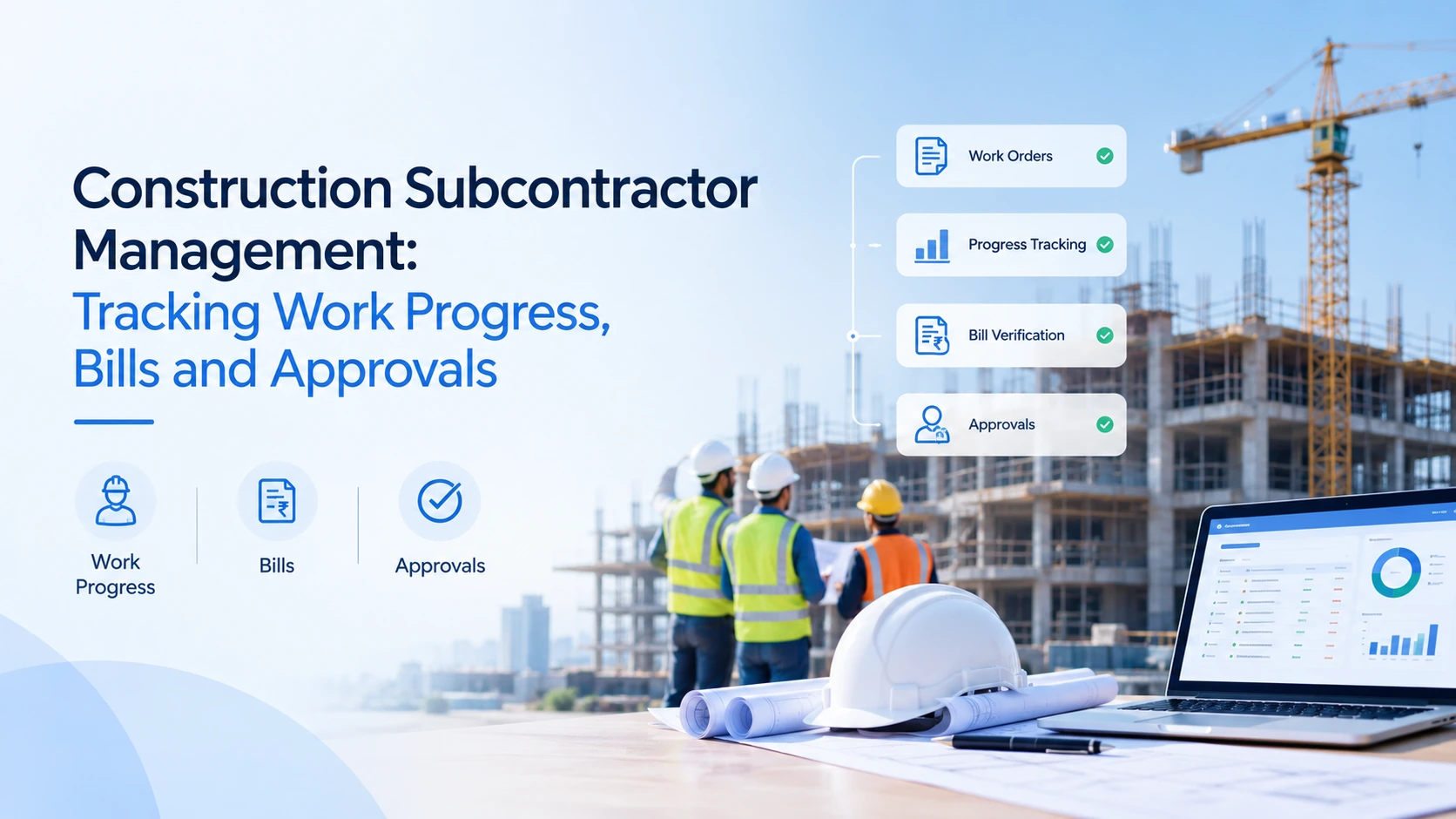
Post 02
Construction Subcontractor Management: Tracking Work Progress, Bills and Approvals
22 Oct 2026
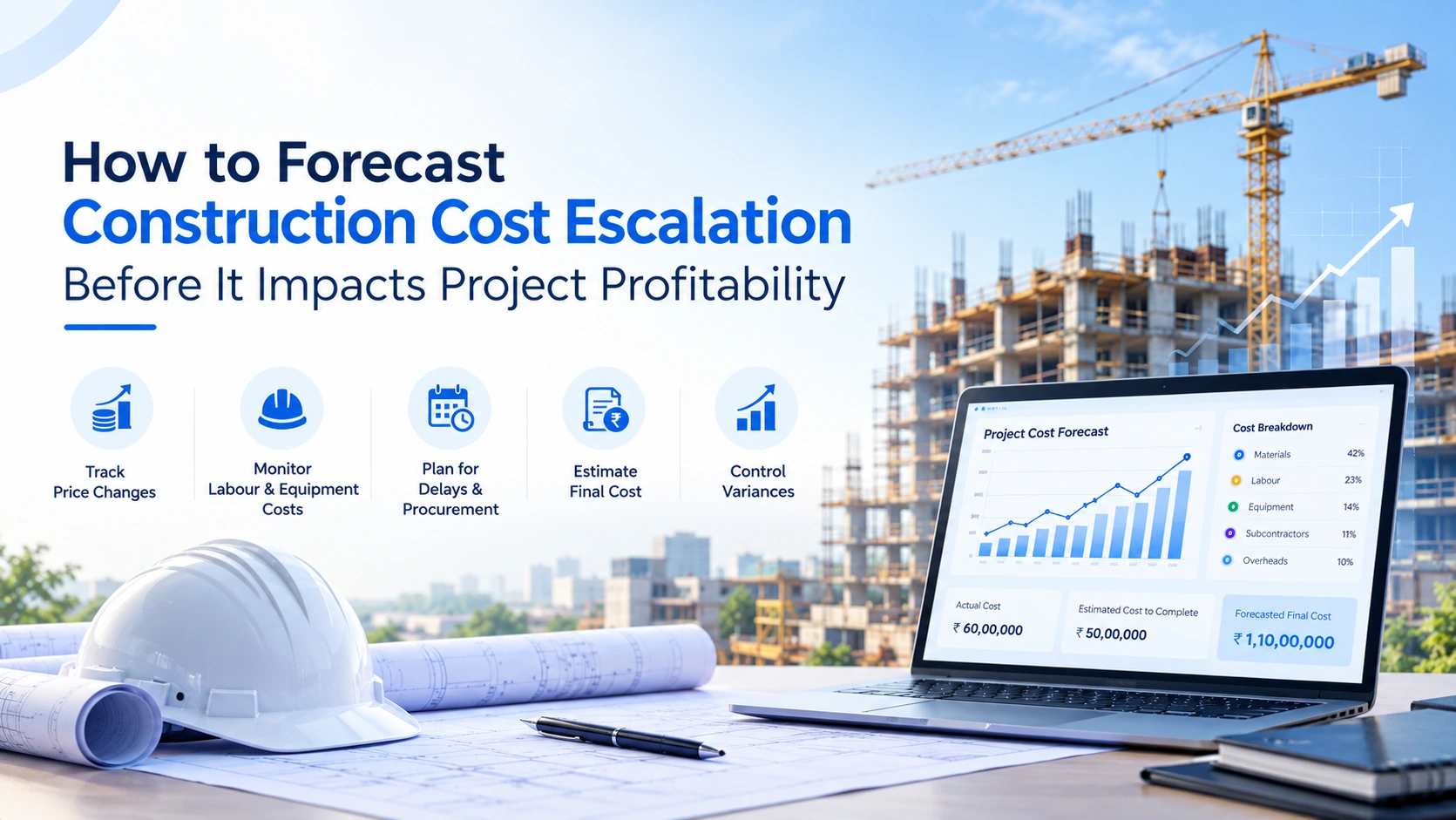
Post 03
How to Forecast Construction Cost Escalation Before It Impacts Project Profitability
21 Oct 2026