Email:
sales@bicanvas.com
Sales:
Call Icon +91 8530414111
Language Icon
Email: sales@bicanvas.com Sales: +91 8530414111
img img

Blogs

Expert insights, practical advice, helpful tips, and industry-leading best practices
Our Blogs

Our Latest Blogs

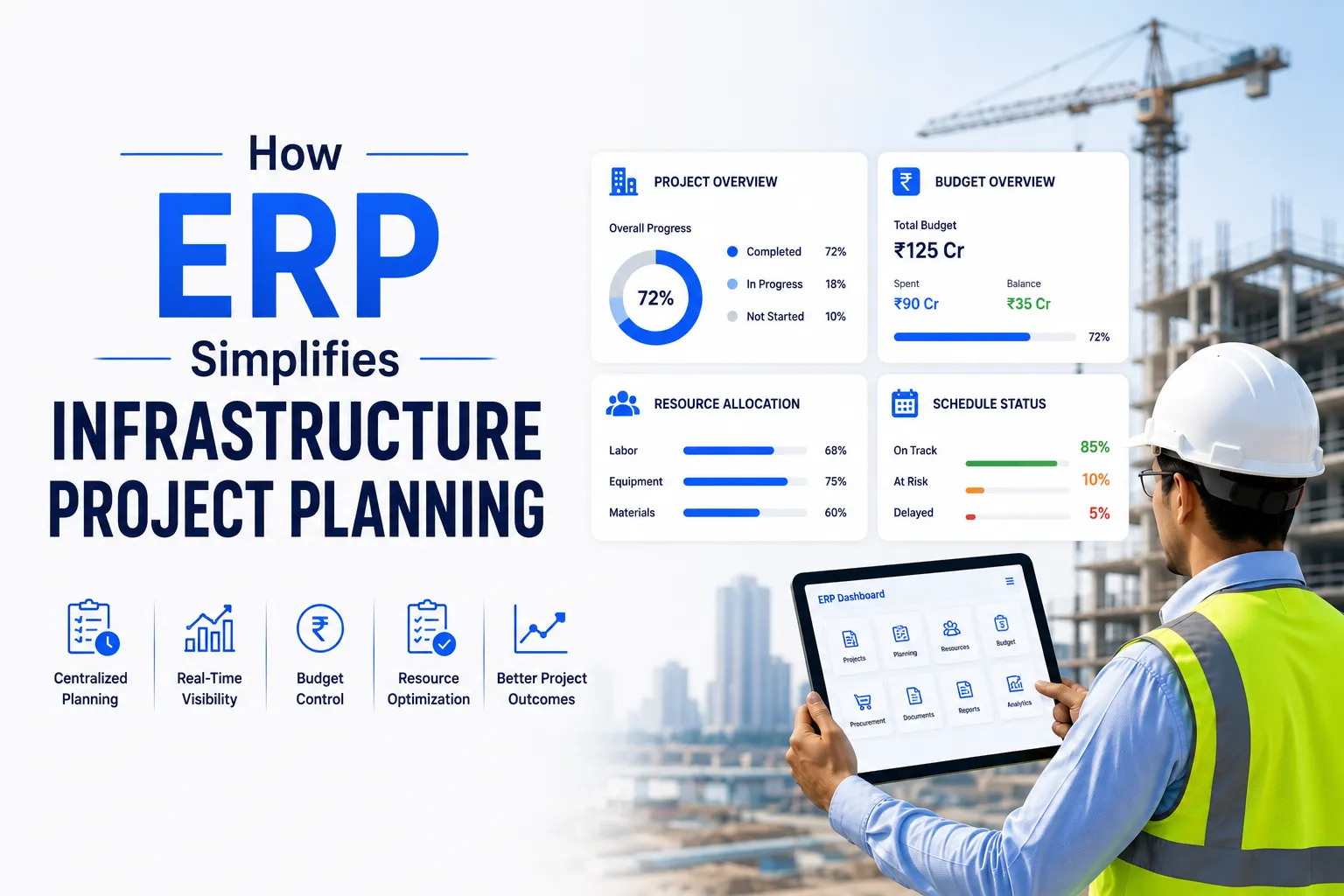
How ERP Simplifies Infrastructure Project Planning
10 Apr 2024

How ERP Simplifies Infrastructure Project Planning

Planning an infrastructure project is a tough task, especially when you manage it with Excel sheets and WhatsApp chats. Whether it’s a highway, metro rail system, bridge, or water treatment plant, these projects are large in scale, technically demanding, and often take several years to complete from initial planning to final execution, involving multiple phases.

Things can quickly get chaotic when there are numerous contractors, tight budgets, heavy equipment, and fluctuating deadlines. That’s where ERP (Enterprise Resource Planning) steps in as a game-changer. ERP brings all your project data into one system, giving you real-time visibility into every aspect of the job. You can plan better, track progress, control costs, and avoid delays. It connects teams, automates routine tasks, and helps you make faster decisions with accurate information. With ERP, you spend less time putting out fires and more time building successfully.

In this blog, let’s explore how ERP helps simplify and streamline infrastructure project planning.

What is ERP?

ERP is software that unifies all your business operations into a single integrated system, including project planning, finance, procurement, labor management, equipment tracking, compliance, and reporting. ERP provides a single platform where everything is connected and eliminates the need for spreadsheets, emails, and separate software for each department.

The Struggle Behind Planning Infrastructure Without ERP

You might be facing the following issues if you're handling infrastructure projects manually or using outdated tools:

  • Scattered project data: Everyone uses different tools, and files are not synchronized.
  • Delayed approvals: Procurement, design changes, or contractor payments get stuck in email threads.
  • Lack of real-time tracking: Delays or overspending go unnoticed until it’s too late.
  • Complex compliance: Hours are spent compiling records for government reporting or audits.
  • Inaccurate forecasting: Poor data leads to budget overruns and resource mismanagement.

What ERP Simplifies In Your Infrastructure Project Planning.

1. Centralized Project Planning

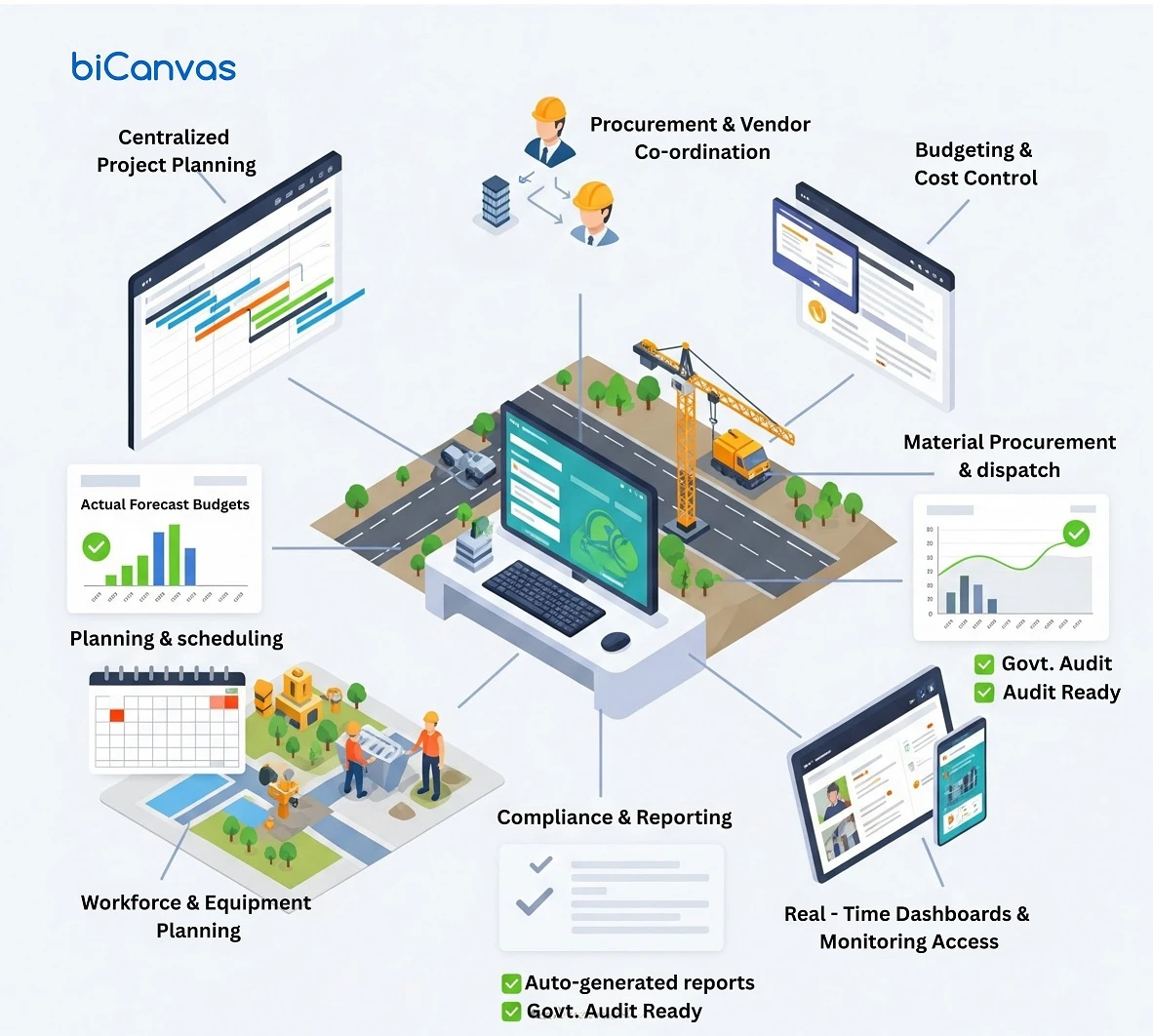
ERP allows you to define budgets, assign tasks, set milestones, and develop comprehensive project plans all in one location with biCanvas cloud-based Infrastructure ERP software.

Benefits:
  • Everyone follows the same strategy
  • Clearly defined dependencies and work allocations
  • Compare anticipated timelines with real-time progress

Imagine your project managers, engineers, and finance team all looking at the same live dashboard — eliminating confusion or duplicated effort.

2. Seamless Procurement & Vendor Coordination

ERP systems come with built-in procurement workflows for buying materials, hiring subcontractors, and managing vendors.

Benefits:
  • Create digital purchase orders and get fast approvals
  • Track material deliveries across multiple sites
  • Assign procurement expenses directly to specific projects

Track every purchase and know exactly how much has been spent and received — no more overordering or lost receipts.

3. Budgeting, Forecasting, and Cost Control

ERP tools allow you to set financial controls and track your spending at every stage of the infrastructure project.

Benefits:
  • Set budgets by project phase, task, or department
  • Compare real-time spend with planned estimates
  • Receive alerts when costs exceed budget

No more end-of-month surprises — just proactive financial control.

4. Workforce and Equipment Planning

Infrastructure requires a large workforce and heavy equipment. ERP helps in proper planning and utilization of both.

Benefits:
  • Organize labor by project phase
  • Track equipment usage and maintenance schedules
  • Avoid project delays caused by idle resources
How ERP Simplifies Infrastructure Project Planning

5. Built-in Compliance and Reporting

Public infrastructure projects are heavily regulated. ERP automates documentation and maintains audit trails for approvals and transactions.

Benefits:
  • Every transaction is digitally recorded
  • Generate client or government reports with a few clicks
  • Control access with role-based permissions

6. Real-Time Dashboards and Mobile Access

Modern ERP systems offer live dashboards and mobile access, so your site and office teams stay aligned.

Benefits:
  • Instant project status updates
  • Faster decisions, fewer delays
  • Improved communication between locations

Conclusion

Infrastructure projects are complex — but managing them doesn’t have to be. With ERP, you don’t just digitize paperwork; you build a system for better planning, smoother execution, and stronger project outcomes.

ERP helps you:

  • Plan with clarity
  • Execute with confidence
  • Deliver on time and within budget

If your current tools are slowing you down, it’s time to invest in an ERP solution that supports long-term growth and efficiency.

Discover how a powerful ERP system can eliminate delays, reduce costs, and bring clarity to every phase of your project. Schedule a free demo today!
Our Blogs

Our Latest Blogs

/frontend/images/blog/how-erp-simplifies-infrastrucre-project-planning
10 Apr 2024

How ERP Simplifies Infrastructure Project Planning

Planning an infrastructure project is a tough task, especially when you manage it with Excel sheets and WhatsApp chats. Whether it’s a highway, metro rail system, bridge, or water treatment plant, these projects are large in scale, technically demanding, and often take several years to complete from initial planning to final execution, involving multiple phases.

Things can quickly get chaotic when there are numerous contractors, tight budgets, heavy equipment, and fluctuating deadlines. That’s where ERP (Enterprise Resource Planning) steps in as a game-changer. ERP brings all your project data into one system, giving you real-time visibility into every aspect of the job. You can plan better, track progress, control costs, and avoid delays. It connects teams, automates routine tasks, and helps you make faster decisions with accurate information. With ERP, you spend less time putting out fires and more time building successfully.

In this blog, let’s explore how ERP helps simplify and streamline infrastructure project planning.

What is ERP?

ERP is software that unifies all your business operations into a single integrated system, including project planning, finance, procurement, labor management, equipment tracking, compliance, and reporting. ERP provides a single platform where everything is connected and eliminates the need for spreadsheets, emails, and separate software for each department.

The Struggle Behind Planning Infrastructure Without ERP

You might be facing the following issues if you're handling infrastructure projects manually or using outdated tools:

  • Scattered project data: Everyone uses different tools, and files are not synchronized.
  • Delayed approvals: Procurement, design changes, or contractor payments get stuck in email threads.
  • Lack of real-time tracking: Delays or overspending go unnoticed until it’s too late.
  • Complex compliance: Hours are spent compiling records for government reporting or audits.
  • Inaccurate forecasting: Poor data leads to budget overruns and resource mismanagement.

What ERP Simplifies In Your Infrastructure Project Planning.

1. Centralized Project Planning

ERP allows you to define budgets, assign tasks, set milestones, and develop comprehensive project plans all in one location with biCanvas cloud-based Infrastructure ERP software.

Benefits:
  • Everyone follows the same strategy
  • Clearly defined dependencies and work allocations
  • Compare anticipated timelines with real-time progress

Imagine your project managers, engineers, and finance team all looking at the same live dashboard — eliminating confusion or duplicated effort.

2. Seamless Procurement & Vendor Coordination

ERP systems come with built-in procurement workflows for buying materials, hiring subcontractors, and managing vendors.

Benefits:
  • Create digital purchase orders and get fast approvals
  • Track material deliveries across multiple sites
  • Assign procurement expenses directly to specific projects

Track every purchase and know exactly how much has been spent and received — no more overordering or lost receipts.

3. Budgeting, Forecasting, and Cost Control

ERP tools allow you to set financial controls and track your spending at every stage of the infrastructure project.

Benefits:
  • Set budgets by project phase, task, or department
  • Compare real-time spend with planned estimates
  • Receive alerts when costs exceed budget

No more end-of-month surprises — just proactive financial control.

4. Workforce and Equipment Planning

Infrastructure requires a large workforce and heavy equipment. ERP helps in proper planning and utilization of both.

Benefits:
  • Organize labor by project phase
  • Track equipment usage and maintenance schedules
  • Avoid project delays caused by idle resources
How ERP Simplifies Infrastructure Project Planning

5. Built-in Compliance and Reporting

Public infrastructure projects are heavily regulated. ERP automates documentation and maintains audit trails for approvals and transactions.

Benefits:
  • Every transaction is digitally recorded
  • Generate client or government reports with a few clicks
  • Control access with role-based permissions

6. Real-Time Dashboards and Mobile Access

Modern ERP systems offer live dashboards and mobile access, so your site and office teams stay aligned.

Benefits:
  • Instant project status updates
  • Faster decisions, fewer delays
  • Improved communication between locations

Conclusion

Infrastructure projects are complex — but managing them doesn’t have to be. With ERP, you don’t just digitize paperwork; you build a system for better planning, smoother execution, and stronger project outcomes.

ERP helps you:

  • Plan with clarity
  • Execute with confidence
  • Deliver on time and within budget

If your current tools are slowing you down, it’s time to invest in an ERP solution that supports long-term growth and efficiency.

Discover how a powerful ERP system can eliminate delays, reduce costs, and bring clarity to every phase of your project. Schedule a free demo today!
OUR BLOGS

Our Latest Blogs

img
17 Dec 2025

Why 2026 Will Punish Companies with Outdated Workflows: The Cloud-Based ERP Reality

  Executive Summary The digital shift is no longer approaching—it is already reshaping how industries operate. By 2026, organizations across construction, manufacturing, and infrastructure will face a clear divide between those operating on modern, connected systems and those constrained by outdated workflows. This divide will not be subtle. It will be visible in margins, talent retention, execution speed, and customer trust. Cloud-based ERP systems are no longer a competitive differentiator. They are fast becoming the minimum operational baseline required to survive. As labor shortages intensify, margins tighten, compliance pressures rise, and AI-driven decision-making becomes standard, businesses that continue to rely on manual or fragmented processes will experience compounding operational and financial strain. The consequences are already measurable. A significant portion of the construction workforce is nearing retirement, productivity growth has stagnated for decades, and digitally mature companies are capturing a disproportionate share of industry revenue. By 2026, these forces converge, leaving little room for gradual or cosmetic change. Key signals shaping this shift: A rapidly aging workforce accelerating knowledge loss Persistent productivity leakage tied to manual coordination Faster ROI cycles driven by automation and integration Market consolidation favoring digitally mature firms The 2026 Wake-Up Call: What Is Fundamentally Changing If your organization still relies on spreadsheets, paper logs, disconnected apps, and email-heavy coordination to run projects, the challenge is no longer efficiency. It is resilience. In 2026, outdated workflows will directly translate into reduced competitiveness, higher risk exposure, and shrinking profitability. At its core, this is a construction workflow management problem. Fragmented systems, manual handoffs, and siloed data structures cannot support the speed, precision, and accountability modern projects demand. When information moves slower than decisions, execution breaks down. The market will not wait for slow adapters. Organizations that fail to modernize foundational workflows will find themselves reacting to crises instead of controlling outcomes. This is not driven by technology trends alone, but by market behavior that increasingly rewards speed, visibility, and predictability. Industry data reinforces this urgency. Construction productivity has grown at roughly one percent annually for decades, while the broader global economy has nearly tripled that rate. At the same time, digital leaders continue to consolidate revenue share, leaving laggards with shrinking margins and fewer opportunities. Three Structural Forces Reshaping Operations 1. The Talent Equation Is Breaking Down The workforce challenge facing construction, manufacturing, and infrastructure companies is structural, not cyclical. A large segment of experienced professionals is approaching retirement just as project complexity increases. At the same time, younger professionals entering the workforce expect clarity, autonomy, and digital-first systems. Outdated processes that rely on tribal knowledge rather than documented workflows create long onboarding cycles and inconsistent execution. New hires take months to become productive because critical information is scattered across emails, spreadsheets, and individual experience. Cloud-based ERP systems centralize operational knowledge, historical data, and standardized processes. This shift reduces dependency on individual memory and allows organizations to shorten onboarding cycles dramatically while improving consistency. The operational impact of outdated talent workflows typically includes: Extended onboarding and training timelines Burnout among engineers and site managers Knowledge loss during retirements and attrition 2. Financial Precision Has Become a Survival Skill In an environment defined by volatile material costs, supply chain uncertainty, and tight margins, financial ambiguity is expensive. Manual cost tracking, delayed reconciliations, and fragmented approval processes create invisible leakage across projects. Poor construction workflow management is often the root cause. When financial and operational data are disconnected, leaders lose the ability to intervene early. Issues surface only after margins have already eroded. Modern cloud-based ERP platforms replace reactive financial control with real-time visibility. Costs, commitments, and cash flow become measurable as work happens, not weeks later. This precision is increasingly the difference between predictable profitability and constant firefighting. Common financial consequences of manual workflows include: Billing and payroll errors Compliance violations and disputes Rework driven by miscommunication 3. Speed Now Determines Market Relevance Markets are no longer rewarding meticulous planning cycles that take months to execute. They reward organizations that can respond quickly to change. Approval chains, procurement decisions, and resource allocation must happen in near real time. Digitally mature companies use integrated ERP systems to compress response cycles dramatically. Decisions that once required weeks are now made in days or hours because data is visible, reliable, and shared. The gap between digital leaders and laggards is no longer incremental. It is compounding. By 2026, agility will not be a strategic advantage; it will be a basic requirement to remain relevant. Where 2026 Will Expose Outdated Workflows The penalties for clinging to legacy processes are not theoretical. They show up consistently across organizations that delay modernization. Operational inefficiency is often the first signal. Manual coordination creates friction at every handoff, slowly draining productivity across teams. Small delays accumulate, resulting in missed deadlines and rising overhead. Speed is the next casualty. Slow approvals and delayed reporting increase opportunity cost, allowing competitors to move faster and capture value. AI initiatives frequently fail when built on fragmented foundations. Without standardized data and integrated systems, automation only accelerates existing problems. Effective AI adoption requires modern construction workflow management that provides clean, governed data. Talent attrition follows closely. Skilled professionals leave environments where systems slow them down and paperwork dominates their time. Over time, this erodes organizational capability. Security and compliance risks also increase. Manual controls cannot keep pace with machine-speed threats, leaving organizations exposed to breaches and regulatory penalties. Finally, customer trust erodes. Delayed responses, inconsistent information, and billing disputes undermine confidence, even when delivery quality is otherwise strong. Industries Under the Greatest Pressure While every sector faces pressure to modernize, construction, infrastructure, manufacturing, RMC, and supply chain operations experience amplified risk due to their complexity and reliance on real-time coordination. These industries depend on accurate, timely information flowing between field teams, finance, procurement, and leadership. Without cloud-based ERP systems, maintaining that flow becomes increasingly difficult as scale and complexity increase. Common operational requirements across these sectors include: Real-time project and cost visibility Integrated financial and operational control Mobile access for field execution What 2026 Demands: The New Operational Baseline Organizations that will thrive in 2026 share a clear characteristic: they treat ERP as core infrastructure, not a support function. Cloud-based ERP systems provide the digital backbone required to operate at modern speed and scale. Today, effective construction workflow management is not about task tracking. It is about orchestrating data, decisions, and accountability across the organization in real time. This new baseline includes unified visibility, automated and governed workflows, mobile-first execution, embedded security, and data structures that support AI-driven insight. The Path Forward Successful transformation follows a clear sequence. Organizations modernize foundations before pursuing advanced automation. Cloud-based ERP provides that foundation by standardizing processes, integrating systems, and improving data quality. A phased approach allows companies to focus first on high-impact workflows, generate early ROI, and build momentum without overwhelming teams. Over time, this creates a resilient operating model capable of adapting to future disruption. The question is no longer whether modernization is necessary. It is whether it will be proactive or forced by declining performance and competitive pressure. The 2026 Reality 2026 will not punish experimentation or learning. It will punish stagnation. Organizations that modernize workflows, adopt cloud-based ERP, and invest in strong operational foundations will gain speed, resilience, and profitability. Those that delay will face compounding inefficiencies, talent loss, security exposure, and shrinking relevance. The systems you operate today will determine where you stand when the market tightens further. The window for gradual change is closing. The decisions made now will define whether 2026 becomes a turning point or a breaking point.  

OUR BLOGS

Our Latest Blogs

img
19 Jul 2025

Streamline Supply Chain Management with a Unified ERP

In today's fast-paced world, dealing with multiple vendors, fluctuating demands, global shipping delays, and growing client expectations makes supply chain and logistics workflows more complex. If you're managing operations with spreadsheets, phone calls, and disconnected systems, it's a recipe for delays, stockouts, or unhappy customers. This is where a unified ERP system makes all the difference. Let’s walk through, in simple terms, how ERP simplifies and streamlines supply chain operations, helps you reduce expenses, avoid chaos, and stay ahead of the competition. What Is a Unified ERP? A unified ERP (Enterprise Resource Planning) system integrates purchasing, inventory, warehousing, production, sales, logistics, and finance into one single platform. You end up with a single source of truth for your entire supply chain instead of juggling four or five disconnected tools. What Happens When You Don’t Use ERP? Many companies still manage their supply chain manually or through fragmented systems. This causes problems like: Outdated inventory data Delayed approvals and miscommunication Missed or duplicate orders No visibility into supplier performance Inaccurate forecasting and stock imbalances If that sounds familiar, it's time to adopt a better solution—ERP. How ERP Streamlines Supply Chain Operations ERP helps manage the entire supply chain in one system, simplifying the ability to monitor orders, inventory, and deliveries. It improves supply chain collaboration and reduces delays by providing real-time updates to all departments. 1. Real-Time Inventory Management ERP automatically tracks inventory across warehouses, locations, and process stages. Benefits: Know exact stock availability in real time Receive alerts before running out or overstocking Auto-update inventory upon goods receipt or shipment No more stock surprises—just a smooth inventory flow. 2. Smarter Procurement Planning ERP helps you plan purchasing based on demand, supplier lead times, and past data. Benefits: Auto-generate POs by assessing stock levels Choose suppliers by price, delivery speed, or past performance Track order status and expected delivery dates This eliminates last-minute purchases and strengthens vendor relationships. 3. Seamless Vendor & Supplier Management ERP centralizes all vendor data, including contacts, contracts, delivery logs, and performance records. Benefits: Compare supplier quotes and turnaround times easily Track delays, rejections, or compliance issues Automate vendor communication and approval workflows Vendor visibility is critical to building resilient supply chains. 4. Demand Forecasting with Data ERP leverages real-time sales and trend data to make accurate predictions about future demand. Benefits: Procure or produce just the right quantity Cut down excess inventory and storage costs Be ready for seasonal spikes or emergency orders Forecasting becomes data-driven—not guesswork. 5. Faster Order Fulfillment Once a sales order is placed, ERP activates workflows across inventory, shipping, and billing. Benefits: Faster delivery from order to dispatch Fewer fulfillment errors All departments work in sync This results in happier customers and repeat business. 6. Unified Dashboard for Decision-Makers ERP gives you live dashboards and analytics to track performance metrics across the supply chain. Benefits: Detect issues early—before they escalate Track KPIs like fulfillment rates, supplier reliability, and cost per order Make quicker, smarter decisions No more waiting for reports—your insights are live. Why It Matters More Than Ever Recent global disruptions—from pandemics to shipping backlogs—have shown us how fragile supply chains can be. Businesses need flexible, data-driven systems to handle changes without breaking down. A unified ERP helps you: React faster to market or supply disruptions Stay productive across distributed teams and locations Scale operations without creating bottlenecks This is more than just software—it’s your strategy for building resilience and growth. Conclusion Trying to manage supply chains manually is like driving blind. It’s slow, risky, and stressful. A unified ERP gives you a clear view of your operations and puts you in control—from sourcing to delivery. If your team is still stuck chasing updates, struggling with inventory errors, or reacting to surprises, it’s time to upgrade. Ready to simplify your supply chain? Discover how biCanvas ERP can give you full visibility and control across sourcing, logistics, inventory, and finance. Book your free demo today!

OUR BLOGS

Our Latest Blogs

img
08 Dec 2025

Best Ready Mix Concrete ERP (RMC ERP) in 2026 — Complete Guide

The Ready-Mix Concrete industry has always operated under pressure — tight timelines, strict mix-design requirements, real-time dispatch coordination, unpredictable delays, rising material costs, and the responsibility of delivering consistent quality to every site. In 2026, the complexity has only increased. Customers expect faster deliveries, tighter quality control, and complete traceability, while RMC companies need better control over batching, logistics, and cost to stay profitable. This is where Ready Mix Concrete ERP (RMC ERP) systems play a crucial role. Unlike generic ERPs, RMC-focused solutions are designed specifically to handle batching, raw material planning, fleet management, delivery scheduling, mix-design control, silo-level inventory, and quality assurance. A modern RMC ERP not only improves operational stability but also reduces wastage, prevents errors, and brings transparency across plants. This guide explores the 10 best Ready-Mix Concrete ERP software solutions in 2026, evaluated on depth, reliability, scalability, and real-world usefulness. Why RMC Businesses Are Moving to ERP in 2026 Managing an RMC business manually is becoming increasingly difficult. Plants run multiple batches per hour, fleets are constantly on the move, mix designs need precision, and customers demand instant updates. Plant operators, dispatch teams, supervisors, and accounts teams often struggle with disconnected systems — spreadsheets, WhatsApp messages, handwritten delivery slips, and offline batching reports. RMC ERP solves these challenges by standardizing mix designs, coordinating dispatch in real time, preventing raw material shortages, reducing billing errors, and providing end-to-end visibility — from batching to delivery. Companies adopting RMC ERP in 2026 are seeing a clear improvement in operational efficiency, faster deliveries, reduced wastage, and better cash flow. How We Selected the Top RMC ERP Solutions Every ERP listed in this article was evaluated based on several core parameters: batching integration capability, material consumption tracking, delivery scheduling and fleet management, quality control depth, multi-plant scalability, financial integration, ease of implementation, mobile accessibility, and overall cost-value ratio. Our goal was to highlight platforms that genuinely understand the realities of RMC operations and deliver measurable improvements. 1. biCanvas ERP — Best Overall RMC ERP for 2026 biCanvas stands out because of how well it connects the entire lifecycle of ready-mix operations. While it is widely used across construction, infrastructure, supply chain, and manufacturing, its workflow depth makes it naturally strong for RMC businesses. It brings batching, materials, dispatch, equipment, and financials under one ecosystem, making it suitable for both single-plant operators and large multi-plant companies. The system offers real-time visibility of plant production, inventory levels, order status, and fleet movement. Its dispatch workflows help reduce delays caused by poor coordination, while built-in financial controls ensure every load is tracked until invoicing. What makes biCanvas particularly effective is how smoothly it handles multi-department connectivity — something many RMC companies struggle with when using fragmented systems. The platform doesn’t feel promotional or pushy; instead, it fits organically into the operational needs most RMC companies already recognize. 2. Inntech RMC ERP — Ideal for Small and Mid-Sized Operators Inntech provides an easy-to-understand interface, basic batching integration, and simple inventory management—making it suitable for companies just transitioning from manual operations. It is affordable, quick to deploy, and handles essential workflows without overwhelming teams. While not as comprehensive as enterprise-grade systems, it meets the needs of smaller plants effectively. 3. ReadyMix ERP (TMS) — Strong for Quality-Driven Environments Companies that prioritize mix-design accuracy and testing often choose ReadyMix ERP. It offers strong QC workflows, batch-wise quality records, automated delivery notes, and compliance documentation. Plants with tight quality requirements benefit greatly from its structured reporting and traceability features. 4. QCRETE ERP — Best for Multi-Location Enterprises QCRETE suits organizations operating several RMC plants across regions. Its central dashboards make it easy for management to monitor material consumption, plant performance, and delivery patterns across units. The system also includes advanced QC features, though it requires a longer implementation period and slightly higher investment. 5. E-ReadyMix ERP — Focused on Dispatch & Delivery Optimization This ERP is favored by companies where delivery timelines are the biggest challenge. The software provides route planning, GPS tracking, and dispatch automation, helping teams reduce delays and manage peak hours more efficiently. Its strength lies more on the logistics side than in deep manufacturing workflows. 6. TRANSFLOW RMC ERP — Best for Fleet-Heavy Operations TRANSFLOW is designed for companies managing large fleets of transit mixers, pump trucks, and material carriers. Its dispatch engine and real-time vehicle tracking allow operations teams to maximize fleet utilization. It performs especially well in high-volume RMC markets where vehicle movement directly affects profitability. 7. ERPNext (Customized for RMC) — Flexible and Cost-Efficient ERPNext is an open-source platform that becomes useful when customized for RMC. It can manage sales orders, batching reports, material usage, and billing, but requires development support to match the depth of purpose-built RMC ERPs. It works best for smaller businesses with budget limitations and simple workflows. 8. ReadyMix360 — Best Lightweight Cloud-Native Option ReadyMix360 is cloud-based, modern, and easy to learn. It fits companies looking for a clean UI and quick deployment. Although feature depth is moderate compared to enterprise-grade platforms, it covers essential workflows effectively. 9. CIMS RMC ERP — Strongest for Quality & Testing Records CIMS is known for its comprehensive QC module. It enables plants to maintain detailed records of slump tests, cube tests, mix variations, and compliance logs. Companies that must follow strict quality documentation standards often prefer this system. 10. Propel RMC Suite — Best for Basic Workflow Digitalization Propel offers straightforward features for batching, invoicing, and material tracking. It is suitable for small plants that need digital structure without extensive automation or high-level analytics. It provides a good starting point for early-stage RMC companies. Choosing the Right RMC ERP Selecting the right ERP depends on plant size, production volume, and operational complexity. For quality-driven plants, QC modules are essential. For businesses focused on timely deliveries, fleet and dispatch optimization are priorities. Multi-plant operations require centralized dashboards and consolidated reporting. Modern RMC operations benefit from connected, mobile-first platforms that reduce errors and streamline operations. Why biCanvas ERP Stands Out Among all RMC ERPs, biCanvas is uniquely positioned. It combines end-to-end operational visibility, mobile-first workflows, financial integration, and plant-to-office connectivity. With biCanvas, managers can track production, fleet, inventory, and costs in real time — without juggling multiple tools. The platform is scalable, cloud-native, and built for growth, making it the preferred choice for RMC companies aiming for efficiency, accuracy, and profitability. Take Action Now If your RMC business is ready to eliminate manual inefficiencies, ensure consistent quality, and gain complete visibility across plants, it’s time to explore the possibilities with biCanvas. Book a demo today and experience how a purpose-built RMC ERP can transform your operations and profitability.

Chat with biCanvas