By Mohini Dodwade Infrastructure
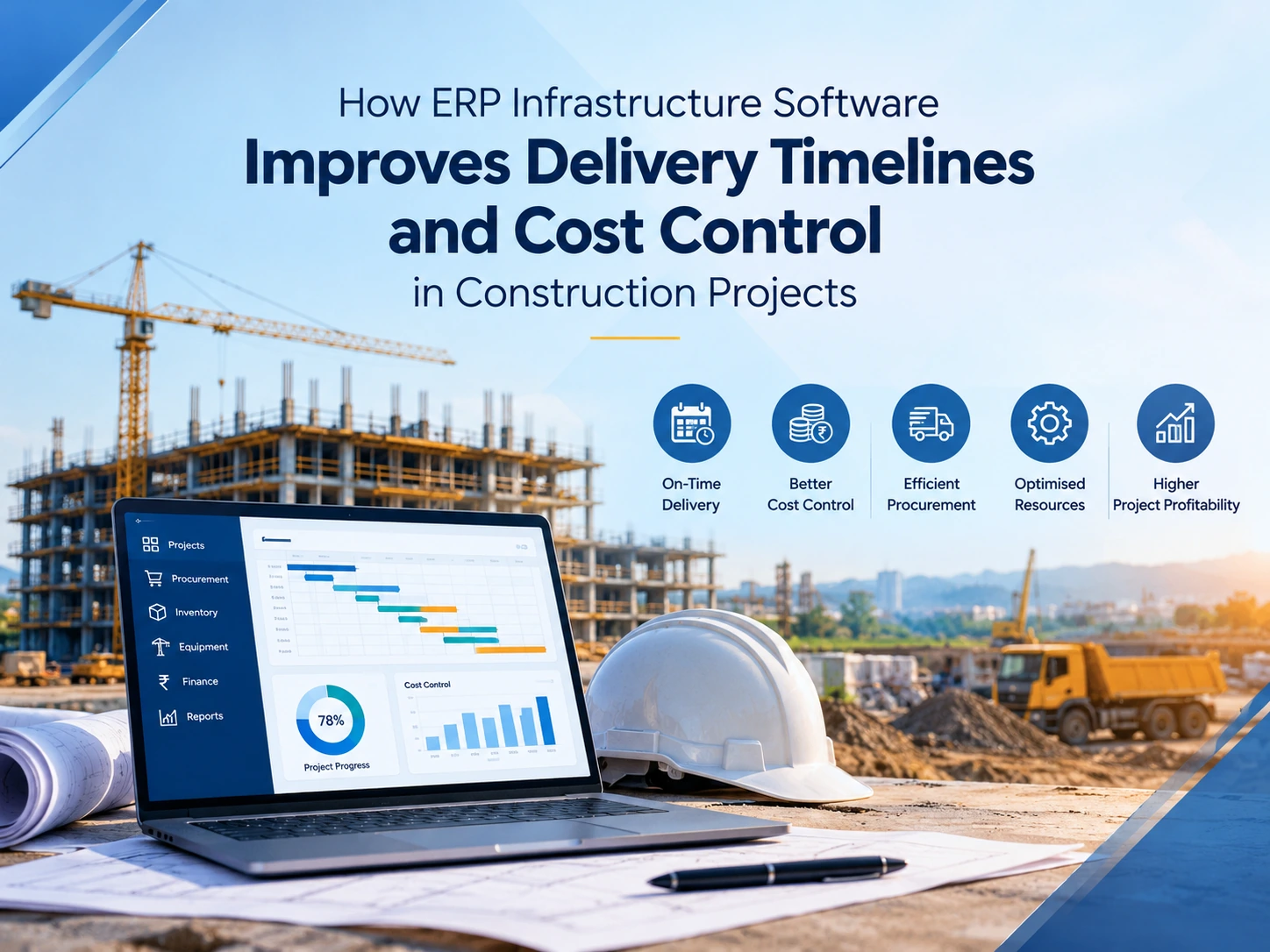
How ERP Infrastructure Software Improves Delivery Timelines and Cost Control in Construction Projects
Infrastructure projects rarely fall behind schedule because of one major problem. More often, delays build up through a series of smaller issues: materials arriving late, purchase approvals getting stuck, equipment remaining idle, or site progress reports reaching management too late.
These problems become harder to manage when multiple projects, contractors, suppliers and departments operate independently.
This is where ERP infrastructure software can make a practical difference. By connecting project planning, procurement, inventory, equipment, finance and site execution, an integrated ERP system helps infrastructure companies identify operational gaps before they become expensive setbacks.
For contractors, infrastructure developers, ready-mix concrete (RMC) businesses and manufacturing companies supporting construction operations, the objective is not simply to digitise existing processes. It is to connect everyday decisions with project schedules and financial performance.
Why Infrastructure Projects Struggle With Delays and Cost Overruns
An infrastructure project depends on several activities happening in the correct sequence. Materials must arrive when required, equipment must be available, labour must be allocated, and contractors must complete work according to the schedule.
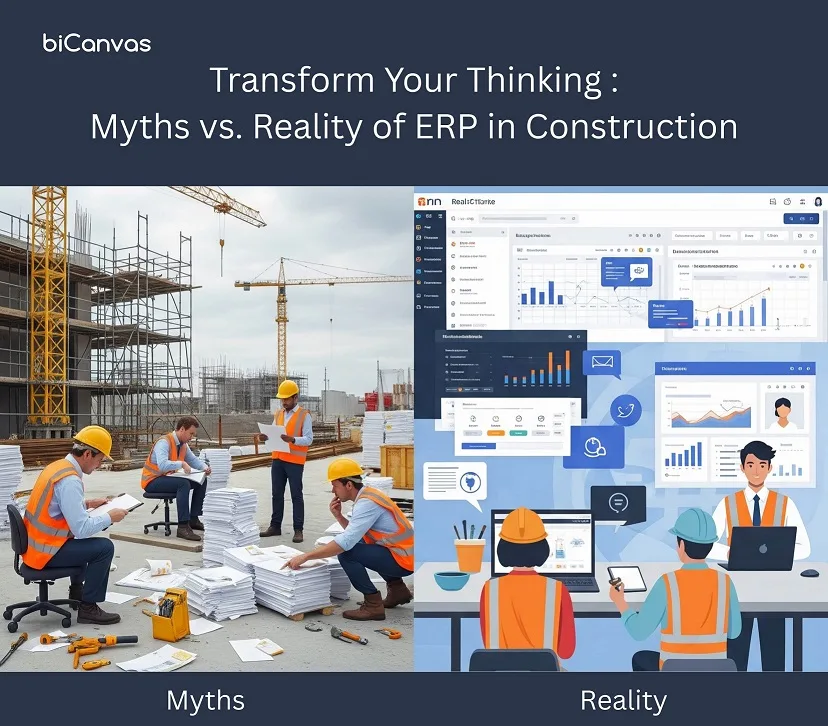
When these activities are managed through disconnected spreadsheets, accounting software and manual reports, coordination becomes difficult.
Consider a road construction project that requires aggregates, cement, steel and machinery at different stages. If procurement does not have visibility into the project schedule, orders may be raised too late. If inventory records are outdated, the team may purchase materials already available at another site.
Meanwhile, management may continue working with an approved budget without knowing that actual expenses are moving beyond planned limits.
The underlying problem is a lack of connected operational information.
An integrated construction ERP system helps bridge this gap by linking project requirements with procurement, inventory, equipment utilisation and financial records.
1. Connect Project Planning With Actual Site Progress
Project schedules are useful only when they reflect what is happening on site.
Infrastructure teams need to track planned activities, milestones, resource requirements and actual progress throughout the project lifecycle. When site updates are delayed, project managers may continue following a schedule that no longer reflects operational reality.
ERP infrastructure software can connect project planning with daily progress reporting and resource allocation.
For example, a project manager can break a highway construction project into work packages, assign budgets and define material requirements. Site engineers can then record progress against those activities, allowing management to compare planned and actual execution.
This creates better visibility into activities falling behind schedule, resources required for upcoming work, delayed milestones and variations between planned and actual progress.
The value comes from linking the schedule to operational data, not simply displaying tasks on a dashboard.
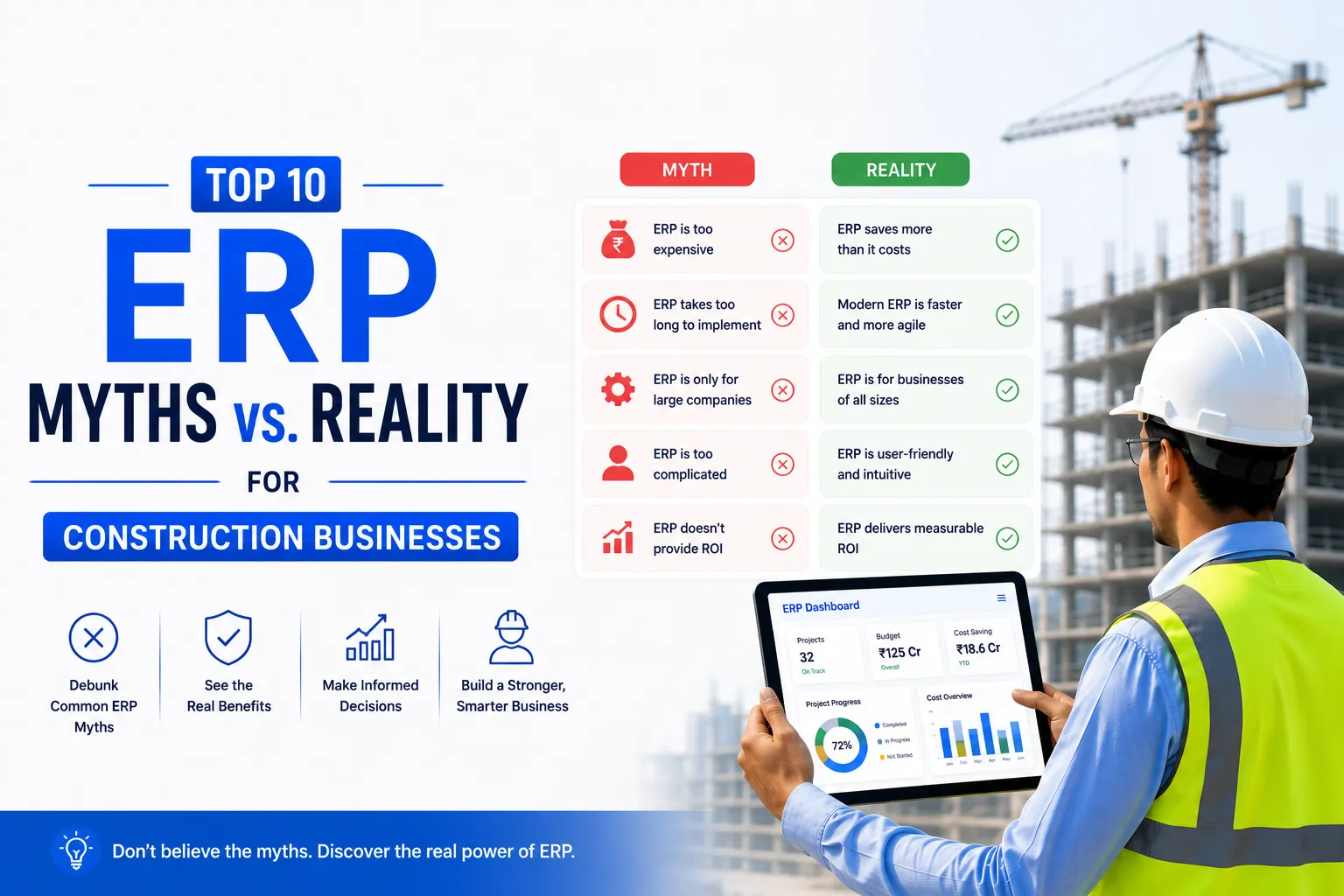
Businesses evaluating infrastructure ERP software in India should examine how well a platform connects project planning with procurement, site execution and cost tracking.
For a deeper explanation of this process, read How ERP Simplifies Infrastructure Project Planning.
2. Improve Material Procurement and Delivery Coordination
Material availability directly affects construction timelines. A shortage of cement, steel, aggregates or other essential supplies can interrupt site activities even when labour and equipment are ready.
At the same time, purchasing too much material too early can increase storage costs, working capital requirements and the risk of wastage.
An integrated ERP system helps connect material planning with project schedules, inventory balances and procurement activities.
The process can work as follows:
Project teams define material requirements based on the project plan and approved quantities.
Inventory records help identify available stock across relevant locations.
Procurement teams raise purchase requests for outstanding requirements.
Approval workflows route requests to the appropriate decision-makers.
Purchase orders and goods receipt records help track orders through delivery.
Material issues and consumption are recorded against the relevant project or activity.
This connected process gives procurement teams better visibility into what is required, what has already been ordered and what remains outstanding.
It can also reduce avoidable purchases, duplicate requests and delays caused by missing approvals.
For construction businesses managing several sites, material transfers, stock reconciliation and wastage tracking are equally important.
Explore Construction Inventory and Procurement Management for a closer look at how material planning, purchasing and inventory control work together.
3. Control Project Costs Before Budget Overruns Escalate
An approved project budget does not guarantee that a project will remain profitable.
Costs continue to accumulate through material purchases, labour, equipment, subcontractors, transportation and other operating expenses. If these costs are reviewed only at the end of the month, management may discover a problem after corrective action has become difficult.
A suitable construction ERP software platform should connect project budgets with actual expenditure and purchase commitments.
Consider a project with an approved material budget of ₹50 lakh. Purchase orders worth ₹35 lakh have already been issued, and actual material consumption has reached ₹22 lakh.
Looking only at the amount consumed may give management an incomplete picture. Significant financial commitments already exist, even if the corresponding materials have not yet been delivered or consumed.
A connected ERP system can help distinguish between:
Budget: The approved financial allocation.
Committed cost: The value of approved orders and other recognised commitments.
Actual cost: Expenses recorded against the project.
Cost variance: The difference between planned and actual financial performance.
These figures need to be interpreted according to the company's accounting rules and project costing methods. Their purpose is to provide a clearer view of financial exposure.
With project-level cost tracking, managers can investigate unusual spending, review procurement decisions and take corrective action before overruns become more difficult to address.
For a broader understanding of how project execution, procurement and financial controls connect, read Construction ERP: The Backbone of Efficient Construction Management.
4. Reduce Equipment Downtime With Better Maintenance Planning
Heavy equipment plays a critical role in infrastructure execution. Excavators, loaders, batching plants, crushers, transit mixers and other machinery must be available when scheduled activities require them.
Unexpected breakdowns can interrupt work, delay deliveries and increase repair expenses.
Equipment management within an ERP system can help businesses maintain asset records, track utilisation, schedule preventive maintenance and monitor fuel or operating expenses.
Where supported by the equipment and integration setup, Industrial Internet of Things (IIoT) connectivity can provide machine operating data that helps teams monitor usage and identify maintenance requirements.
For example, an RMC plant may use operating-hour data to plan maintenance around production requirements rather than waiting for a breakdown. A fleet operator may combine vehicle records, fuel information and maintenance schedules to improve oversight of its vehicles.
These capabilities are particularly useful when several plants, machines or project sites compete for the same resources.
IIoT integration does not automatically prevent breakdowns. Its effectiveness depends on data quality, suitable sensors, maintenance procedures and how consistently teams act on the information.
Read Construction ERP Mobile App for Site Engineers: DPR, RA Billing, Labour, Plant and Equipment to explore how site reporting and equipment management can support construction operations.
5. Use Cloud ERP to Connect Site Teams and Head Office
Infrastructure projects often operate across geographically separated sites. Project managers, procurement teams, finance departments and senior management may all need different information to make decisions.
When each team maintains separate records, reconciliation becomes a recurring task.
Cloud-based ERP infrastructure solutions can provide authorised users with access to shared operational information from different locations, subject to connectivity, permissions and system configuration.
This can help teams coordinate site progress, purchase requests, stock availability, contractor records, equipment utilisation and project expenses.
Cloud deployment can also simplify centralised system administration and access to updated information. However, businesses should assess internet availability at remote sites, offline requirements, data residency, security controls, backup policies and disaster recovery before selecting a platform.
The objective is to make reliable information available to the people who need it without creating additional reporting work for site teams.
For an overview of the broader capabilities to consider, explore the complete guide to construction ERP software.
6. Automate Approvals and Repetitive Workflows
Approval delays are an often-overlooked cause of project disruption.
A purchase request may remain pending because the responsible manager is unavailable. A contractor bill may move between departments without a clear record of its status. A payment request may require repeated follow-ups because supporting documents are incomplete.
Workflow automation helps standardise these processes.
An ERP platform with configurable workflows can route purchase requests, expense claims, contractor bills and other transactions according to predefined approval rules.
For example, a company can configure different approval levels based on transaction value, department, project or budget limits.
The system can also maintain approval histories and pending-action records, making it easier to identify where a process is delayed.
This does not eliminate the need for human review. Instead, it reduces unnecessary manual coordination and gives employees a clearer understanding of their responsibilities.
Contractor billing is another area where structured workflows matter. Read Vendor Management System: Integrating Contractor and Labour Control for Strategic Cost Governance for more information on contractor records, work verification and payment controls.
7. Turn Operational Data Into Actionable Decisions With BI Dashboards
Infrastructure businesses generate substantial amounts of data through procurement, inventory, project execution, finance and equipment operations.
The challenge is turning that information into decisions before problems affect delivery or profitability.
Business intelligence (BI) dashboards can consolidate relevant information into management views that support faster investigation and planning.
Depending on the ERP's capabilities and configured data, useful indicators may include:
Performance indicator
What it helps management understand
Planned versus actual progress
Whether project activities are meeting the schedule
Budget versus actual cost
Where expenditure is deviating from approved allocations
Outstanding purchase orders
Which material deliveries require follow-up
Inventory and material consumption
Whether stock levels match operational requirements
Equipment utilisation
How effectively machinery is being used
Pending approvals
Which decisions may be holding up operations
Project billing and receivables
Where billing or payment follow-up may be needed
A dashboard is only as reliable as the underlying records. Businesses should define clear reporting rules, maintain accurate data and assign responsibility for updating site information.
The aim is to identify exceptions that need attention, rather than simply produce more reports.
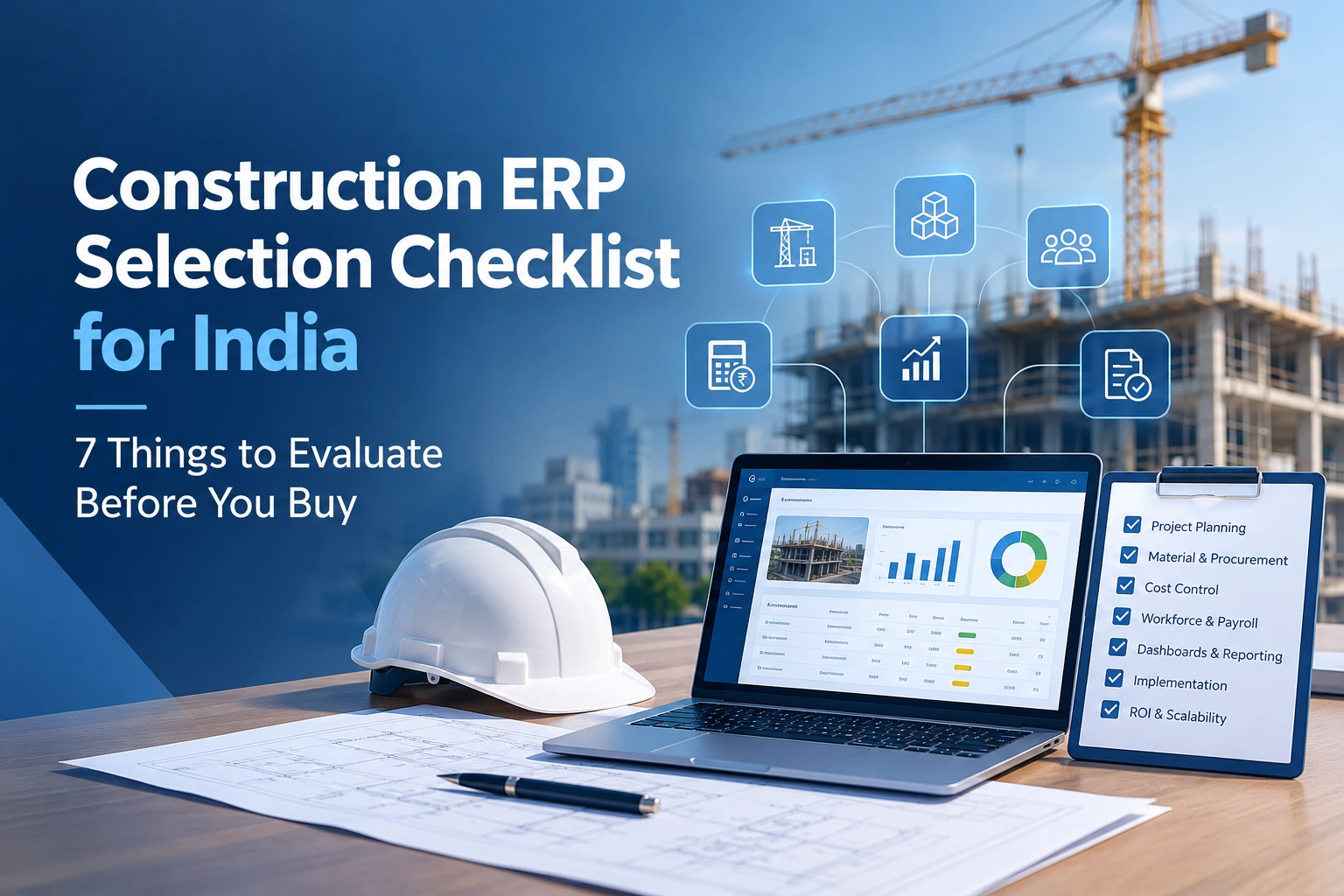
When evaluating platforms, use a construction ERP selection checklist for India to compare reporting, project controls, integration requirements and implementation considerations.
What to Look for When Choosing ERP Infrastructure Software
Not every ERP platform is suitable for a project-driven infrastructure business. A general accounting system may handle financial transactions effectively but still leave gaps in site execution, procurement planning and equipment management.
Before selecting a solution, evaluate the following capabilities.
Project planning and scheduling: Can the system manage work breakdown structures, milestones, budgets and daily progress reporting?
Procurement and inventory: Can material requirements be linked to project needs, stock availability, purchase orders and goods receipts?
Project cost control: Can management compare budgets, commitments and actual expenditure at project or activity level?
Contractor and vendor management: Can the system support contractor records, work tracking, billing and approval processes?
Equipment and IIoT integration: Can it manage maintenance and utilisation, and connect with relevant equipment or plant systems where required?
Cloud access and security: Does the deployment support multi-site operations, role-based access, backups and appropriate data protection?
Custom workflows: Can approval processes and operational rules be configured to match the company's requirements?
BI dashboards and reporting: Can management obtain consistent, timely information without relying on repeated manual consolidation?
Integration with existing systems: Can the ERP exchange data with accounting tools, PLCs, GPS systems or other operational applications where needed?
The best ERP software for construction is not necessarily the platform with the longest feature list. It is the one that fits the company's operating model and connects its most important processes reliably.
For a practical comparison of selection criteria, see Best ERP Software for the Construction Industry.
How biCanvas Supports Connected Infrastructure Operations
biCanvas, a product of DataDynamx, is designed to support enterprise operations across construction, infrastructure, ready-mix concrete and related industries.
Its capabilities cover areas such as project planning, budgeting, procurement, material management, contractor coordination, equipment management and business intelligence.
For infrastructure businesses, the value of these functions lies in connecting operational processes that would otherwise be managed separately.
For example, project planning can inform material requirements, procurement records can support delivery tracking, and project-level financial information can help management review expenditure against budgets.
Depending on the implementation, cloud access, configurable workflows, IIoT and PLC integrations can further connect office processes with plant and site operations.
Businesses evaluating biCanvas should map these capabilities against their actual requirements, including the integrations, reporting rules and approval structures needed for their projects.
Visit the biCanvas website to learn more about its enterprise software capabilities.
Conclusion
Infrastructure project delivery depends on coordination between planning, procurement, materials, equipment, contractors and finance. When these functions operate independently, small information gaps can lead to larger scheduling and cost-control problems.
ERP infrastructure software helps connect these activities, making it easier to monitor project progress, track financial commitments, coordinate deliveries and identify operational issues earlier.
The most useful system is not simply one that digitises existing records. It is one that connects project requirements with actual execution and gives teams the information they need to act.
For infrastructure companies looking to improve delivery timelines and cost visibility, evaluating ERP around these practical outcomes is a stronger starting point than choosing software based on features alone.
Frequently Asked Questions
1. What is ERP infrastructure software?
ERP infrastructure software is an enterprise resource planning system that connects project planning, procurement, inventory, equipment, finance and other business operations for infrastructure and construction companies.
2. How does ERP infrastructure software help reduce project delays?
It can improve coordination between project schedules, material procurement, inventory, equipment and site reporting. Earlier visibility into pending approvals, material shortages and delayed activities helps teams take corrective action sooner.
3. Can ERP software help control construction project costs?
Yes. When configured correctly, it can connect project budgets with purchase commitments, recorded expenses, material consumption and other project costs. This helps management identify variances and investigate overspending.
4. Why is cloud ERP useful for infrastructure companies?
Cloud ERP can give authorised teams across multiple sites access to shared information. Companies should also evaluate connectivity, offline requirements, data security, backups and recovery arrangements.
5. What role does IIoT play in infrastructure ERP?
IIoT integrations can bring operating information from connected equipment and industrial systems into enterprise workflows. Depending on the setup, this can support equipment monitoring, maintenance planning and operational reporting.
6. Is infrastructure ERP useful for ready-mix concrete businesses?
Yes. An appropriate system can connect batching plant operations, raw material inventory, production records, delivery scheduling, fleet information and financial tracking. The exact capabilities depend on the software and its integrations.
7. How should a company choose the right infrastructure ERP?
Start by identifying its biggest operational problems. Then evaluate project scheduling, material planning, cost control, equipment management, approval workflows, cloud access, reporting, integrations and implementation requirements using realistic business scenarios.
8. What should businesses check before implementing ERP infrastructure software?
Businesses should review data quality, existing systems, process ownership, user training, integration requirements, security, implementation scope and measurable success criteria. A phased rollout can help validate the system before expanding it across all projects.


 +91-85304 14111