Email:
sales@bicanvas.com
Sales:
Call Icon +91 8530414111
Language Icon
Email: sales@bicanvas.com Sales: +91 8530414111
img img

Blogs

Expert insights, practical advice, helpful tips, and industry-leading best practices
Our Blogs

Our Latest Blogs

Why Are Enterprise Applications Becoming A Growing Trend in Business Industries?
30 Dec 2020

Why Are Enterprise Applications Becoming A Growing Trend in Business Industries?

Introduction

Like the rest of the world, companies are also on the lookout for advanced technologies. Enterprise applications are the connection that bridges the gap between business operations and inventory management. They also help businesses keep running in an orderly and efficient way. This article will familiarize you with some of the common technologies and practices employed by developers to accomplish their tasks.

A business can be completely transformed by the effective deployment of an Enterprise Resource Planning (ERP) system, which can improve operations' scalability and efficiency. As per a research report, 70% of enterprises adopt ERP software, and 53% of them find positive results after implementation. Globally, the manufacturing industry leads ERP usage with a 33.66% share, followed by supply chain and logistics (9.90%) and construction (1.98%).

What Are Enterprise Applications?

Enterprise applications are software solutions that support and improve business processes. These include CRM, ERP, HR, and SCM systems. They automate tasks, organize data, and improve team communication for better execution and increased profitability.

How Enterprise Applications Are Transforming Businesses

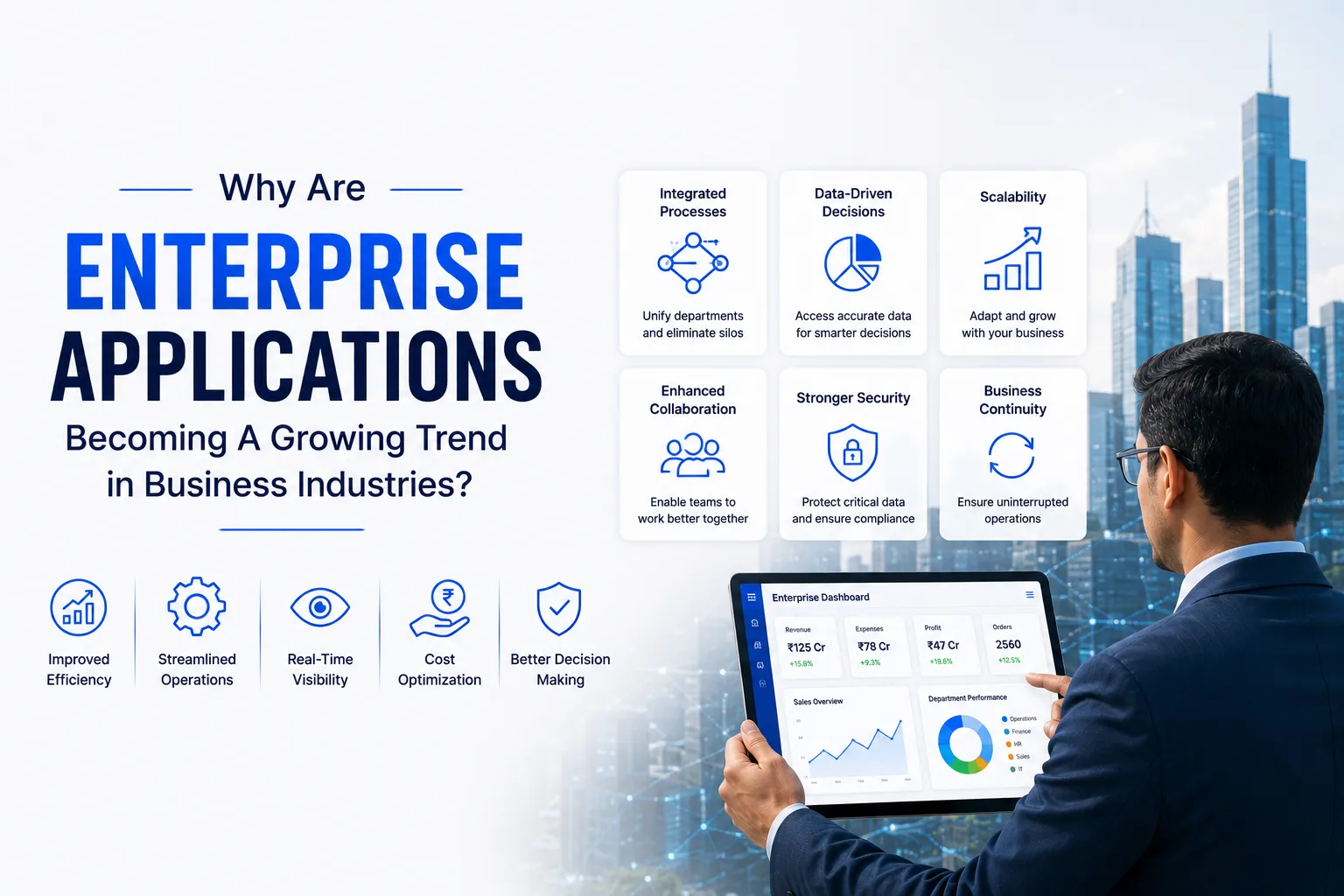
Through process simplification, data visibility enhancement, and real-time decision-making, enterprise applications are transforming business operations. From streamlining processes to raising customer engagement, these tools are driving efficiency and a competitive edge across industries.

1. Improving Efficiency and Productivity

Enterprise applications automate repetitive and time-consuming tasks, allowing employees to focus on strategic work. For example, ERP automates inventory tracking, helping avoid overstocking or shortages and ensuring accuracy without manual errors.

2. Collaboration and Communication

These systems provide centralized platforms for teams to collaborate, share files, and access real-time project updates. Employees can work from any location, increasing flexibility and productivity—especially in remote or hybrid setups.

3. Better Decision-Making with Data Insights

Enterprise applications transform large volumes of raw data into actionable insights using AI and analytics. ERP and CRM systems help companies identify inefficiencies, optimize resources, and enhance customer experience. Secure, real-time data access supports better strategic planning.

4. Stronger Security and Compliance

Data security is a top priority. Enterprise applications are built with security features like data encryption, user access control, and audit trails. This ensures companies comply with industry standards and safeguard sensitive data.

5. Scalability for Growth

Enterprise applications are built to scale. As your business grows, you can add users, departments, and features without disrupting performance. This flexibility supports expansion across multiple locations or markets.

Best Practices for Implementing Enterprise Applications

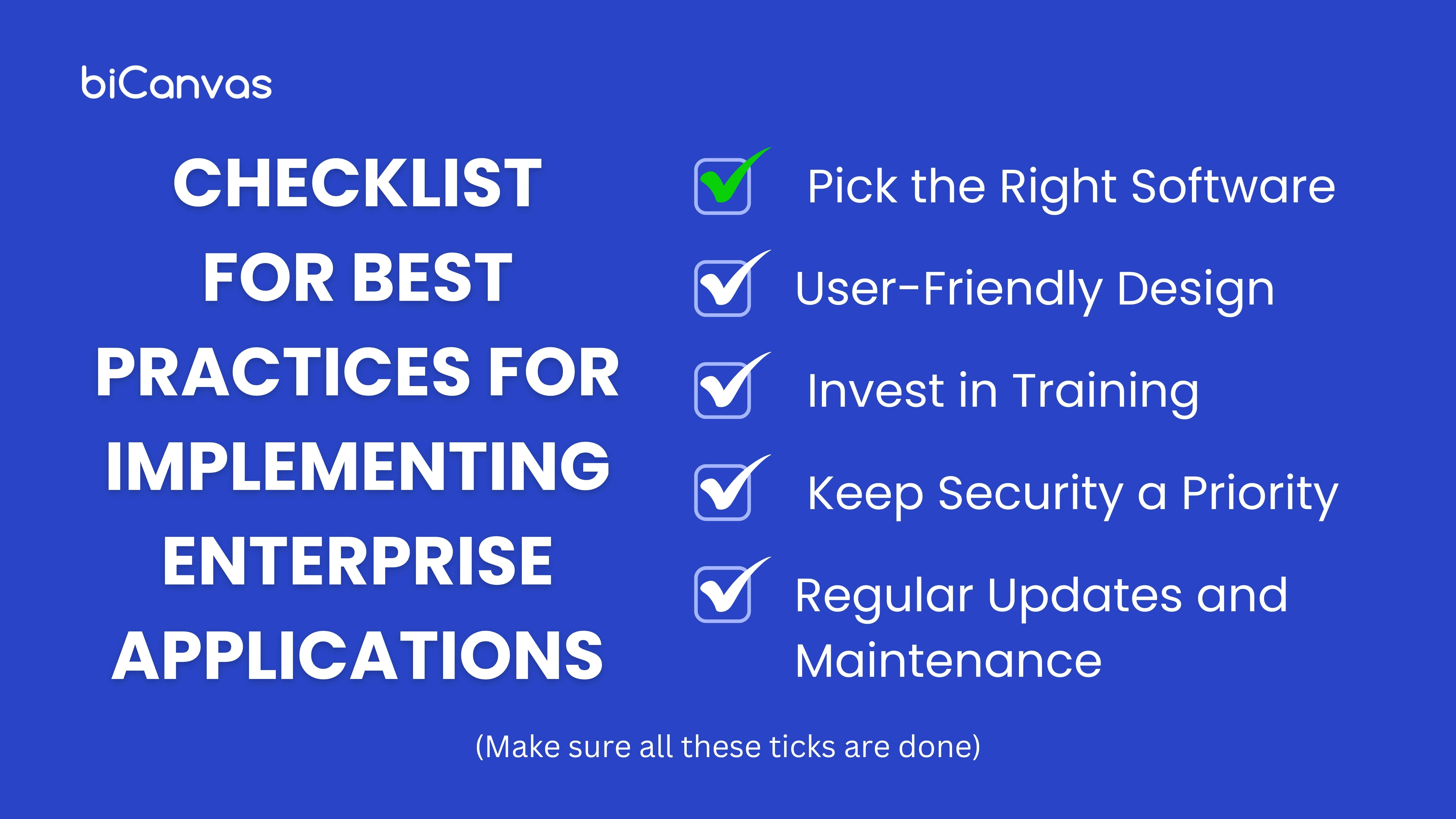
Best Practices for Implementing Enterprise Applications
  • Pick the Right Software: Choose a solution that aligns with your business goals and operational needs.
  • User-Friendly Design: Ensure the application is easy to navigate so employees can use it efficiently.
  • Invest in Training: Provide thorough training to maximize system utilization and ROI.
  • Keep Security a Priority: Implement best practices to protect sensitive business data.
  • Regular Updates and Maintenance: Keep your systems updated to maintain performance and security.

Also, check out the common myths and mistakes people make while implementing ERP software

Conclusion

Enterprise applications form the foundation of digital transformation in modern businesses. They simplify operations, enhance collaboration, and deliver data-driven insights that lead to sustainable growth. Whether you're a small startup or a large enterprise, investing in the right enterprise applications helps future-proof your business and keeps you competitive in a rapidly evolving market. Some businesses still face problems managing, even after using management software, but why? Want to know what mistakes they are making while installing the software?

Our Blogs

Our Latest Blogs

/frontend/images/blog/why-enterprise-application-becoming-a-growing-trend-in-business-industries
30 Dec 2020

Why Are Enterprise Applications Becoming A Growing Trend in Business Industries?

Introduction

Like the rest of the world, companies are also on the lookout for advanced technologies. Enterprise applications are the connection that bridges the gap between business operations and inventory management. They also help businesses keep running in an orderly and efficient way. This article will familiarize you with some of the common technologies and practices employed by developers to accomplish their tasks.

A business can be completely transformed by the effective deployment of an Enterprise Resource Planning (ERP) system, which can improve operations' scalability and efficiency. As per a research report, 70% of enterprises adopt ERP software, and 53% of them find positive results after implementation. Globally, the manufacturing industry leads ERP usage with a 33.66% share, followed by supply chain and logistics (9.90%) and construction (1.98%).

What Are Enterprise Applications?

Enterprise applications are software solutions that support and improve business processes. These include CRM, ERP, HR, and SCM systems. They automate tasks, organize data, and improve team communication for better execution and increased profitability.

How Enterprise Applications Are Transforming Businesses

Through process simplification, data visibility enhancement, and real-time decision-making, enterprise applications are transforming business operations. From streamlining processes to raising customer engagement, these tools are driving efficiency and a competitive edge across industries.

1. Improving Efficiency and Productivity

Enterprise applications automate repetitive and time-consuming tasks, allowing employees to focus on strategic work. For example, ERP automates inventory tracking, helping avoid overstocking or shortages and ensuring accuracy without manual errors.

2. Collaboration and Communication

These systems provide centralized platforms for teams to collaborate, share files, and access real-time project updates. Employees can work from any location, increasing flexibility and productivity—especially in remote or hybrid setups.

3. Better Decision-Making with Data Insights

Enterprise applications transform large volumes of raw data into actionable insights using AI and analytics. ERP and CRM systems help companies identify inefficiencies, optimize resources, and enhance customer experience. Secure, real-time data access supports better strategic planning.

4. Stronger Security and Compliance

Data security is a top priority. Enterprise applications are built with security features like data encryption, user access control, and audit trails. This ensures companies comply with industry standards and safeguard sensitive data.

5. Scalability for Growth

Enterprise applications are built to scale. As your business grows, you can add users, departments, and features without disrupting performance. This flexibility supports expansion across multiple locations or markets.

Best Practices for Implementing Enterprise Applications

Best Practices for Implementing Enterprise Applications
  • Pick the Right Software: Choose a solution that aligns with your business goals and operational needs.
  • User-Friendly Design: Ensure the application is easy to navigate so employees can use it efficiently.
  • Invest in Training: Provide thorough training to maximize system utilization and ROI.
  • Keep Security a Priority: Implement best practices to protect sensitive business data.
  • Regular Updates and Maintenance: Keep your systems updated to maintain performance and security.

Also, check out the common myths and mistakes people make while implementing ERP software

Conclusion

Enterprise applications form the foundation of digital transformation in modern businesses. They simplify operations, enhance collaboration, and deliver data-driven insights that lead to sustainable growth. Whether you're a small startup or a large enterprise, investing in the right enterprise applications helps future-proof your business and keeps you competitive in a rapidly evolving market. Some businesses still face problems managing, even after using management software, but why? Want to know what mistakes they are making while installing the software?

OUR BLOGS

Our Latest Blogs

img
09 Feb 2026

Construction ERP: The Backbone of Efficient Construction Management

In today’s high-pressure environment, construction companies are expected to deliver complex projects with tighter margins, stricter timelines, and greater accountability. This is precisely why construction erp has become essential for modern construction businesses. Manual tracking systems and disconnected software tools simply cannot support the operational depth required today. A well-implemented construction erp brings together planning, execution, procurement, and financial control into a single operational framework. Instead of reacting to problems after they occur, teams gain visibility early enough to take corrective action. Why Construction ERP Software Is Purpose Built for the Industry Generic ERP systems are not designed for site-driven operations. Construction erp software is built around project lifecycles, where costs, resources, and timelines evolve continuously. It aligns project budgets directly with work progress, ensuring financial accuracy throughout execution. A reliable erp system in construction ensures that site teams, procurement, and finance operate on the same data. This reduces reporting delays, prevents miscommunication, and improves decision-making at every level. Construction erp software typically enables Project based budgeting and cost tracking Integration of procurement with project demand Real time visibility into work progress and expenditure How Construction ERP Strengthens Project Control One of the most valuable outcomes of construction erp is real time control over project performance. With construction erp software, actual costs are continuously measured against planned budgets, helping teams identify deviations early. An effective erp system in construction also connects inventory, equipment, and subcontractor management to project execution. This reduces material shortages, controls idle resources, and improves overall site productivity. For growing organizations, construction industry erp standardizes workflows across projects, reducing dependency on manual coordination and individual judgment. Key control benefits delivered by construction industry erp include Accurate cost to complete forecasting Centralized contract and billing data Improved coordination between site and finance teams The Role of Construction Industry ERP in Business Scalability As construction companies scale, operational complexity increases rapidly. Construction industry erp allows businesses to grow without losing financial or operational control. By centralizing data, leadership teams can monitor performance across multiple projects and locations. Without a structured erp system in construction, scaling often leads to delayed reporting and compliance risks. Construction industry erp mitigates these challenges by enforcing process consistency and financial discipline. What Defines the Best Construction ERP Software Selecting the best construction erp software is a strategic decision, not a technical one. The system must reflect real construction workflows, support project based accounting, and provide actionable reporting rather than static data. The best construction erp software adapts to different project types while maintaining consistency in cost control, procurement, and financial reporting. Over time, the best construction erp software becomes a long term operational asset rather than just a system implementation. The best construction erp software typically offers End to end project lifecycle visibility Strong financial and billing controls Scalable architecture for growing project portfolios Why Construction ERP Is a Long Term Advantage Companies that adopt construction erp early gain structural advantages in governance, transparency, and execution reliability. Construction erp reduces operational blind spots and supports informed decision making across all project stages. A mature erp system in construction also strengthens stakeholder confidence by enabling accurate reporting, predictable cash flow, and controlled project delivery. Final Perspective In an industry where execution risk directly impacts profitability, construction erp provides the foundation for sustainable operations. By investing in robust construction erp software and choosing the best construction erp software aligned with real site conditions, construction businesses position themselves for long term growth. For organizations aiming to scale responsibly, construction industry erp and a well integrated erp system in construction are no longer optional. They are business critical.

OUR BLOGS

Our Latest Blogs

img
20 Jan 2026

Cloud-Based ERP Solutions for Manufacturing: Driving Efficiency, Control, and Scalable Growth

Manufacturing businesses today operate under constant pressure to improve efficiency, control costs, and scale operations without increasing complexity. Yet many organizations still rely on disconnected systems, spreadsheets, and manual coordination between production, procurement, inventory, and finance. These gaps often lead to delayed decisions, excess inventory, production bottlenecks, and margin leakage. This is where cloud-based ERP solutions for manufacturing play a transformative role. By unifying core manufacturing processes into a single, real-time platform, cloud ERP enables manufacturers to gain execution-level visibility, enforce process discipline, and respond faster to operational deviations. Modern platforms like biCanvas are designed specifically for complex manufacturing environments—supporting production planning, WIP tracking, inventory control, equipment lifecycle management, procurement workflows, and integrated financial oversight. More importantly, they move ERP beyond reporting into active execution control, helping manufacturers protect margins and scale sustainably.   Key Features of Cloud-Based ERP Systems Cloud-based ERP systems are built to centralize manufacturing operations while remaining flexible and scalable. Unlike legacy on-premise systems, cloud ERP platforms provide continuous access to real-time data across plants, warehouses, and departments. Core features typically include production planning, BOM management, inventory visibility, procurement automation, equipment management, and financial integration. biCanvas extends these capabilities by embedding approvals, validations, and workflow controls directly into operational transactions—ensuring that deviations are addressed at the source, not after financial impact has already occurred. Role-based dashboards, audit trails, and real-time alerts allow management teams to monitor performance without depending on delayed reports or manual follow-ups.   Benefits of Implementing Cloud-Based ERP in Manufacturing One of the most significant benefits of cloud-based ERP in manufacturing is end-to-end visibility. Production status, material consumption, inventory levels, and cost impact are visible in real time, enabling proactive decision-making instead of reactive corrections. Cloud ERP also improves cross-functional coordination. Production, procurement, maintenance, and finance teams operate on a single source of truth, reducing reconciliation effort and eliminating conflicting data. This alignment directly improves planning accuracy and execution reliability. Scalability is another critical advantage. As manufacturers expand into new plants, product lines, or regions, cloud ERP systems scale without heavy infrastructure investment—making growth faster and more predictable.   How Cloud-Based ERP Enhances Operational Efficiency Operational inefficiencies often stem from delayed approvals, poor material planning, and lack of execution-level tracking. Cloud-based ERP systems enhance efficiency by standardizing workflows and automating decision checkpoints. Production schedules become more reliable when material availability, machine capacity, and labor constraints are visible in advance. Procurement is triggered based on actual demand rather than assumptions, reducing overstocking and emergency purchases. Real-time WIP tracking ensures deviations in output or consumption are identified early. With platforms like biCanvas, transactions that violate budgets, approvals, or process rules can be flagged—or blocked—before they escalate into financial losses. This shift from passive reporting to active operational control is where efficiency gains truly compound.   Challenges of Transitioning to Cloud-Based ERP Despite its advantages, transitioning to a cloud-based ERP system requires careful planning. Resistance to change is common, particularly in manufacturing environments accustomed to legacy processes or informal workarounds. Data migration and system integration also require structured execution. Historical data must be validated, and integrations with machines, quality systems, or third-party tools must be planned carefully. However, these challenges are temporary. With phased implementation, role-based training, and strong change management, manufacturers can achieve faster adoption and long-term operational stability.   Selecting the Right Cloud-Based ERP Solution for Your Manufacturing Business Not all ERP platforms are designed for manufacturing execution. Selecting the right solution requires evaluating depth of operational control, not just feature checklists. Manufacturers should assess whether the ERP supports real production workflows, inventory accuracy, procurement governance, equipment tracking, and financial visibility in a single system. biCanvas is built for environments where execution discipline and cost control are critical—not just reporting. Equally important is scalability and vendor expertise. A manufacturing ERP should grow with the business while continuing to support complex operational requirements.     Case Studies: Successful Implementations of Cloud-Based ERP Manufacturing organizations adopting cloud-based ERP systems consistently report measurable improvements: 20–30% reduction in inventory carrying costs due to improved demand visibility 15–25% improvement in production schedule adherence through real-time WIP tracking 30–40% reduction in manual reporting effort, enabling faster decision-making Manufacturers using execution-driven ERP platforms like biCanvas often identify cost overruns within days rather than weeks—allowing corrective action before margins are impacted. The key factor behind success is not just automation, but early detection and control of deviations.   Future Trends in Cloud-Based ERP for Manufacturing The future of manufacturing ERP is increasingly intelligent and predictive. Artificial intelligence and machine learning are being embedded into ERP platforms to support demand forecasting, preventive maintenance, and anomaly detection. Sustainability tracking is also becoming a standard ERP capability, enabling manufacturers to monitor energy usage, material waste, and environmental impact. Cloud-based ERP systems are evolving into strategic platforms that support long-term operational resilience and compliance.   Integrating Cloud-Based ERP with Other Technologies Cloud ERP systems increasingly integrate with IoT, mobile platforms, and analytics tools. IoT integration enables real-time monitoring of equipment performance, while mobile ERP access allows supervisors to capture data directly from the shop floor. Platforms like biCanvas are designed to unify these inputs into a single operational view—connecting production, inventory, finance, and equipment data for faster, more accurate decision-making.   Conclusion: The Future of Manufacturing with Cloud-Based ERP Solutions Cloud-based ERP solutions are no longer optional for manufacturing businesses aiming to remain competitive. They provide the foundation for operational visibility, execution control, and scalable growth. By choosing a manufacturing-focused ERP like biCanvas, organizations move beyond delayed reporting toward real-time control—identifying issues early, protecting margins, and building disciplined, data-driven operations. As manufacturing complexity continues to increase, cloud ERP will be the backbone of efficient, resilient, and profitable manufacturing enterprises.

OUR BLOGS

Our Latest Blogs

img
08 Dec 2025

Best Ready Mix Concrete ERP (RMC ERP) in 2026 — Complete Guide

The Ready-Mix Concrete industry has always operated under pressure — tight timelines, strict mix-design requirements, real-time dispatch coordination, unpredictable delays, rising material costs, and the responsibility of delivering consistent quality to every site. In 2026, the complexity has only increased. Customers expect faster deliveries, tighter quality control, and complete traceability, while RMC companies need better control over batching, logistics, and cost to stay profitable. This is where Ready Mix Concrete ERP (RMC ERP) systems play a crucial role. Unlike generic ERPs, RMC-focused solutions are designed specifically to handle batching, raw material planning, fleet management, delivery scheduling, mix-design control, silo-level inventory, and quality assurance. A modern RMC ERP not only improves operational stability but also reduces wastage, prevents errors, and brings transparency across plants. This guide explores the 10 best Ready-Mix Concrete ERP software solutions in 2026, evaluated on depth, reliability, scalability, and real-world usefulness. Why RMC Businesses Are Moving to ERP in 2026 Managing an RMC business manually is becoming increasingly difficult. Plants run multiple batches per hour, fleets are constantly on the move, mix designs need precision, and customers demand instant updates. Plant operators, dispatch teams, supervisors, and accounts teams often struggle with disconnected systems — spreadsheets, WhatsApp messages, handwritten delivery slips, and offline batching reports. RMC ERP solves these challenges by standardizing mix designs, coordinating dispatch in real time, preventing raw material shortages, reducing billing errors, and providing end-to-end visibility — from batching to delivery. Companies adopting RMC ERP in 2026 are seeing a clear improvement in operational efficiency, faster deliveries, reduced wastage, and better cash flow. How We Selected the Top RMC ERP Solutions Every ERP listed in this article was evaluated based on several core parameters: batching integration capability, material consumption tracking, delivery scheduling and fleet management, quality control depth, multi-plant scalability, financial integration, ease of implementation, mobile accessibility, and overall cost-value ratio. Our goal was to highlight platforms that genuinely understand the realities of RMC operations and deliver measurable improvements. 1. biCanvas ERP — Best Overall RMC ERP for 2026 biCanvas stands out because of how well it connects the entire lifecycle of ready-mix operations. While it is widely used across construction, infrastructure, supply chain, and manufacturing, its workflow depth makes it naturally strong for RMC businesses. It brings batching, materials, dispatch, equipment, and financials under one ecosystem, making it suitable for both single-plant operators and large multi-plant companies. The system offers real-time visibility of plant production, inventory levels, order status, and fleet movement. Its dispatch workflows help reduce delays caused by poor coordination, while built-in financial controls ensure every load is tracked until invoicing. What makes biCanvas particularly effective is how smoothly it handles multi-department connectivity — something many RMC companies struggle with when using fragmented systems. The platform doesn’t feel promotional or pushy; instead, it fits organically into the operational needs most RMC companies already recognize. 2. Inntech RMC ERP — Ideal for Small and Mid-Sized Operators Inntech provides an easy-to-understand interface, basic batching integration, and simple inventory management—making it suitable for companies just transitioning from manual operations. It is affordable, quick to deploy, and handles essential workflows without overwhelming teams. While not as comprehensive as enterprise-grade systems, it meets the needs of smaller plants effectively. 3. ReadyMix ERP (TMS) — Strong for Quality-Driven Environments Companies that prioritize mix-design accuracy and testing often choose ReadyMix ERP. It offers strong QC workflows, batch-wise quality records, automated delivery notes, and compliance documentation. Plants with tight quality requirements benefit greatly from its structured reporting and traceability features. 4. QCRETE ERP — Best for Multi-Location Enterprises QCRETE suits organizations operating several RMC plants across regions. Its central dashboards make it easy for management to monitor material consumption, plant performance, and delivery patterns across units. The system also includes advanced QC features, though it requires a longer implementation period and slightly higher investment. 5. E-ReadyMix ERP — Focused on Dispatch & Delivery Optimization This ERP is favored by companies where delivery timelines are the biggest challenge. The software provides route planning, GPS tracking, and dispatch automation, helping teams reduce delays and manage peak hours more efficiently. Its strength lies more on the logistics side than in deep manufacturing workflows. 6. TRANSFLOW RMC ERP — Best for Fleet-Heavy Operations TRANSFLOW is designed for companies managing large fleets of transit mixers, pump trucks, and material carriers. Its dispatch engine and real-time vehicle tracking allow operations teams to maximize fleet utilization. It performs especially well in high-volume RMC markets where vehicle movement directly affects profitability. 7. ERPNext (Customized for RMC) — Flexible and Cost-Efficient ERPNext is an open-source platform that becomes useful when customized for RMC. It can manage sales orders, batching reports, material usage, and billing, but requires development support to match the depth of purpose-built RMC ERPs. It works best for smaller businesses with budget limitations and simple workflows. 8. ReadyMix360 — Best Lightweight Cloud-Native Option ReadyMix360 is cloud-based, modern, and easy to learn. It fits companies looking for a clean UI and quick deployment. Although feature depth is moderate compared to enterprise-grade platforms, it covers essential workflows effectively. 9. CIMS RMC ERP — Strongest for Quality & Testing Records CIMS is known for its comprehensive QC module. It enables plants to maintain detailed records of slump tests, cube tests, mix variations, and compliance logs. Companies that must follow strict quality documentation standards often prefer this system. 10. Propel RMC Suite — Best for Basic Workflow Digitalization Propel offers straightforward features for batching, invoicing, and material tracking. It is suitable for small plants that need digital structure without extensive automation or high-level analytics. It provides a good starting point for early-stage RMC companies. Choosing the Right RMC ERP Selecting the right ERP depends on plant size, production volume, and operational complexity. For quality-driven plants, QC modules are essential. For businesses focused on timely deliveries, fleet and dispatch optimization are priorities. Multi-plant operations require centralized dashboards and consolidated reporting. Modern RMC operations benefit from connected, mobile-first platforms that reduce errors and streamline operations. Why biCanvas ERP Stands Out Among all RMC ERPs, biCanvas is uniquely positioned. It combines end-to-end operational visibility, mobile-first workflows, financial integration, and plant-to-office connectivity. With biCanvas, managers can track production, fleet, inventory, and costs in real time — without juggling multiple tools. The platform is scalable, cloud-native, and built for growth, making it the preferred choice for RMC companies aiming for efficiency, accuracy, and profitability. Take Action Now If your RMC business is ready to eliminate manual inefficiencies, ensure consistent quality, and gain complete visibility across plants, it’s time to explore the possibilities with biCanvas. Book a demo today and experience how a purpose-built RMC ERP can transform your operations and profitability.

Chat with biCanvas